




























Views
Downloads

Printable Graphing Systems of Equations Worksheet | Grade 8

Paste this activity's link or code into your existing LMS (Google Classroom, Canvas, Teams, Schoology, Moodle, etc.).
Students can open and work on the activity right away, with no student login required.
You'll still be able to track student progress and results from your teacher account.
Mastering Systems of Equations by Graphing
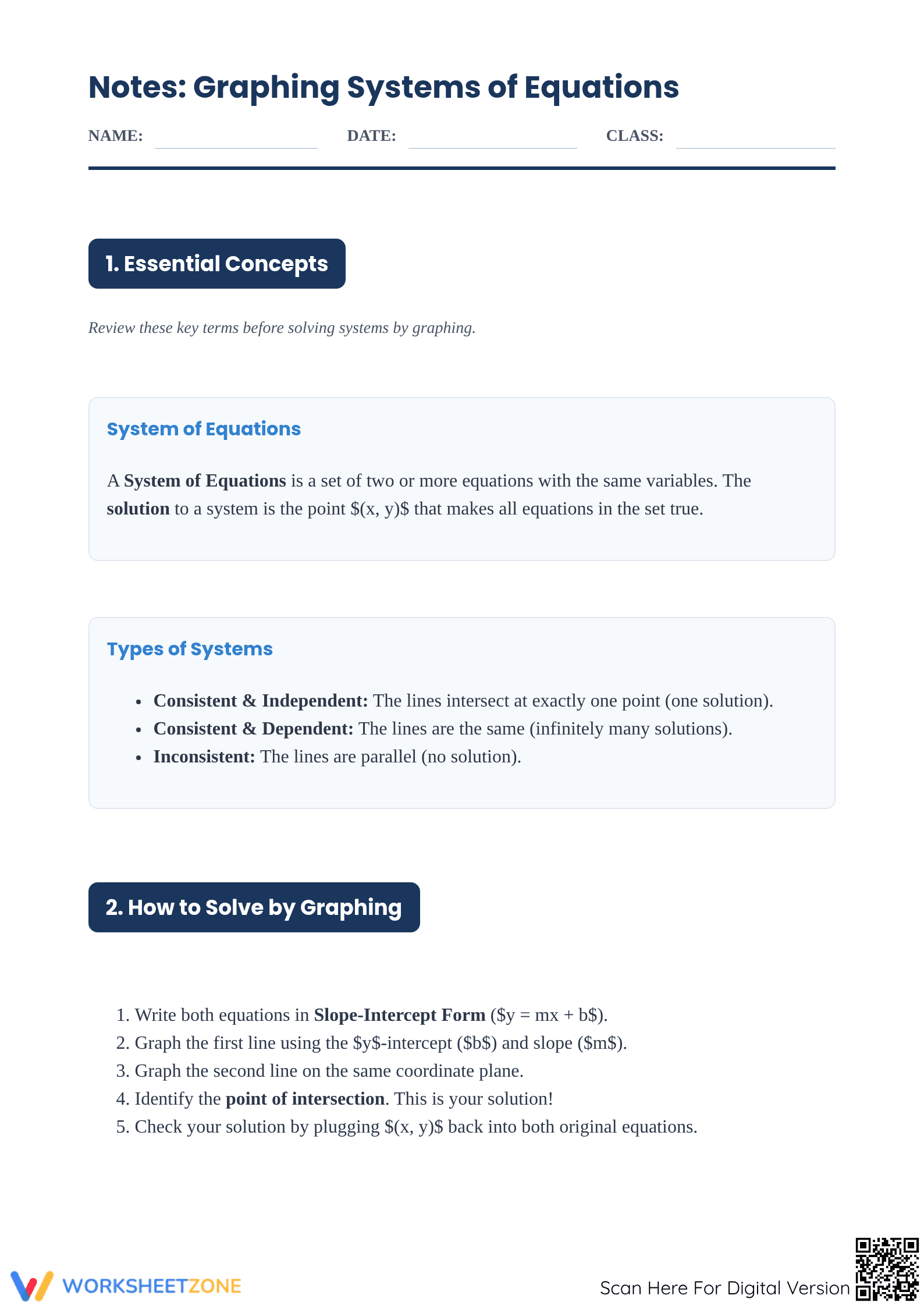
This worksheet helps Grade 8 students master solving systems of linear equations by graphing. It provides clear notes on the three solution types (one, no, and infinite solutions), followed by 12 practice problems. Students will build foundational algebraic skills by visualizing how lines intersect on the coordinate plane, turning an abstract concept into a concrete visual exercise.
At a Glance
- Grade: 8 · Subject: Math, Graphing
- Standard:
CCSS.MATH.CONTENT.8.EE.C.8— Analyze and solve pairs of simultaneous linear equations.- Skill Focus: Graphing Systems of Linear Equations
- Format: 4 pages · 12 problems · Answer key included · PDF
- Best For: Guided practice, concept review, or homework
- Time: 25–40 minutes
What's Inside
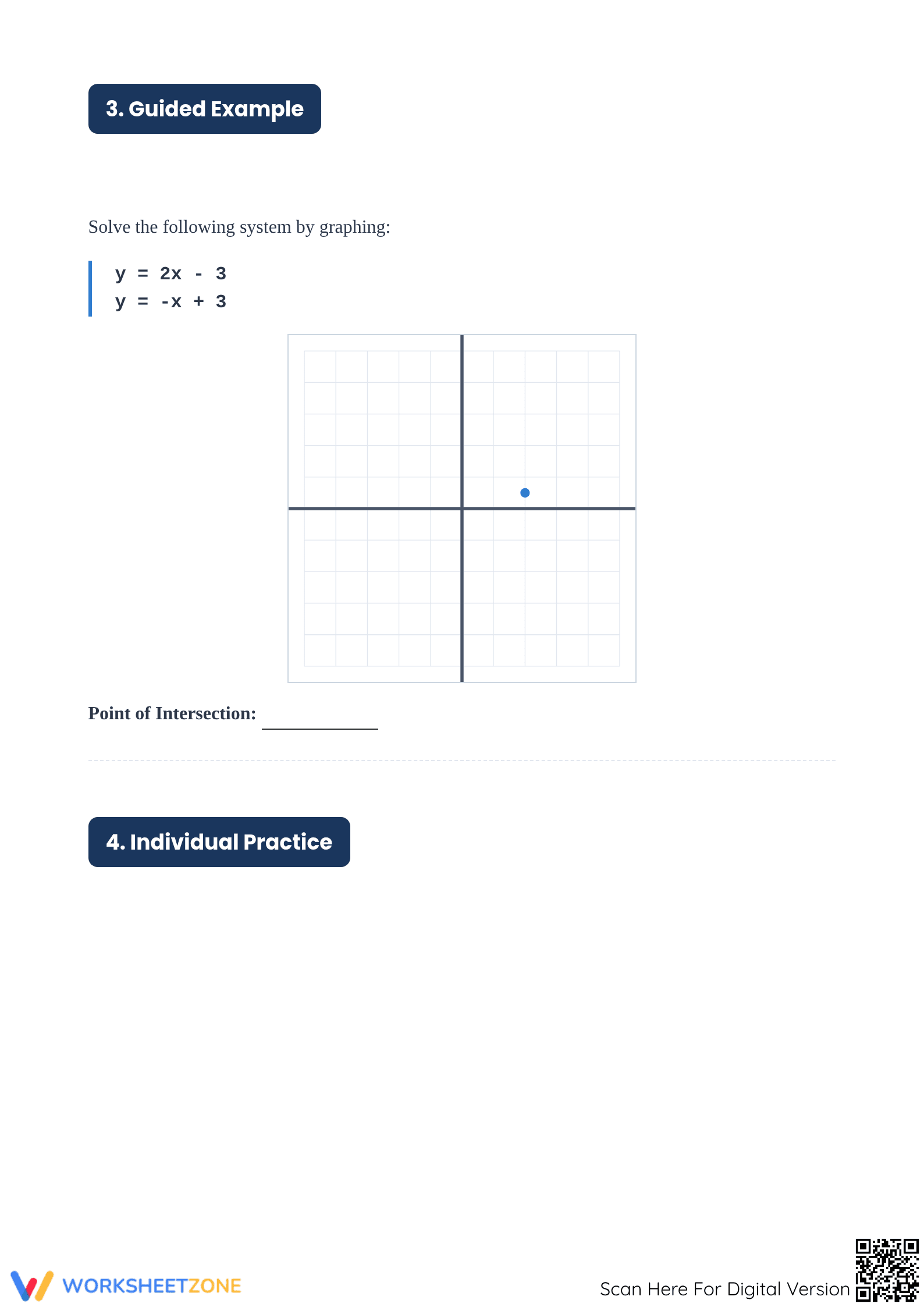
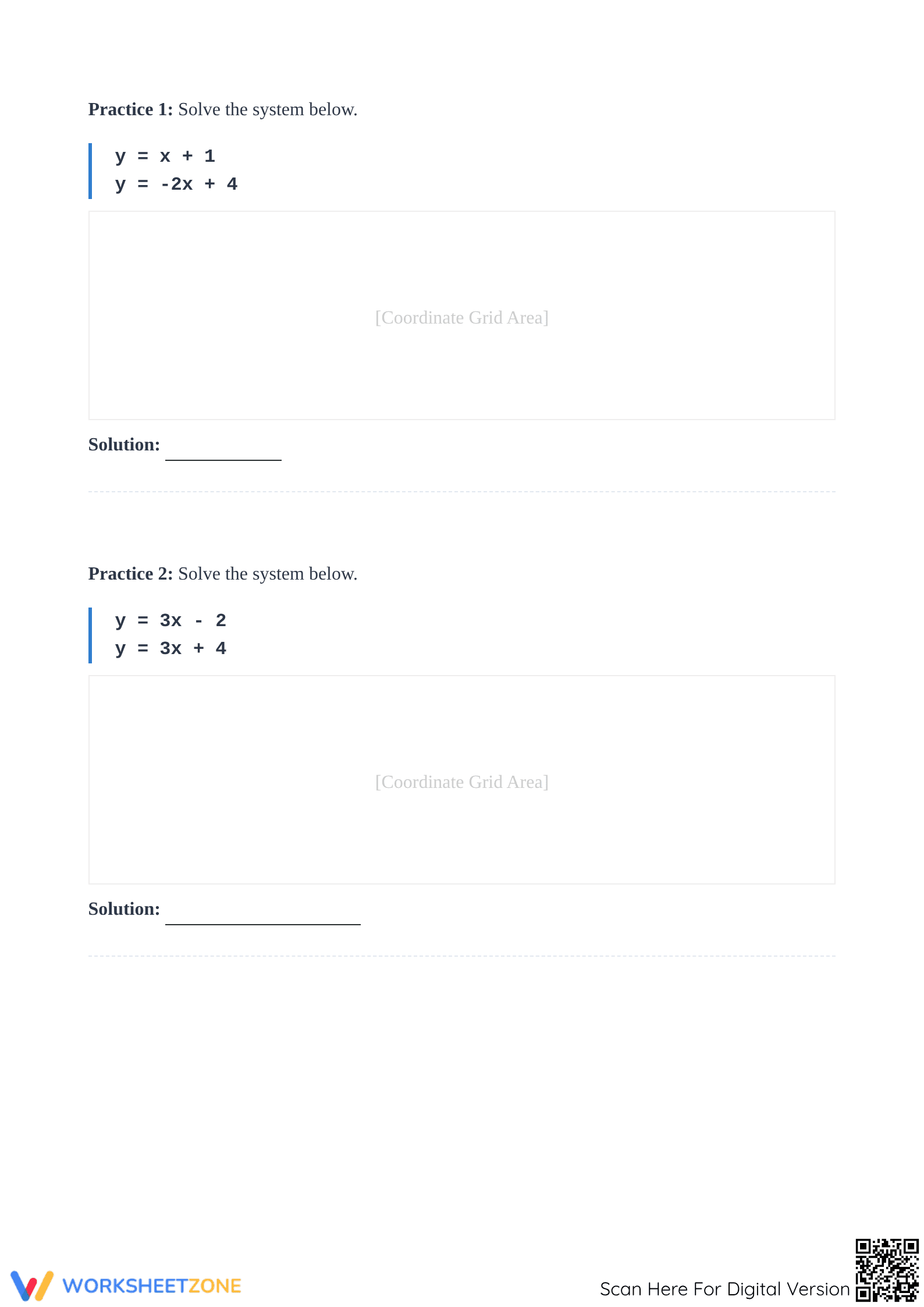
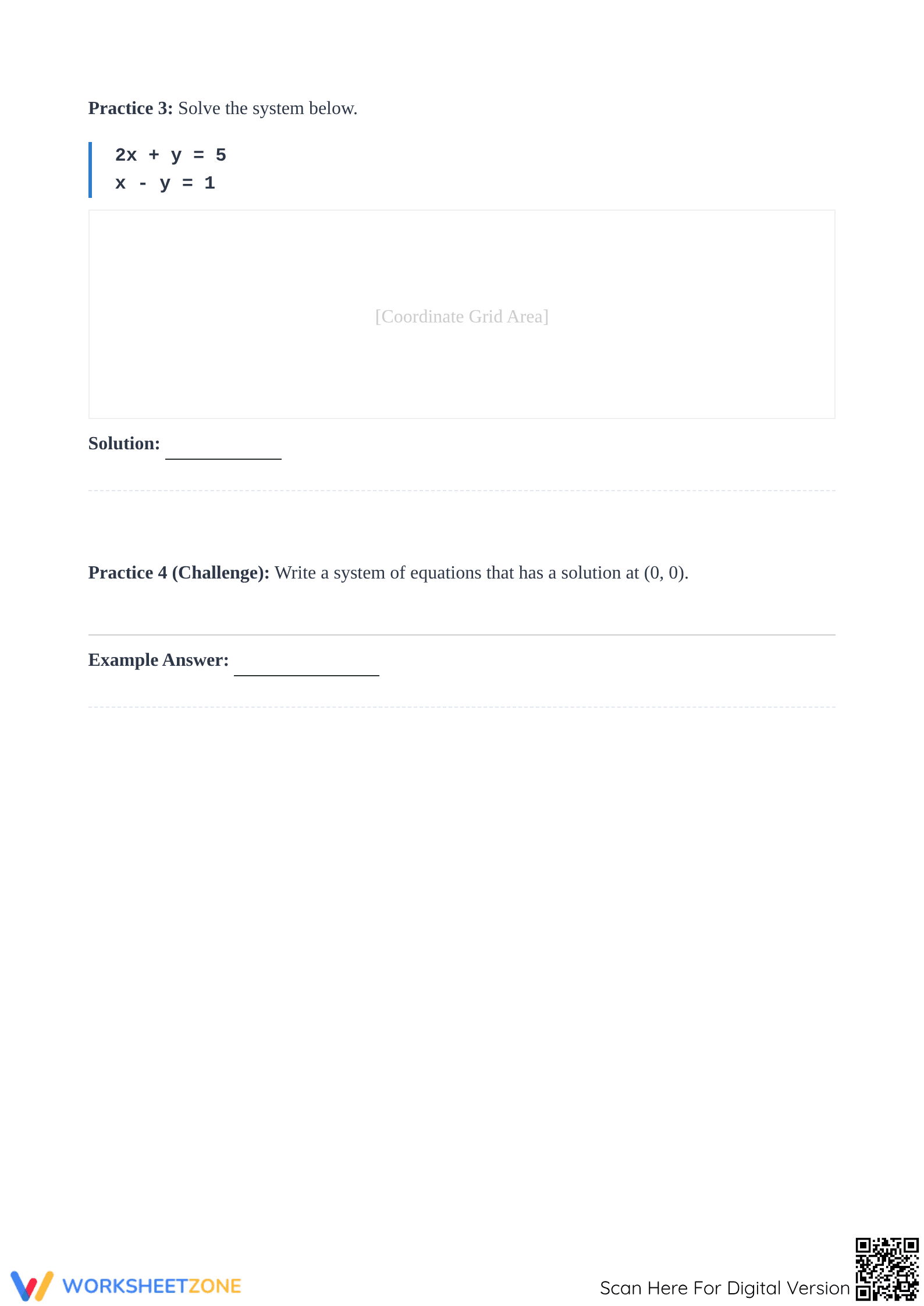
This four-page PDF starts with an instructional notes page defining systems of equations and illustrating the three solution types with clear examples. The next three pages offer 12 practice problems for students to solve by graphing. A complete answer key with correctly graphed lines and identified intersection points is included for easy grading or student self-checking.
A Structured Path to Understanding
The worksheet uses a gradual-release model to build student confidence and ensure mastery.
- Guided Practice: An introductory page provides a fully worked example, establishing the core process of graphing two lines and identifying the solution.
- Supported Practice: The first set of problems uses equations primarily in slope-intercept form, allowing students to focus on the graphing procedure without getting bogged down in algebraic manipulation.
- Independent Practice: The final problems challenge students to apply their skills independently, preparing them to tackle similar items on quizzes and tests.
This proven "I Do, We Do, You Do" structure ensures all learners can access the material.
Standards Alignment for Your Lesson Plans
This worksheet aligns directly with CCSS.MATH.CONTENT.8.EE.C.8, which requires students to "analyze and solve pairs of simultaneous linear equations." The tasks specifically address part C.8.a, understanding that solutions correspond to points of intersection. It also provides a strong foundation for the high school standard HSA.REI.C.6. Both codes can be copied directly into lesson plans or curriculum maps.
How to Use It in Your Classroom
Use this resource immediately following a direct instruction lesson on graphing systems. Students can complete it as in-class work or for homework, which should take approximately 25–40 minutes. For a quick formative assessment, circulate while students work and check if they are correctly plotting the y-intercept and using the slope (rise over run) to draw the lines. It's an ideal resource for reinforcing the visual aspect of solving systems.
Who It's For
Designed for 8th-grade math students, this resource also serves as an excellent review for Algebra 1 students who need to solidify their understanding. Its clear, structured layout benefits all learners, including those who require explicit instruction. Pair this worksheet with an anchor chart displaying the three solution types (one, none, infinite) for a strong visual reference during the lesson.
Aligned with CCSS.MATH.CONTENT.8.EE.C.8, this worksheet provides focused practice on solving systems of equations graphically, a critical gateway skill for higher-level algebra. By requiring students to translate algebraic equations into visual representations, it builds conceptual understanding beyond procedural memorization. Research from Fisher & Frey (2014) emphasizes the importance of such explicit skill practice within a gradual release framework to ensure students move from guided learning to independent application. The 12 problems offer repeated, structured engagement, which is essential for procedural fluency. The ability to analyze the relationship between two linear equations on a coordinate plane prepares students for more complex function analysis and is a key indicator of readiness for advanced mathematics, a finding consistent with data from the National Assessment of Educational Progress (NAEP) on algebraic reasoning.


