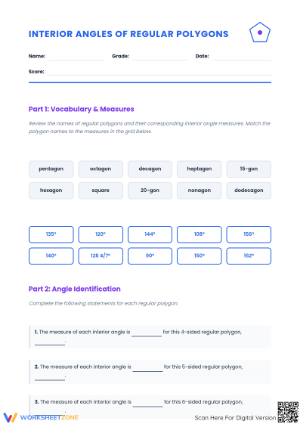
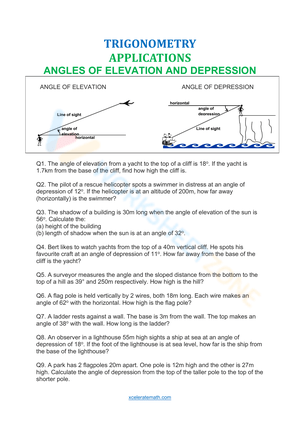
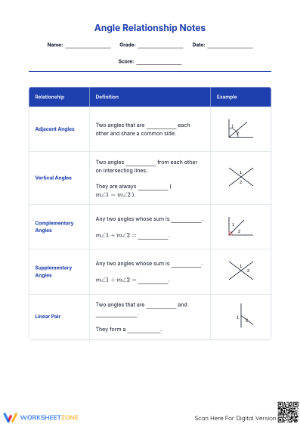
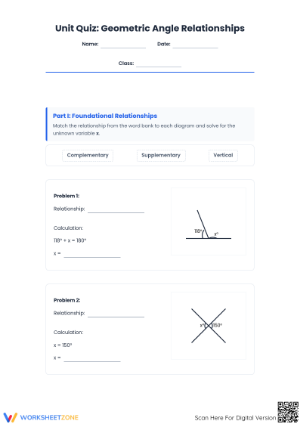
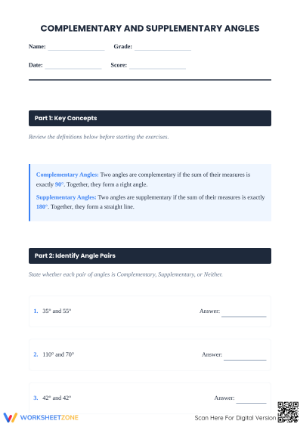
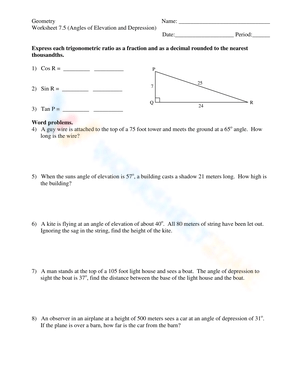
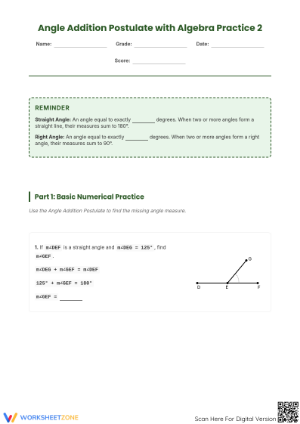
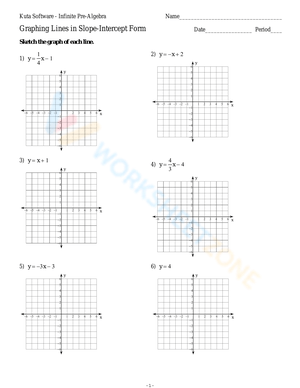
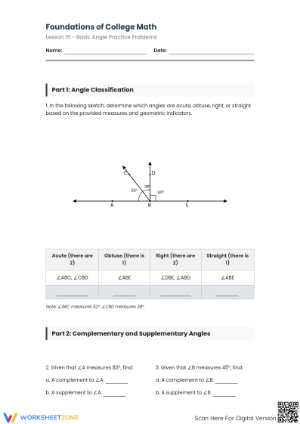
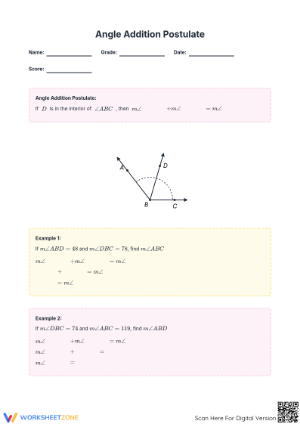
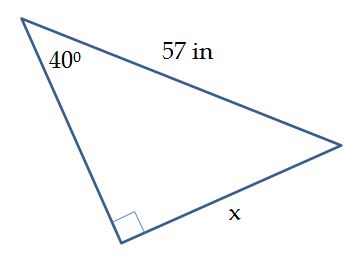
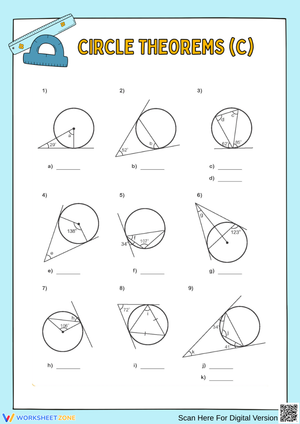
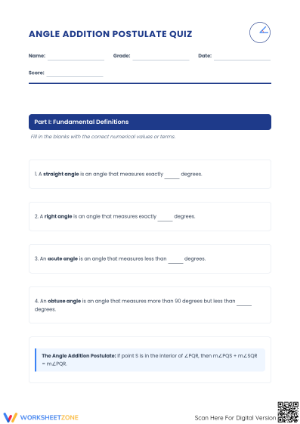
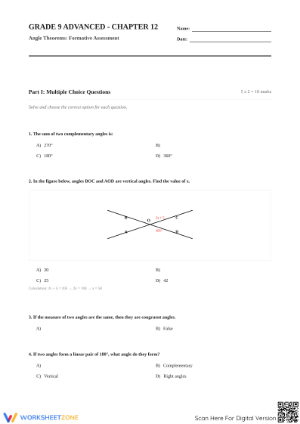
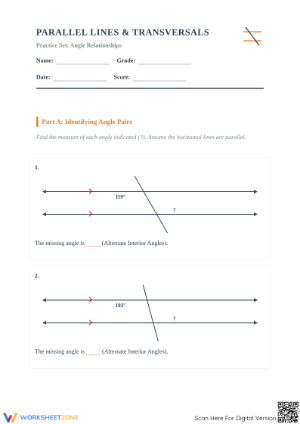
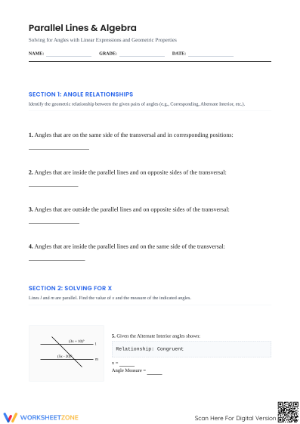
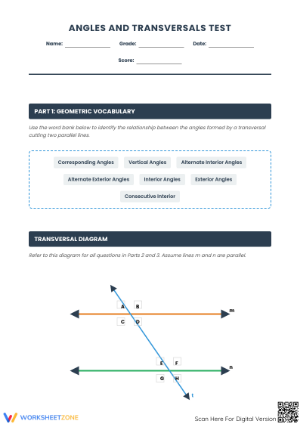
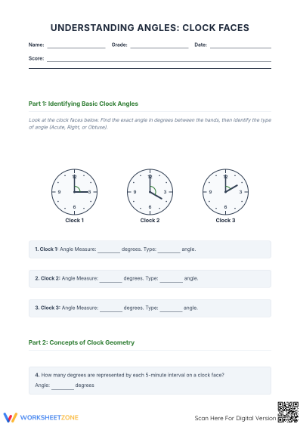
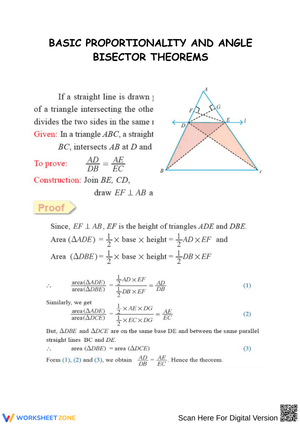
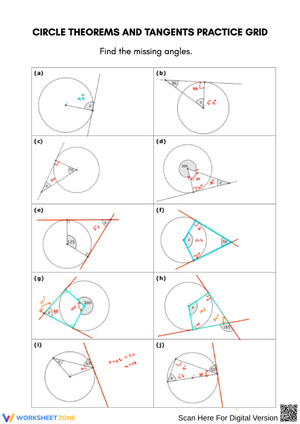
These 11th grade angles worksheets pdf resources address the angle concepts that define junior-year mathematics — radian measure, the unit circle, reference angles across all four quadrants, and the triangle laws students will carry into pre-calculus. Each worksheet targets a single skill cluster, so a teacher can slot one into a warm-up, a guided lesson, or an independent practice block without sorting through a mixed-topic packet. The set is printable and built around the specific places where 11th-grade students actually stall.
Concepts These Worksheets Target
The conceptual jump at this level is not simply from easy to hard — it is from angles as measured shapes to angles as real numbers on a number line. That shift underlies almost every topic in the set.
- Degrees-to-radians conversion: Fluent conversion between degree and radian measure underpins every subsequent skill. Worksheets here ask students to move in both directions before applying the conversion inside larger problems, so it becomes automatic rather than a step they have to reconstruct each time.
- Reference angles and coterminal angles: Each worksheet in this group asks students to identify the reference angle for a given measure, place it in the correct quadrant, and name two coterminal angles. Problems include negative values and measures greater than 360 degrees — both of which expose the errors described below.
- The unit circle: Practice ranges from filling in exact coordinate pairs for the 16 standard angles to determining the sign of a trigonometric function in a given quadrant without a diagram. Blank-circle worksheets ask students to reconstruct the full circle from memory one quadrant at a time.
- Arc length and sector area: Using s = rθ and A = ½r²θ with angles in radians. Problems include real units — radius in meters, arc in centimeters — so students must track unit consistency alongside the algebra.
- Law of Sines and Law of Cosines: Separate worksheets address each law before mixing them. The Law of Sines set includes the ambiguous case (SSA), which most students skip entirely on first encounter.
Student Mistakes Worth Anticipating Before You Teach This Unit
The reference angle error in Quadrant III is the one that appears most consistently. Students know to "subtract from 180°" in Quadrant II, so they apply the same logic in Quadrant III — subtracting their angle from 180° instead of subtracting 180° from their angle. A student working with 210° will compute 180° minus 210° and get a negative result, then stare at it, unsure what went wrong. These worksheets surface this error quickly because they cluster Quadrant III problems immediately after Quadrant II, which is exactly when the confusion peaks.
The ambiguous case of the Law of Sines is a separate problem. Most students learn the SSA setup, solve for one triangle, and stop. The possibility of a second triangle — which arises when the height of the triangle is less than the given side — does not register without direct instruction and repeated practice. These worksheets mark SSA problems with a small notation prompting students to ask, before they solve, whether a second solution exists. That visual cue does not teach the concept, but it does prevent students from closing out a problem that isn't finished.
Radian measure causes a different kind of confusion: students treat it as a unit to cancel rather than as a ratio. They execute the conversion correctly and arrive at the right number, but if you ask why π/6 corresponds to 30°, they cannot explain it. The paired worksheet for this topic asks students to draw the arc, label the radius, and mark the angle before converting — that sequence reliably identifies students who have memorized the procedure without attaching any geometric meaning to it.
Standard Alignment
The core of the set aligns to the High School Functions — Trigonometric Functions domain of the Common Core State Standards. HSF-TF.A.1 defines radian measure as the ratio of arc length to radius; the conversion and arc-length worksheets directly address this standard. HSF-TF.A.2 asks students to explain how the unit circle extends trigonometric functions to all real numbers — the blank-circle reconstruction worksheets push toward that explanation rather than simple recall. HSF-TF.A.3 specifies exact values for π/3, π/4, and π/6 using special right triangles, and that content appears on the reference-angle worksheets before students encounter the full unit circle.
Triangle law work aligns to the Geometry — Similarity, Right Triangles, and Trigonometry domain. HSG-SRT.D.10 and HSG-SRT.D.11 address proof and application of both laws, including problems that require students to select the appropriate law based on what information is given — a judgment call the worksheets make students practice explicitly.
Fitting These Worksheets Into Your Week Without Overloading Students
The most reliable use of this set is a daily five-minute warm-up that rotates through one skill per day. Monday opens with two coterminal angle problems, Wednesday asks for a reference angle and its exact trigonometric values, Friday gives one Law of Cosines setup to diagram and solve. That rhythm builds retrieval practice without cutting into lesson time, and it surfaces gaps before the unit assessment rather than on it.
For whole-class guided practice, the unit circle worksheets work best when introduced one quadrant at a time. Handing students the full 16-angle circle on day one produces cognitive overload — most end up copying rather than reasoning. Releasing one quadrant per session and using a blank-circle worksheet as the exit task produces a noticeably different result. Students who reconstruct Quadrant I independently on Wednesday are generally able to apply the symmetry argument to extend their work into Quadrant II on Thursday, rather than treating each quadrant as a new memorization task.
An 11th grade angles worksheets pdf also fits naturally into station rotations. The Law of Sines and Law of Cosines worksheets work as a paired station — one group works the Sines problems while another works Cosines, then groups swap and compare the reasoning each law requires. That comparison conversation is often when students genuinely sort out when to use each one, which is something direct instruction alone rarely accomplishes.
Adjusting the Set for Different Levels of Readiness
Students who have not yet internalized the 30-60-90 and 45-45-90 triangle relationships will hit a wall on the radian and unit circle worksheets earlier than expected. Those students benefit from working the special-triangle worksheet first — treating it as prerequisite practice before radian measure is introduced. This is a sequencing adjustment, not a remediation track. It takes one class period and prevents the larger unit from breaking down mid-stream.
Students who move quickly through conversion and reference-angle material can go deeper on the ambiguous case. The SSA worksheets include an extension section where students determine, before solving, whether given measures produce zero, one, or two valid triangles. That reasoning step — constructing the altitude, comparing it to the given side — requires geometric thinking that separates procedural fluency from actual understanding at this level.
For classes with a wide range of readiness, the arc-length and sector-area worksheets divide cleanly. Early problems use whole-number radius values and standard angle measures; later problems introduce decimal radii and ask students to work backward from a given arc length to find the central angle. Teachers can assign different stopping points without making the division obvious to students.
Frequently Asked Questions
Do the worksheets cover the ambiguous case of the Law of Sines, or only standard SSA setups?
Both. Problems are ordered so students encounter standard SSA setups across several problems before the ambiguous cases appear. Each ambiguous problem includes a prompt asking whether a second triangle is possible. The answer key for this section shows both solutions where they exist and walks through the height comparison that determines how many valid triangles the given information supports.
How is the unit circle material distributed across the worksheets?
There are three types: an annotated reference worksheet students mark up during instruction, a partially completed version for guided practice, and a blank reconstruction worksheet used as a formative check. The progression is what makes the material work — the annotated version introduces the symmetry patterns, the partial version checks whether students can apply them, and the blank version reveals whether students have internalized the structure or are still working from memorized lists. Using the 11th grade angles worksheets pdf in that order consistently outperforms assigning the blank version as standalone practice.
Do these materials have any application to standardized test preparation?
The multi-step Law of Cosines and Law of Sines word problems mirror the format found on the SAT Math section and most state end-of-course assessments. Students practice translating a written scenario — a surveyor calculating the distance between two landmarks across irregular terrain — into a labeled diagram, then into the correct equation, then through the solution. That full sequence, not just the arithmetic at the end, is what those assessments actually measure.
Are answer keys included?
Yes. Every worksheet comes with a teacher key that shows the work, not just the final value. For unit circle worksheets, the key lists coordinate pairs and the corresponding angle measure. For triangle law problems, it shows the setup equation before any arithmetic. When a substitute is running the class, leaving one of these 11th grade angles worksheets pdf resources with a complete worked key means the review session stays accurate and students get immediate feedback on their setups, not just their final answers.












 Interactive Worksheet Maker
 Quiz Maker
 Word Search Maker
 Crossword Puzzle Maker
 Word Scramble Generator
 Sentence Scramble Generator
 Handwriting Worksheet Generator
 Name Tracing Generator
 Fill In The Blank Generator