


























Views
Downloads

Essential Angles on a Clock Worksheet | Grade 9-12 Math
Paste this activity's link or code into your existing LMS (Google Classroom, Canvas, Teams, Schoology, Moodle, etc.).
Students can open and work on the activity right away, with no student login required.
You'll still be able to track student progress and results from your teacher account.
This high school math worksheet provides a rigorous exploration of angle measurement using the familiar context of a clock face. Students calculate precise degrees between hour and minute hands, bridging the gap between basic geometry and advanced coordinate system concepts. It ensures learners can identify angle types while performing complex calculations involving time-based rotations.
At a Glance
- Grade: 9-12 · Subject: Math
- Standard:
HSG.C.A.2— Identify and describe relationships among angles, radii, and circular arcs- Skill Focus: Clock hand angle calculation
- Format: 3 pages · 10 problems · Answer key included · PDF
- Best For: Geometry rotation and circular motion units
- Time: 25–35 minutes
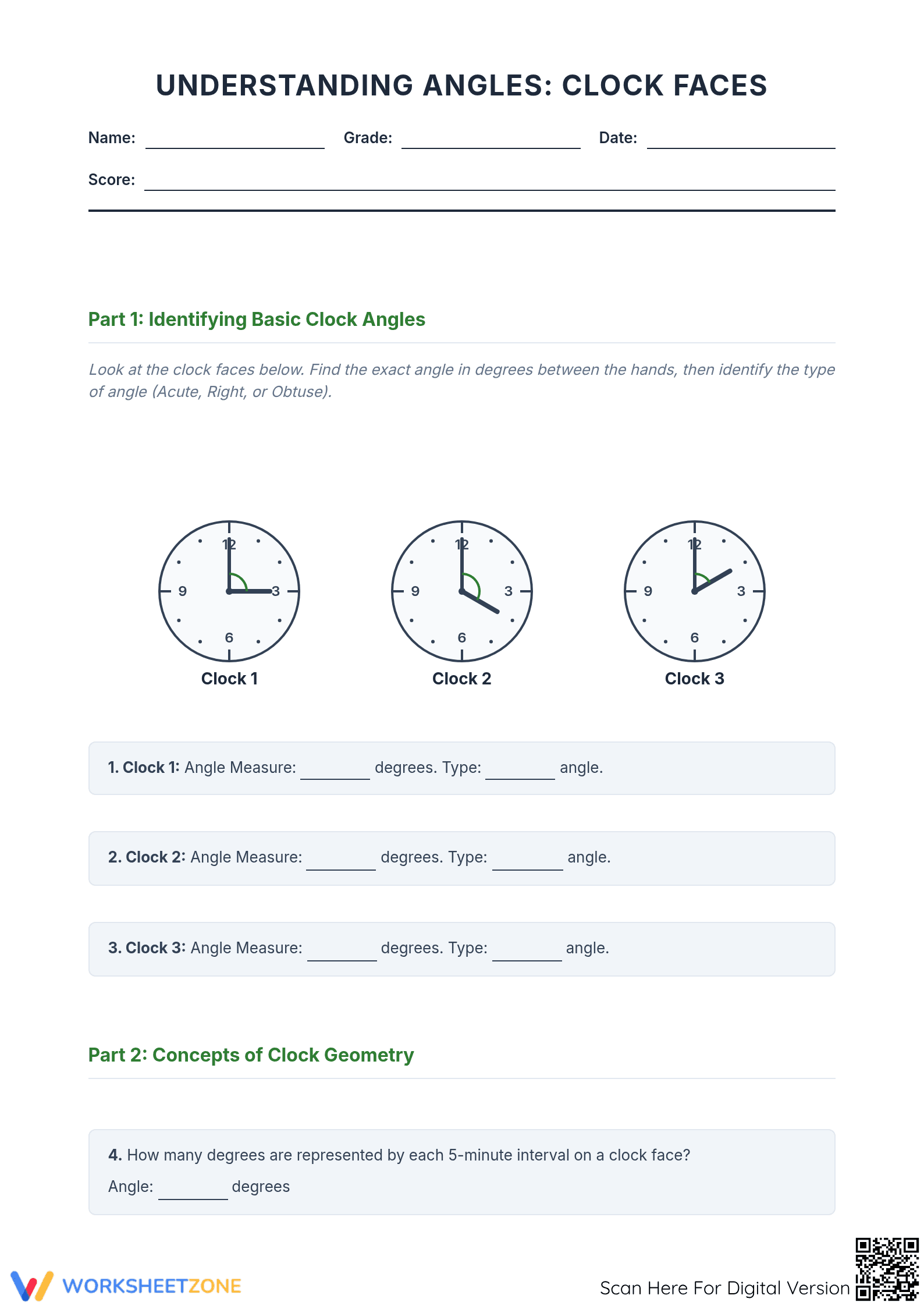
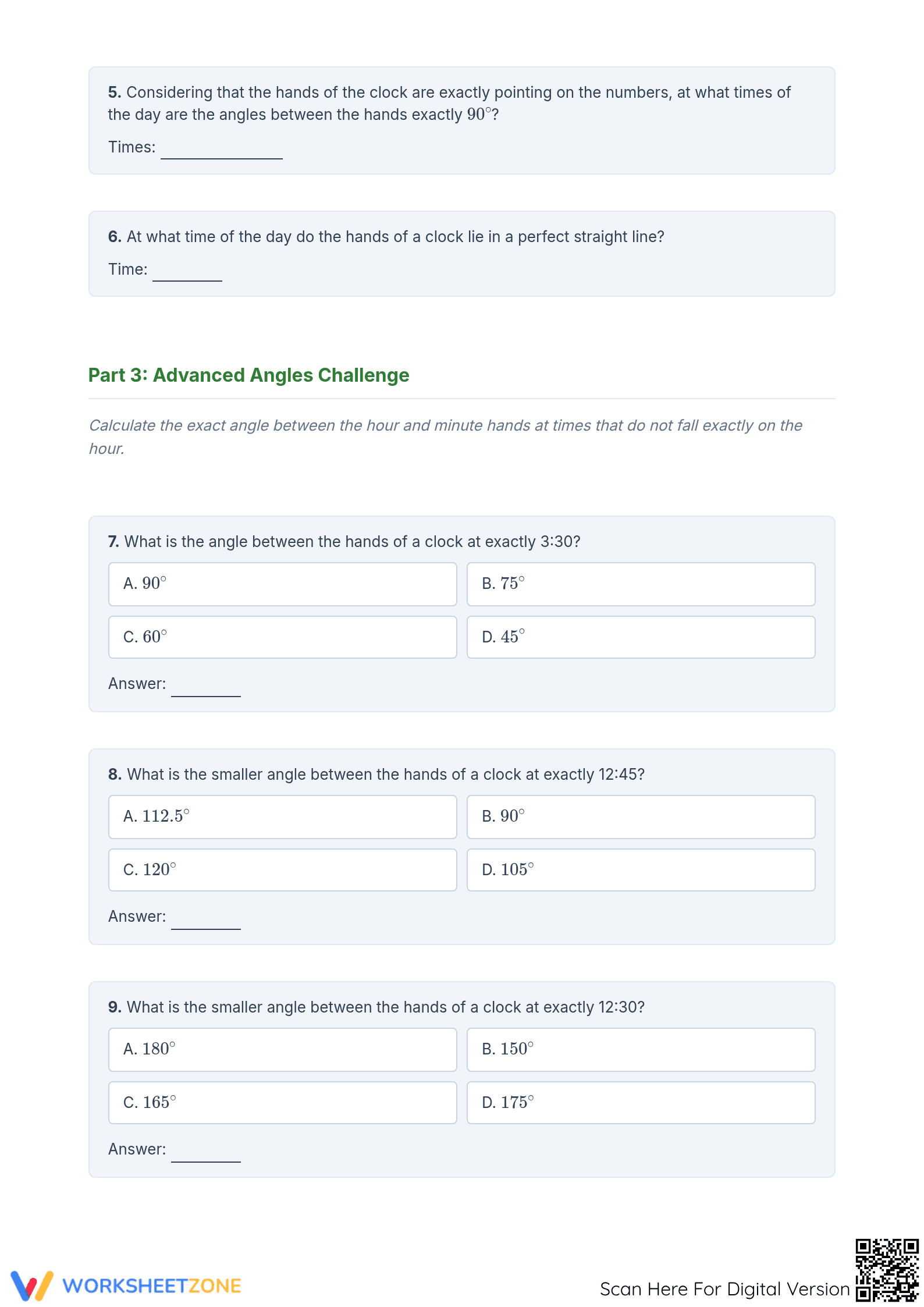
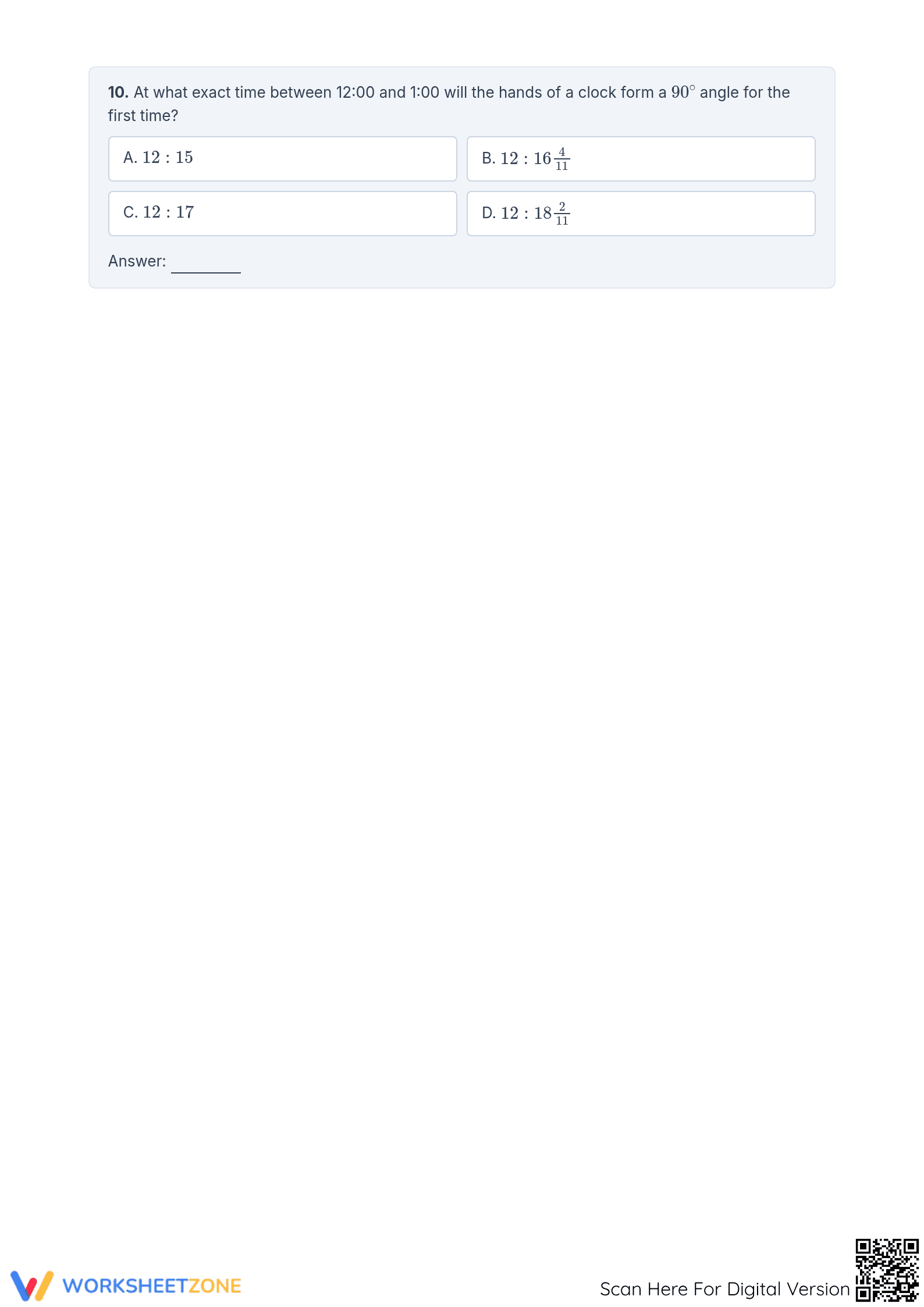
The resource contains three distinct pages featuring 10 comprehensive problems. It begins with visual identification of clock faces, moves into conceptual questions about 5-minute intervals, and concludes with advanced multiple-choice challenges requiring precise calculation of hands at non-integer positions. A full answer key is provided to facilitate quick grading and student self-correction.
Skill Progression
- Guided practice: Starts with three visual clock faces where students identify basic measures and angle types (acute, right, or obtuse).
- Supported practice: Transitions to conceptual questions about degrees per interval and identifying specific times that create 90-degree or 180-degree alignments.
- Independent practice: Presents four advanced challenges involving fractional time positions, requiring students to apply the 360-degree circular model without visual aids.
This sequence follows a gradual-release model, moving from concrete visual cues to abstract mathematical reasoning.
This resource aligns with HSG.C.A.2, focusing on the properties of angles within a circular system. It also supports HSF.TF.A.1 by preparing students for radian measures through degree-based circular partitioning. Both standard codes can be copied directly into lesson plans, IEP goals, or district curriculum mapping tools.
Use this as a bridge activity when transitioning from basic geometry to trigonometry or unit circle units. It works well as a formative assessment after teaching the 360-degree properties of a circle. Teachers should observe if students account for the slight movement of the hour hand during "half-past" intervals. Expected completion time is approximately 30 minutes.
Designed for high school students in Geometry or Algebra II, this worksheet is ideal for learners who need a concrete application of rotational angles. It pairs effectively with a unit circle anchor chart or a direct instruction lesson on angular velocity and circular motion.
According to the RAND AIRS 2024 report, contextualizing abstract geometric principles within real-world models like clock faces significantly improves long-term retention of rotational concepts. This worksheet targets the HSG.C.A.2 standard by requiring students to calculate the exact degree of separation between two rays sharing a common vertex in a circular field. By moving from simple 30-degree increments to complex fractional positions, the 10-task sequence builds the cognitive stamina necessary for advanced trigonometry. Research from Fisher & Frey (2014) emphasizes that such gradual-release scaffolds—moving from visual identification to abstract calculation—allow students to internalize the relationship between time and arc length. This resource provides the necessary repetition to ensure mastery of angle classification and measurement within a 360-degree system, making it a reliable tool for high school mathematics instruction and standardized test preparation.


