


























Views
Downloads
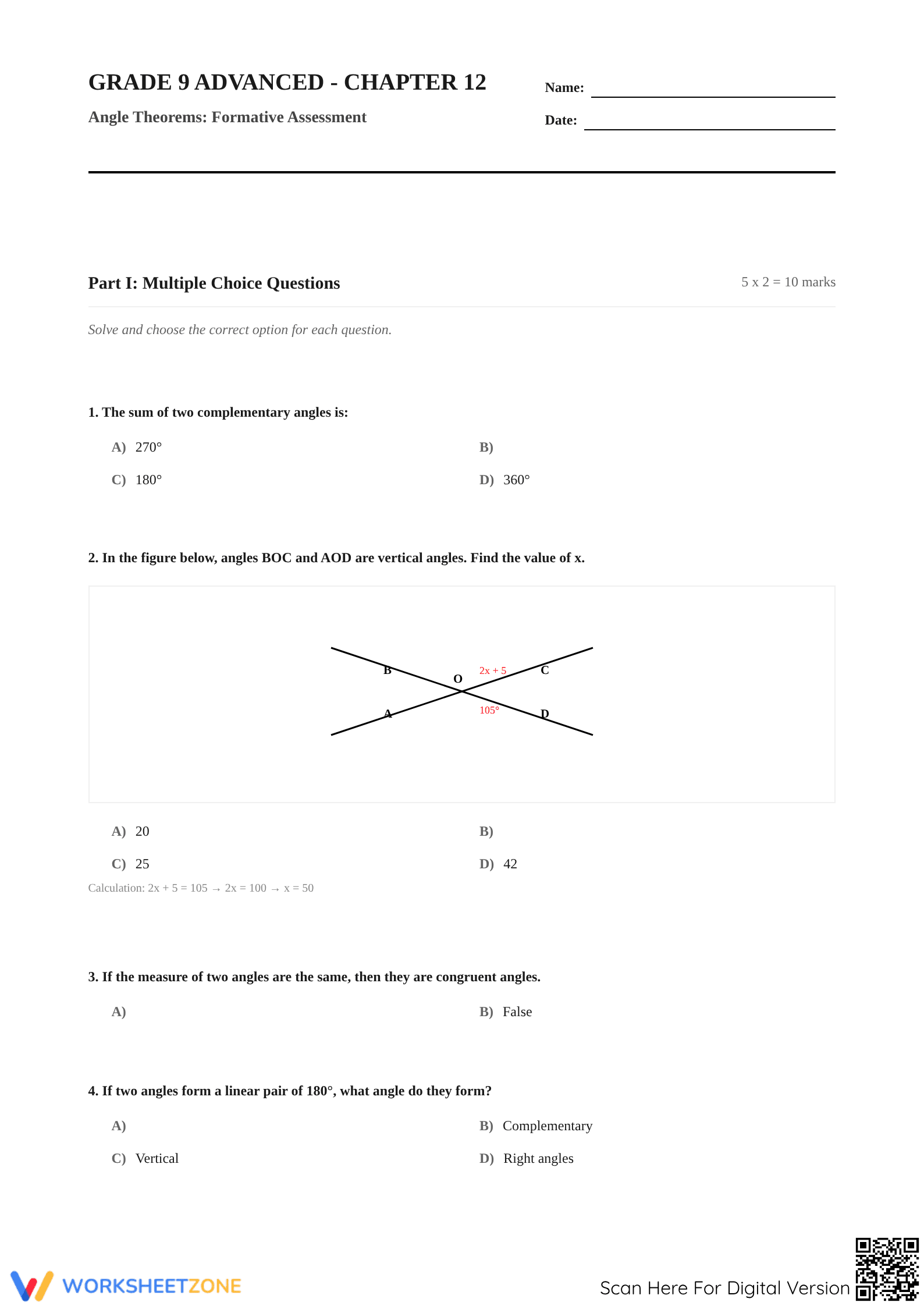
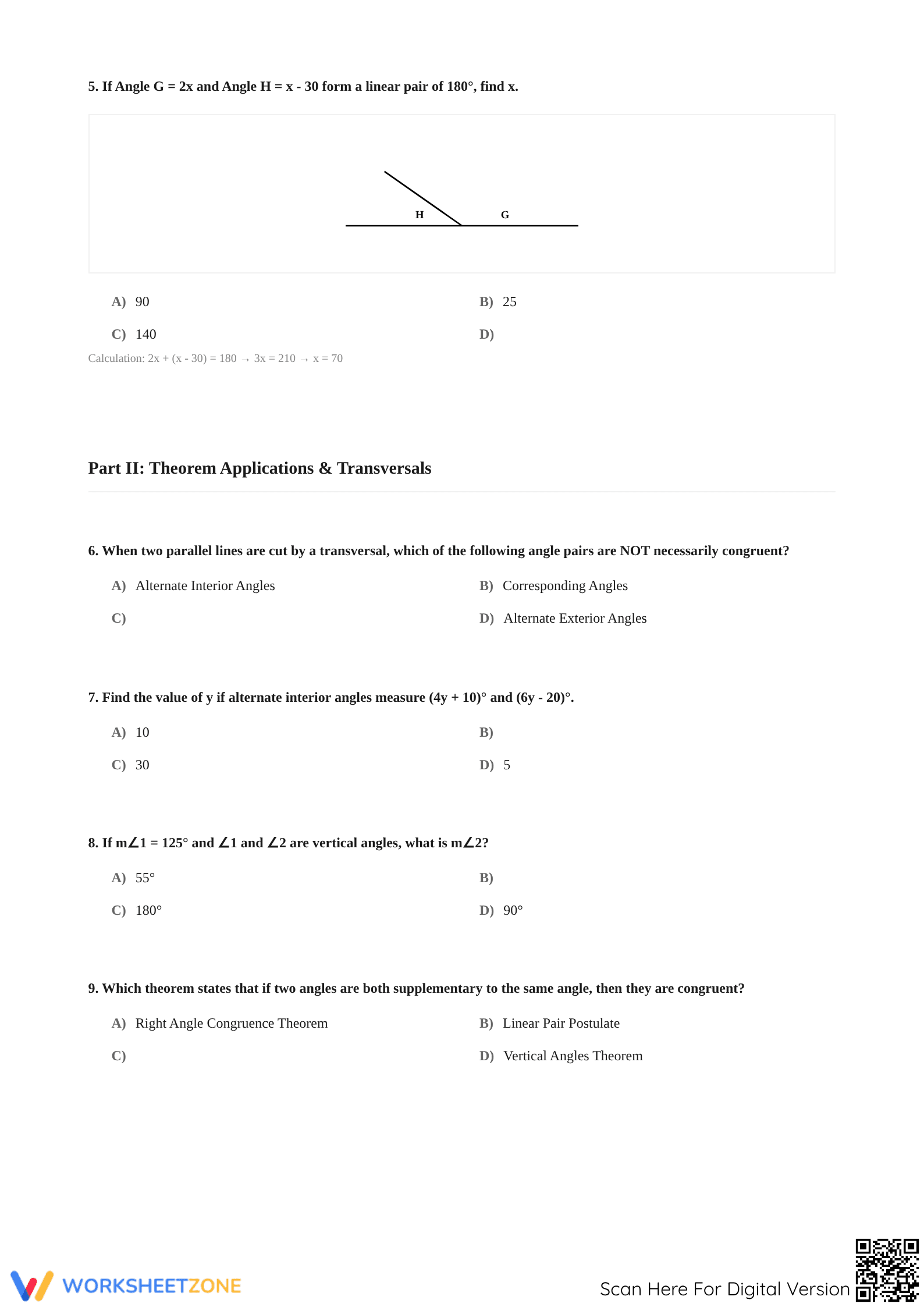
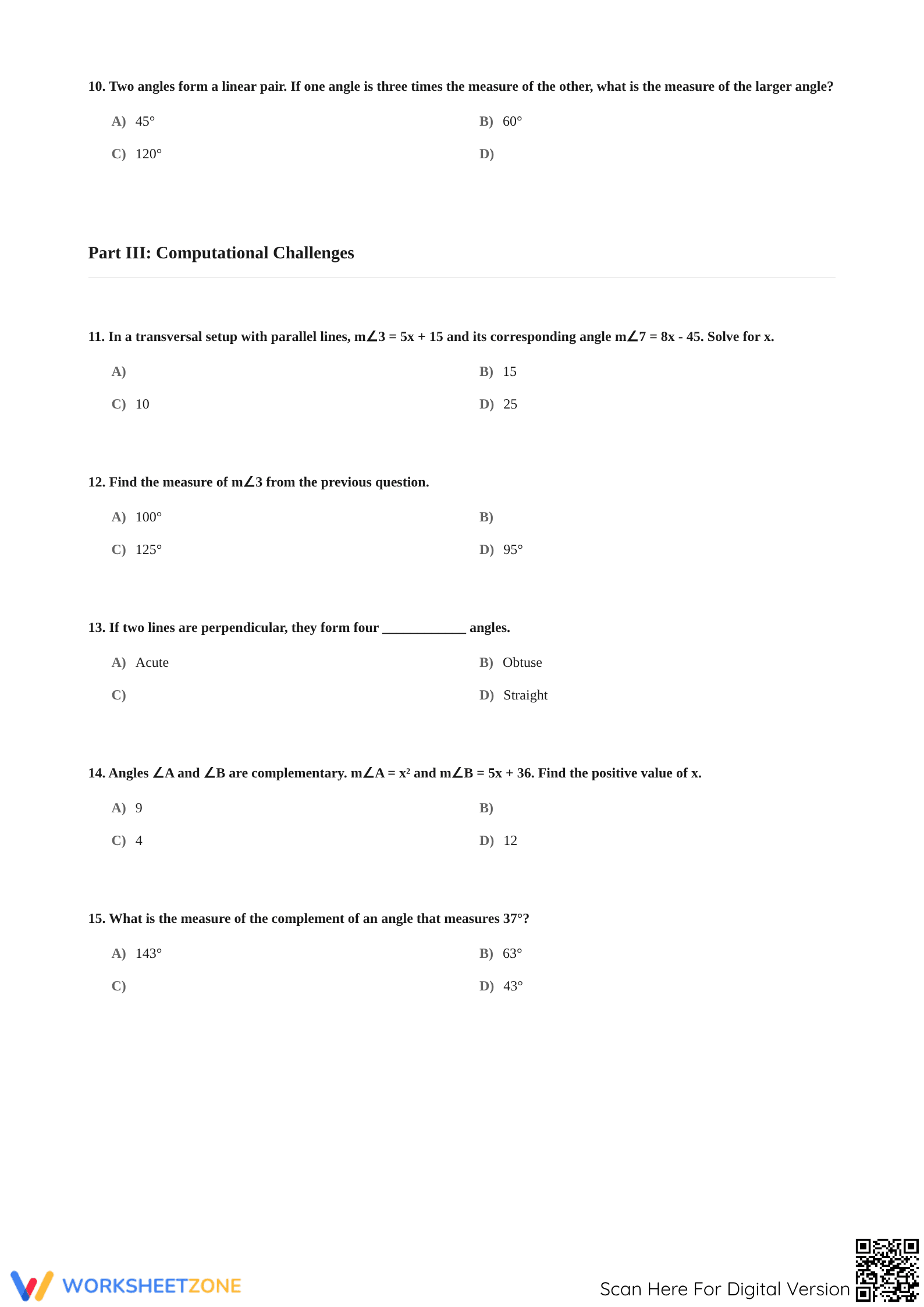
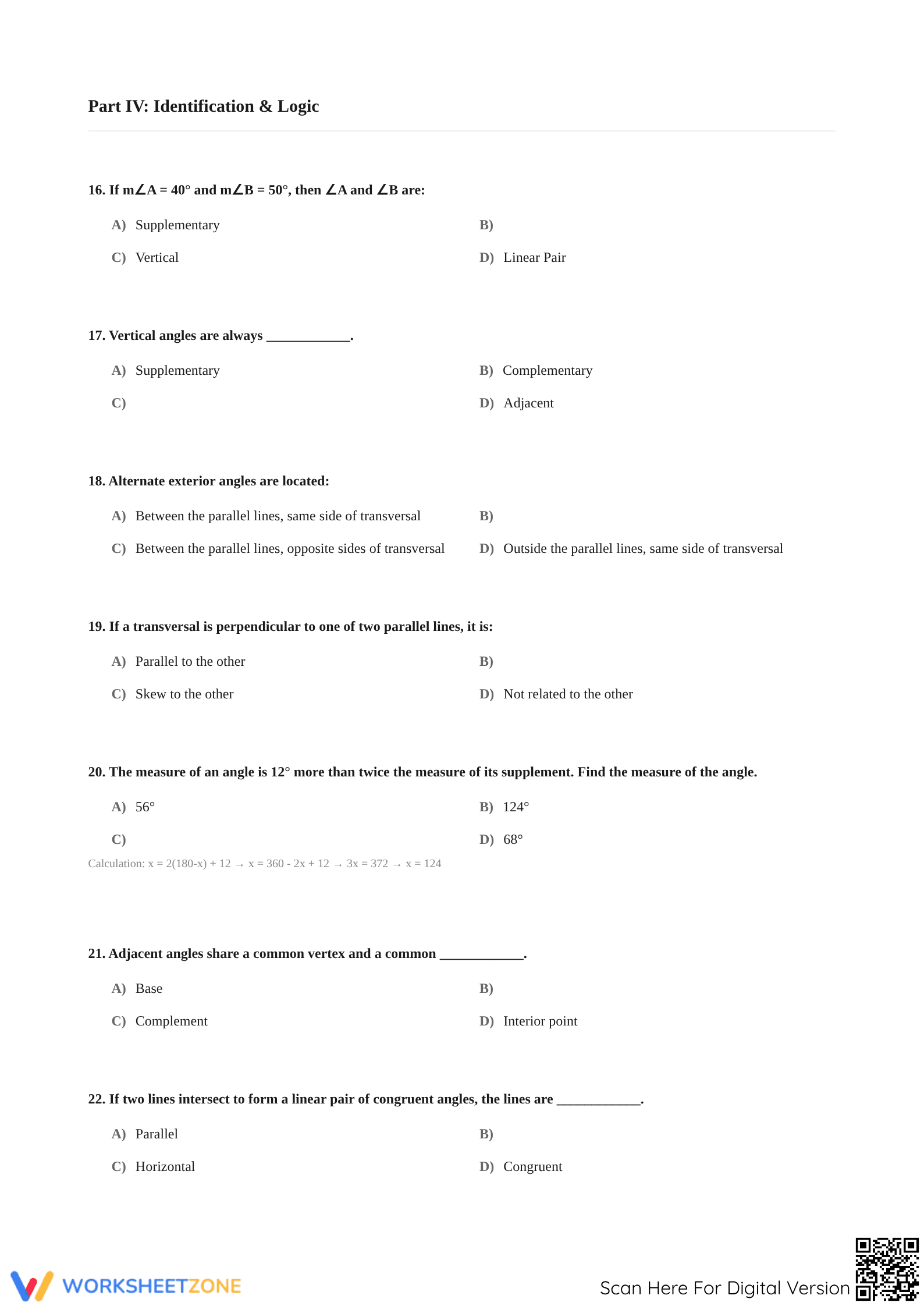

Essential Angle Theorem Assessment | Grade 9-12 Aligned
Paste this activity's link or code into your existing LMS (Google Classroom, Canvas, Teams, Schoology, Moodle, etc.).
Students can open and work on the activity right away, with no student login required.
You'll still be able to track student progress and results from your teacher account.
This comprehensive Grade 9-12 formative assessment provides a rigorous evaluation of student understanding regarding geometric angle relationships and fundamental theorems. By solving these 22 structured problems, learners demonstrate their proficiency in identifying and calculating values for vertical, complementary, supplementary, and transversal-based angle pairs across multiple levels of complexity.
At a Glance
- Grade: 9–12 · Subject: Math
- Standard:
HSG.CO.C.9— Prove theorems about lines and angles including vertical and transversal relationships- Skill Focus: Angle pair identification and calculation
- Format: 4 pages · 22 problems · Answer key included · PDF
- Best For: High school geometry formative assessment
- Time: 40–50 minutes
The worksheet is organized into four distinct modules: Multiple Choice, Theorem Applications, Computational Challenges, and Identification & Logic. Across the 4 pages, students encounter various diagrams requiring them to apply the Vertical Angles Theorem, Linear Pair Postulate, and properties of parallel lines cut by a transversal. The inclusion of a full answer key ensures immediate feedback and efficient grading for educators.
This assessment is specifically structured to provide clear mastery evidence for geometric reasoning. Each of the 22 tasks is mapped to specific sub-skills, ranging from basic identification to complex algebraic applications where students must solve for variables within geometric expressions. Educators can use these specific tiers to identify whether students are meeting or exceeding standards, allowing for precise entries into progress monitoring tools or IEP goals.
The primary alignment for this resource is HSG.CO.C.9, which requires students to prove and apply theorems about lines and angles. This includes the congruence of vertical angles and the specific relationships formed when parallel lines are intersected by a transversal. This standard code can be copied directly into lesson plans, IEP goals, or district curriculum mapping tools to ensure instructional consistency.
For optimal results, assign this worksheet as a mid-unit checkpoint after direct instruction on parallel line properties. Use the Computational Challenges section as a formative observation point; if students struggle with the algebraic setups, it indicates a need for targeted scaffolding in equation modeling. Most students will complete the full 22-task sequence within a single 50-minute class period.
This resource is designed for high school geometry students, including those in advanced Grade 9 tracks or standard high school math sequences. It is particularly effective for learners who require structured practice in translating visual geometric cues into mathematical equations. It pairs naturally with a coordinate geometry unit or a direct instruction lesson on rigid transformations and congruence.
According to research from RAND AIRS 2024, the integration of structured formative assessments in secondary mathematics significantly improves student retention of abstract geometric concepts like the HSG.CO.C.9 standard. By requiring students to articulate the logic behind angle relationships, this worksheet reinforces the cognitive pathways necessary for higher-order geometric proofs. The 22 tasks provided here offer the exact frequency of practice recommended for procedural fluency in angle theorem application. Furthermore, the systematic categorization of problems allows for the isolation of specific misconceptions regarding transversals and perpendicularity. This assessment-focused approach ensures that educators have the data necessary to adjust instruction in real-time, aligning with modern pedagogical standards for data-driven classrooms. Using this validated structure helps bridge the gap between simple identification and the logical rigor required for advanced mathematical reasoning and standardized test readiness.


