




























Views
Downloads

Essential Parallel Lines & Transversals Worksheet | Grade 8

Paste this activity's link or code into your existing LMS (Google Classroom, Canvas, Teams, Schoology, Moodle, etc.).
Students can open and work on the activity right away, with no student login required.
You'll still be able to track student progress and results from your teacher account.
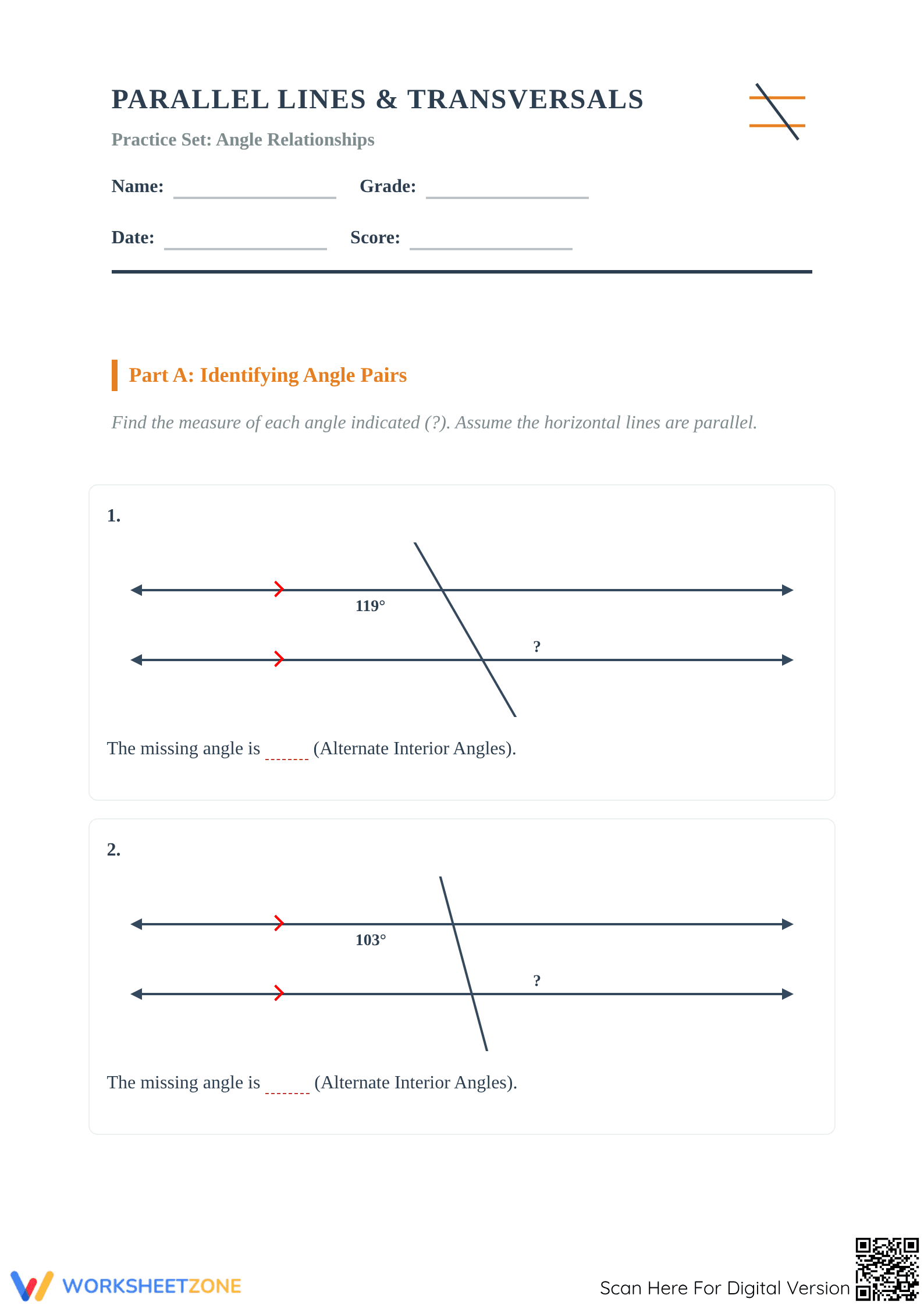
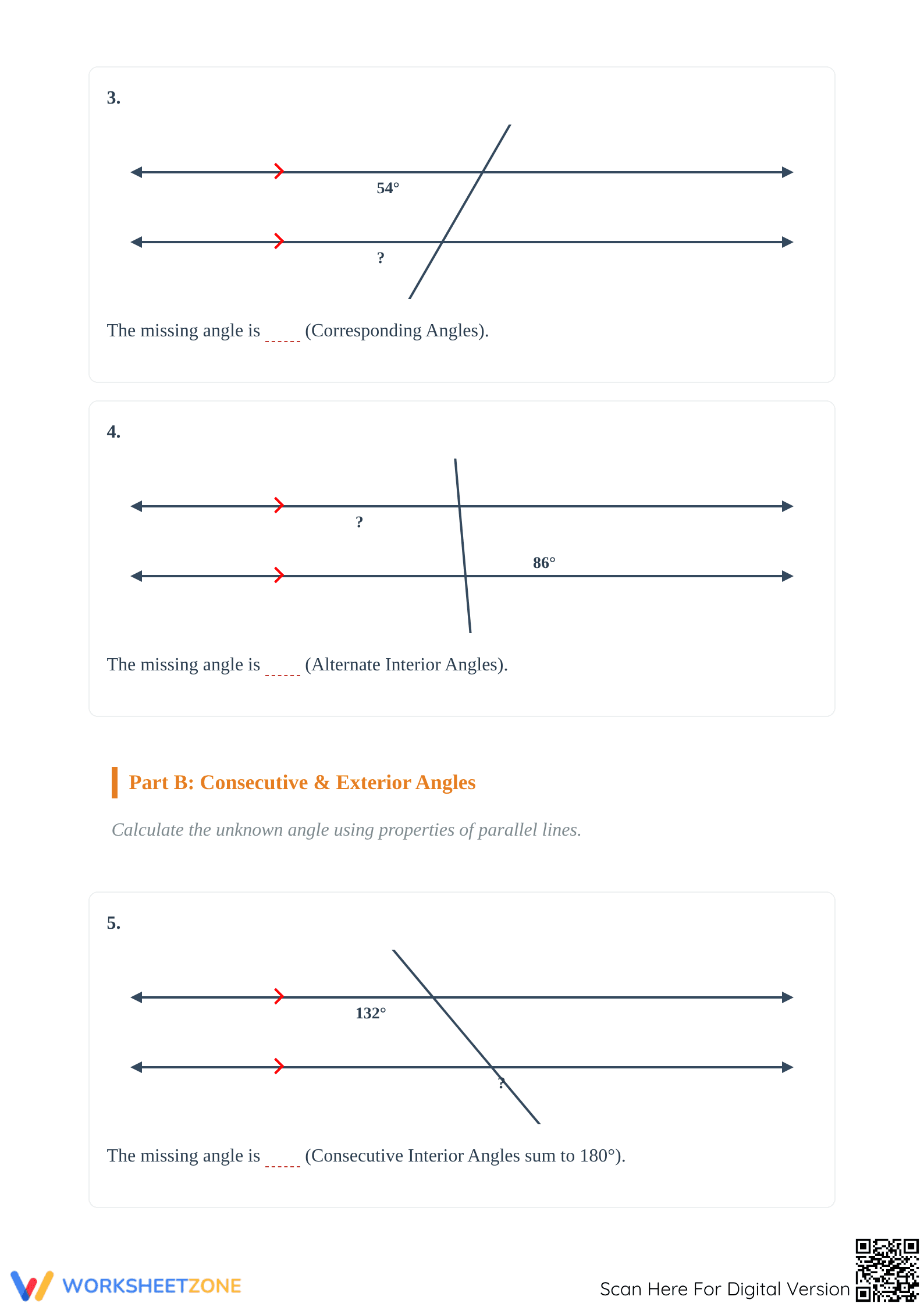
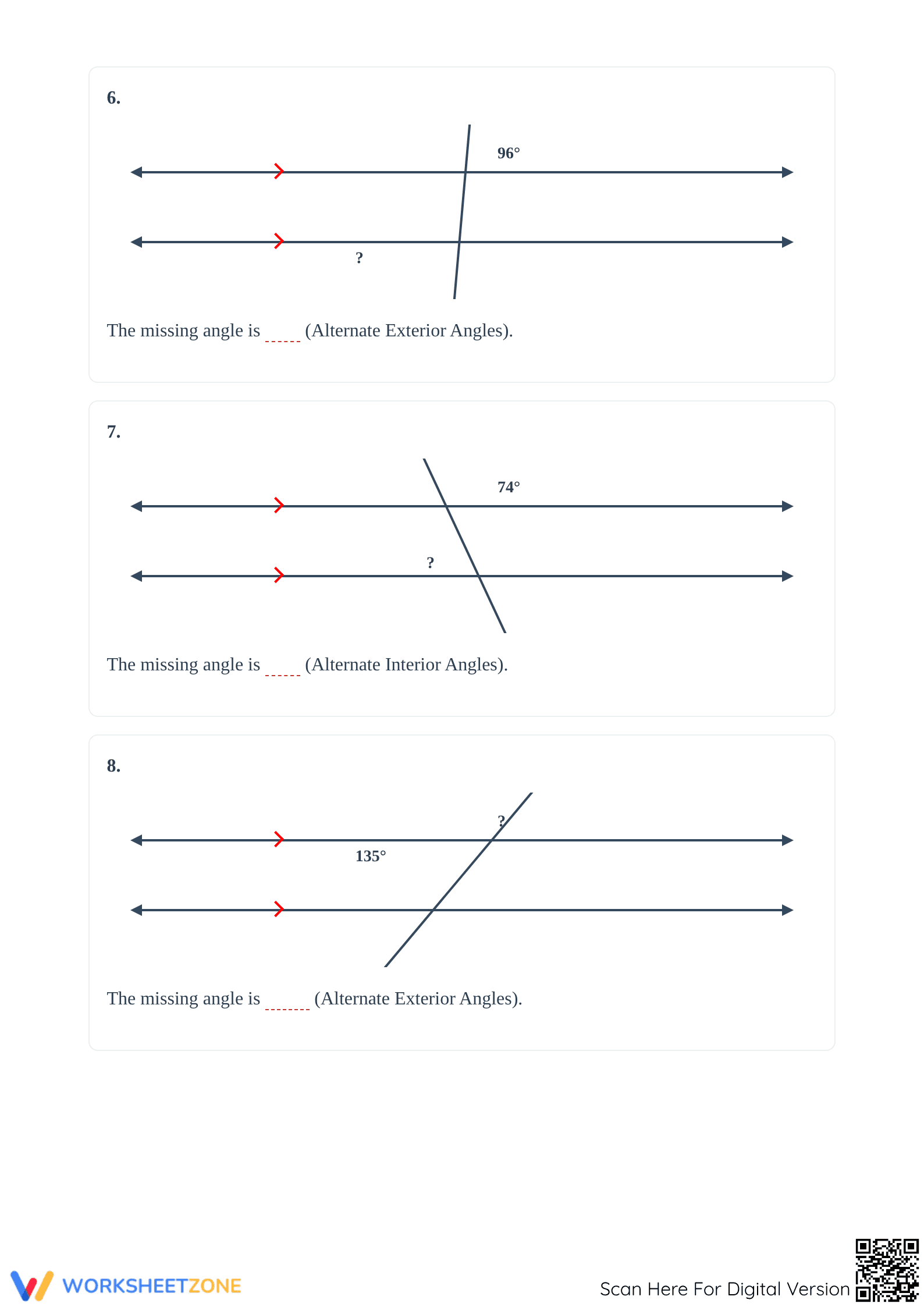
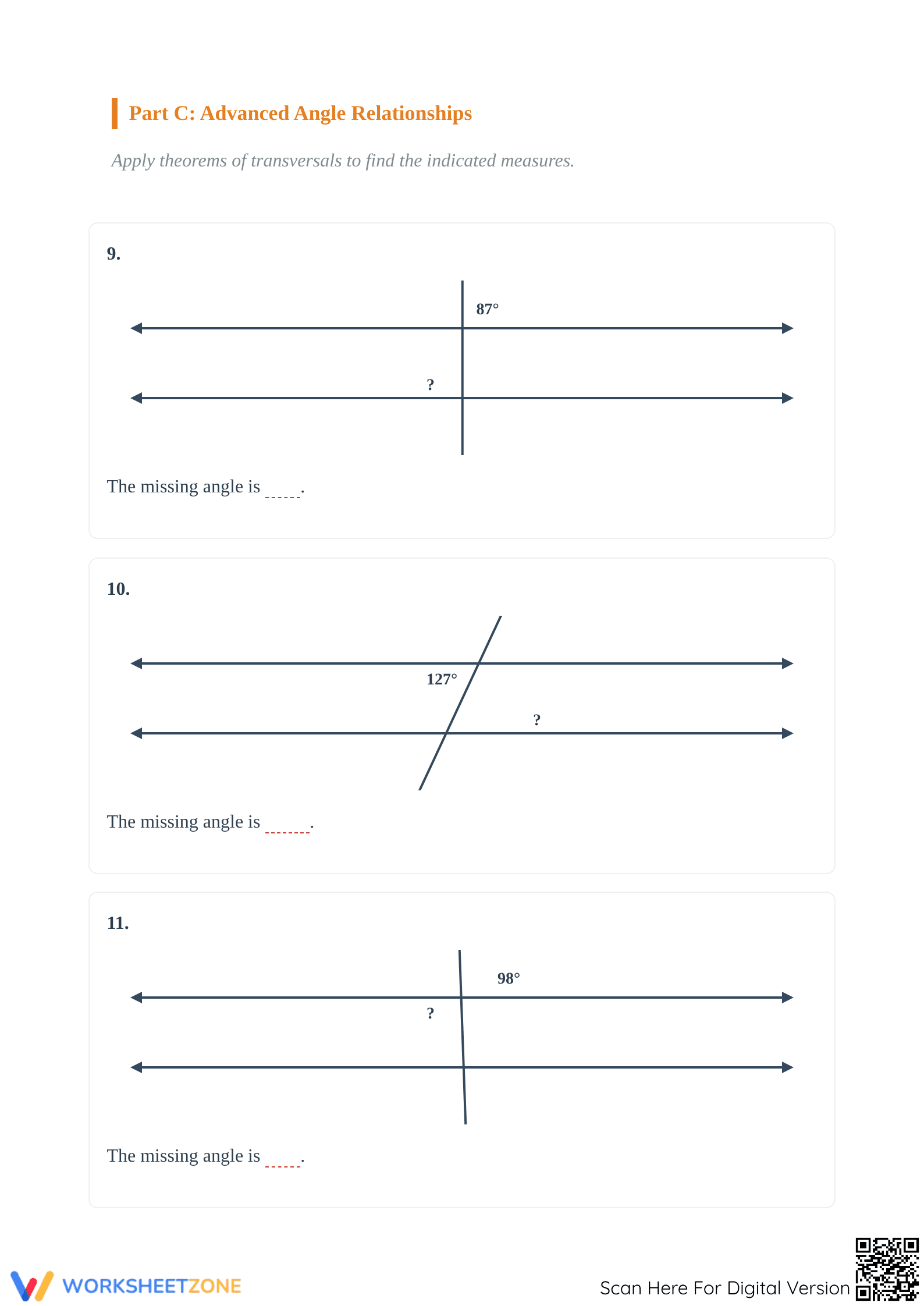
This comprehensive math practice set helps students master the geometric properties of parallel lines and transversals. By calculating unknown angle measures, learners build a strong foundation for geometric proofs and spatial reasoning. Students will identify and solve for alternate interior, alternate exterior, corresponding, and consecutive interior angles across fourteen structured problems designed for classroom success.
At a Glance
- Grade: 8 · Subject: Math
- Standard:
CCSS.MATH.CONTENT.8.G.A.5— Use informal arguments to establish facts about angles created by transversals- Skill Focus: Parallel Line Angle Relationships
- Format: 5 pages · 14 problems · Answer key included · PDF
- Best For: Independent practice or formative assessment
- Time: 30–45 minutes
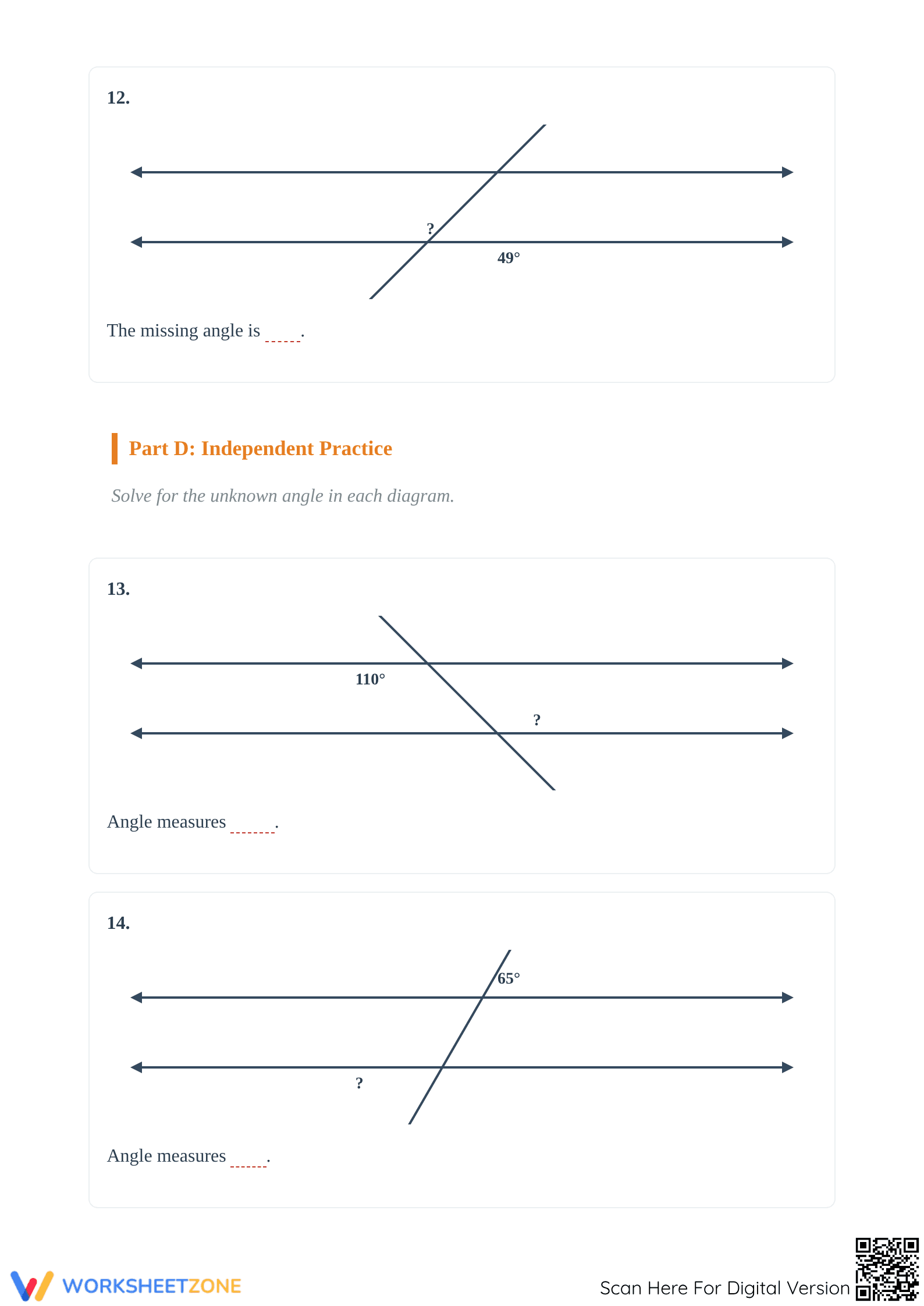
What's Inside: This five-page PDF includes four distinct sections that guide students through the complexities of angle pairs. The worksheet features fourteen clear diagrams where students must identify specific relationships—such as alternate interior or corresponding angles—and calculate missing degrees. A complete answer key is provided, showing the correct numerical measures and the geometric reasoning required for each problem, making it easy for students to self-correct or for teachers to grade quickly.
Skill Progression
- Guided Practice: The first section focuses on basic identification and calculation of alternate interior and corresponding angles with four introductory problems.
- Supported Practice: Students move into consecutive and exterior angle calculations, applying additive properties to solve for unknown measures in more varied orientations.
- Independent Practice: The final pages present advanced relationships and independent solving tasks that require students to apply multiple theorems without explicit prompts.
This structure follows the gradual-release model, ensuring students build confidence before tackling independent applications.
Standards Alignment: This resource is directly aligned to `CCSS.MATH.CONTENT.8.G.A.5`, which requires students to use informal arguments to establish facts about the angles created when parallel lines are cut by a transversal. By solving for unknown measures, students demonstrate their understanding of congruence and supplementary relationships. This standard code can be copied directly into lesson plans, IEP goals, or district curriculum mapping tools.
How to Use It: This worksheet is best used during the middle of a geometry unit after students have been introduced to the definitions of transversal angle pairs. Use the first page as a collaborative activity to check for understanding, then assign the remaining pages for independent practice. A great formative assessment tip is to observe if students can identify supplementary pairs (consecutive interior) versus congruent pairs (alternate interior) without measuring.
Who It's For: This resource is designed for Grade 8 students or high schoolers in a remedial geometry track. It is also an excellent tool for small-group intervention for students who struggle with spatial orientation. For best results, pair this worksheet with a printable anchor chart that defines each angle pair type for quick reference during the independent practice phase.
Structured practice in geometric transversals is critical for transitioning students from basic measurement to deductive reasoning. This worksheet provides a scaffolded sequence, moving from simple identification of angle pairs to complex multi-step calculations, aligning with best practices for geometry instruction. Through fourteen specific tasks tied to CCSS.MATH.CONTENT.8.G.A.5, students internalize relationships between alternate interior, exterior, and corresponding angles. The ability to articulate why two angles are congruent based on their position relative to a transversal is a key indicator of readiness for high school geometry. Research emphasizes that visual aids and repeated application help prevent common misconceptions. This resource offers the necessary repetition for students to identify these relationships regardless of orientation or diagram complexity, serving as an essential tool for evidence-based middle school geometry instruction.


