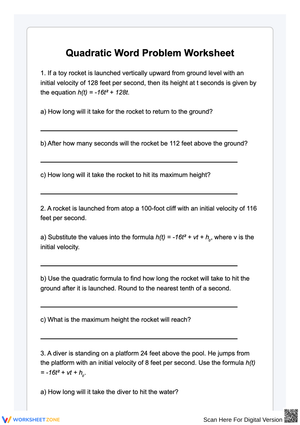
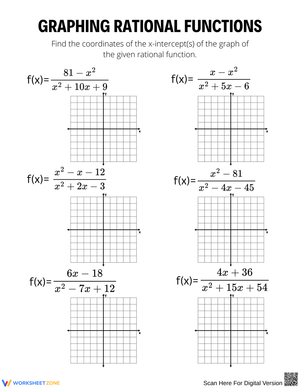
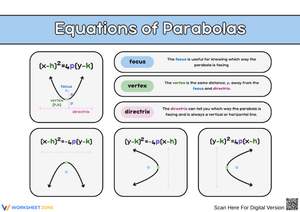
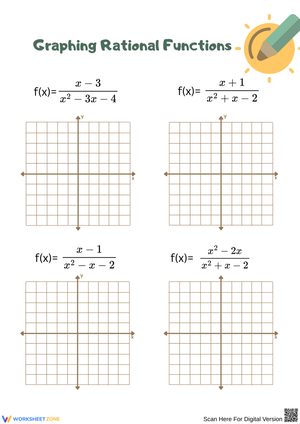
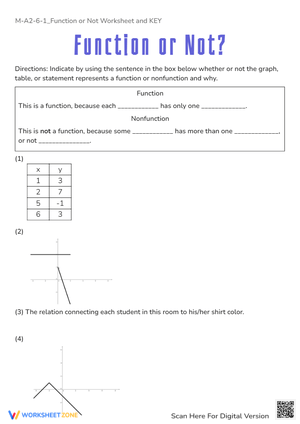
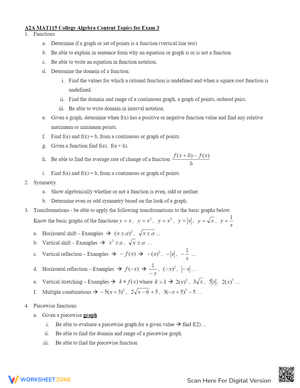
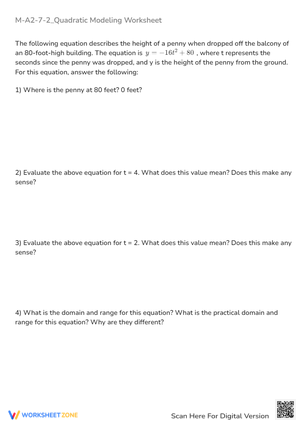
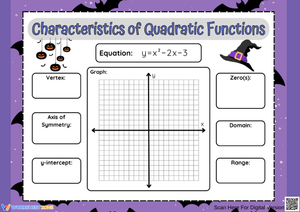
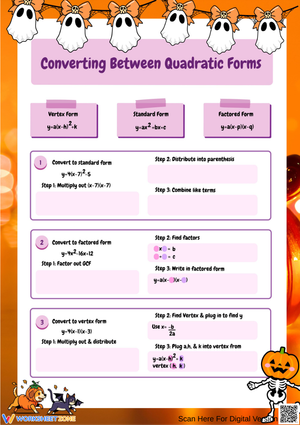
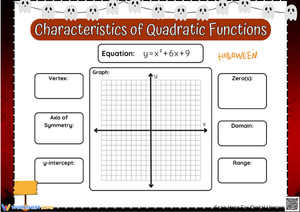
These 11th grade functions pdf worksheets cover the function analysis skills that define junior-year math — transformations of parent functions, composite and inverse functions, piecewise definitions, end behavior, and domain and range — in printable formats ready for direct instruction, independent practice, or targeted pre-test review. Students work through problems that require both algebraic manipulation and graphical interpretation, the combination that most consistently predicts performance on unit assessments and college readiness exams.
The Function Families and Skills Across the Set
Each worksheet targets a specific skill cluster rather than mixing several concepts into one resource. The areas covered are:
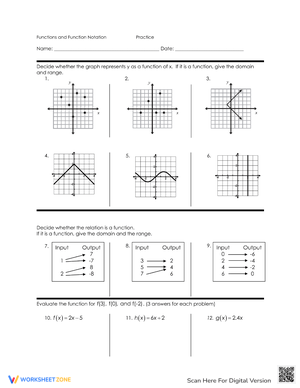
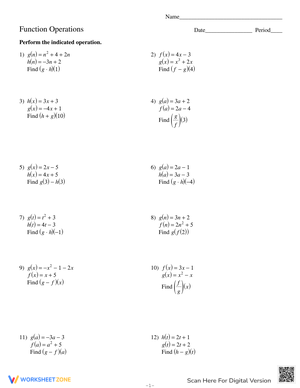
- Function notation and evaluation — including f(a+h) expressions that students will need for difference quotients in Pre-Calculus, and piecewise functions evaluated at boundary values where students must determine which rule applies
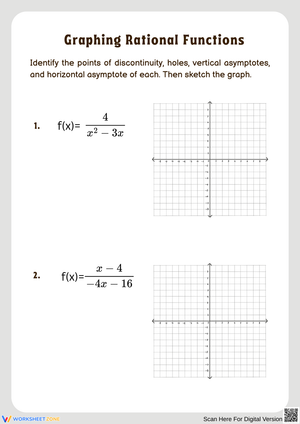
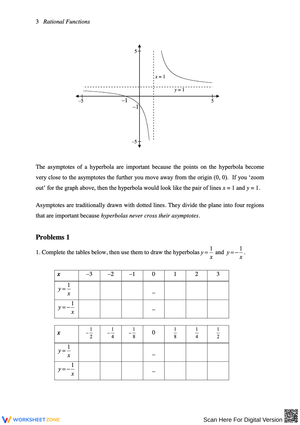
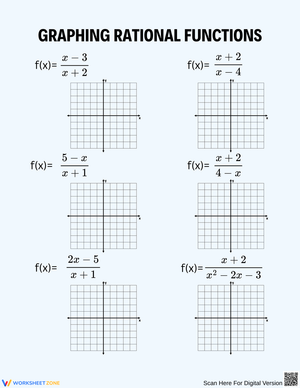
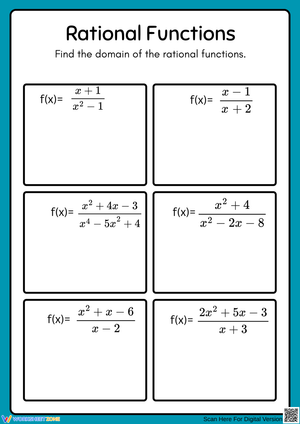
- Transformations — quadratic, absolute value, square root, cubic, and rational parent functions, with problems requiring students to identify parameter effects on equations and graphs, then sketch the result with labeled intercepts, vertices, and asymptotes
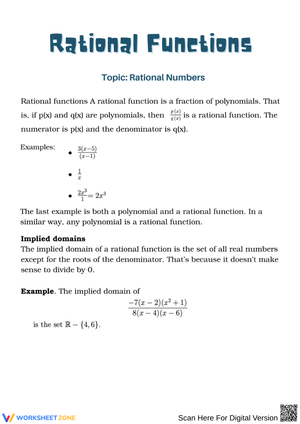
- Composite functions — computing f(g(x)) and g(f(x)) separately, simplifying the resulting expression, and identifying domain restrictions that arise from nesting one function inside another
- Inverse functions — algebraic methods for finding inverses, horizontal line test practice, and domain restriction for functions that are not one-to-one across their natural domain
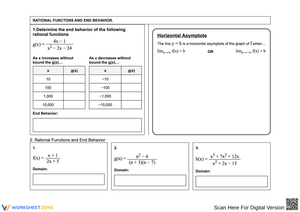
- Exponential and logarithmic functions — treated as inverse pairs throughout the set, which helps students understand both families faster than teaching them in isolation
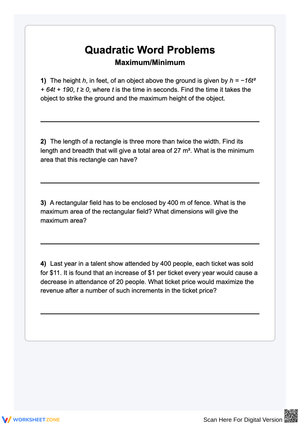
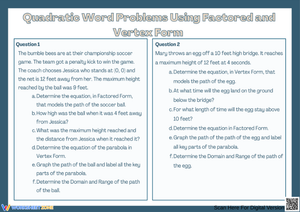
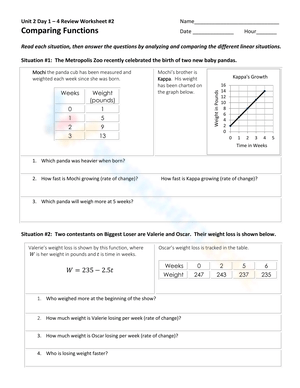
- Real-world function models — interpreting rate of change and concavity in context, not just computing them
Frequent Errors Worth Watching For and Correcting
Horizontal transformations are the most reliable source of mistakes at this level, and the cause is purely perceptual. Students who correctly move a graph down when they see f(x) − 2 will still shift left when they see f(x − 2), reading the subtraction as movement in that direction. These 11th grade functions pdf worksheets address this by requiring students to plot key points on the parent function first, then map each point through the transformation individually, rather than trying to move the whole graph at once. That intermediate step catches the error before it becomes habitual.
Two notation problems appear across almost every class. First, students read f⁻¹(x) as the reciprocal 1/f(x), treating the negative-one superscript as an exponent rather than inverse notation. This confusion usually starts in the first lesson on inverses and spreads silently if it isn't addressed directly. Second, when computing f(g(x)) with a binomial inner function, students write x + 3² instead of (x + 3)² — the parentheses disappear and the result is wrong throughout. Error analysis tasks, where students receive a completed problem containing one deliberate mistake and must locate and explain it, surface these errors more efficiently than re-teaching the procedure from scratch.
Fitting These Worksheets Into Your Planning Week
The sequence that works most reliably goes: direct instruction with one worked example, independent practice on one worksheet while you circulate, then a second encounter — a short selection from another worksheet or an exit ticket — the next day. That second encounter is where retention actually takes hold. Students who return to a composition problem the following day retain the skill far longer than students who only work through it once during the lesson. These 11th grade functions pdf worksheets fit that approach well because each one isolates a single skill, which means assigning a focused follow-up the next morning doesn't require re-explaining unrelated content.
For transformation lessons specifically, one technique worth building in: give students three colored pencils and have them draw the parent function in one color, trace the horizontal shift in a second, and apply the vertical stretch in a third. The physical separation of steps makes transformation order visible on the paper. Students who would otherwise apply a shift and a stretch simultaneously — and arrive at the wrong graph — are forced to slow down and move through the parameters in sequence. It turns a standard graphing exercise into a mapping exercise that builds a much stronger mental model of how each parameter actually moves the curve.
Standard Alignment
These resources address the High School: Functions domain of the Common Core State Standards, primarily two clusters: HSF-IF (Interpreting Functions) and HSF-BF (Building Functions).
HSF-IF.A.1 through HSF-IF.C.9 cover understanding what a function is, using notation correctly, reading key features from graphs and tables, and analyzing different representations of the same function — every evaluation and graphing problem in the set maps to at least one of these standards. HSF-BF.A.1 and HSF-BF.B.3–4 address composition, inverse functions, and how transformations affect graphs. In practical classroom terms, these two clusters represent the bulk of function work that appears on state end-of-course assessments and college readiness exams, which makes targeted practice across both clusters a reliable investment of instructional time in the second semester of 11th grade.
Adjusting the Work for a Range of Learners in the Room
Students who are still unsteady with algebraic manipulation — reliably expanding (x + h)² or simplifying rational expressions before applying a function rule — work better when composition and transformation problems are broken into named steps: identify the inner function, substitute the entire expression, then simplify. That kind of structured, step-by-step format reduces the working memory pressure of tracking multiple operations at once without lowering what the math actually asks students to do.
Students who move quickly through standard problems can extend into three-function compositions, inverses of rational functions with a linear numerator and denominator, or transformation analysis for parent functions they haven't encountered before. Keeping those students in the same conceptual territory as the class — rather than pushing them into unrelated enrichment — means they can participate in discussion and error analysis alongside peers. For classes with a wide range of fluency, having one student explain their process aloud while a partner checks the work tends to surface errors faster than silent independent practice, especially on composition problems where the mistake often lives inside the reasoning rather than on the written work.
Frequently Asked Questions
What function types do these worksheets cover?
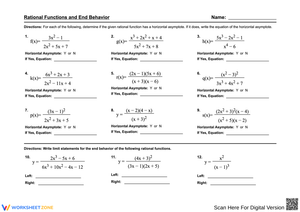
The set includes linear, quadratic, absolute value, square root, cubic, rational, exponential, and logarithmic functions, as well as piecewise-defined functions. Each family gets dedicated practice on transformations, key feature identification, and domain and range rather than brief coverage inside a general review format.
Do the worksheets come with answer keys?
Yes. Each worksheet includes a complete answer key. For graphing problems, the key shows the correctly transformed graph with labeled key points — not just a final number — because students need to see whether their graph's shape and positioning are correct, not only whether they identified the vertex accurately.
Are these suitable for Pre-Calculus as well as Algebra II?
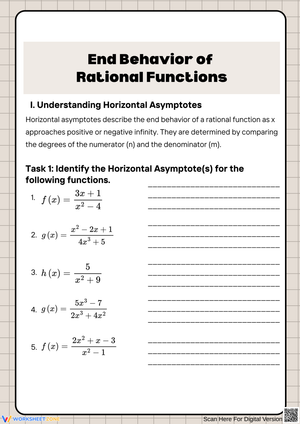
Both courses use these materials well. Transformations, composition, inverses, and end behavior analysis appear in Algebra II and Pre-Calculus alike, though Pre-Calculus typically extends them further into polynomial and trigonometric functions. These 11th grade functions pdf worksheets address the shared foundation of both courses, making them a reliable fit for either curriculum map.