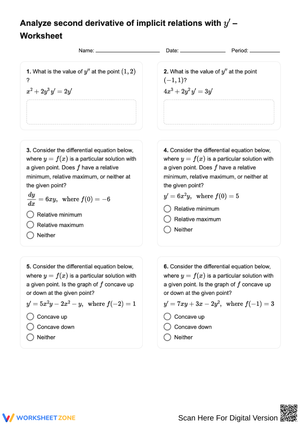
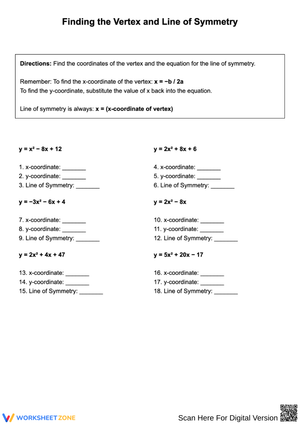
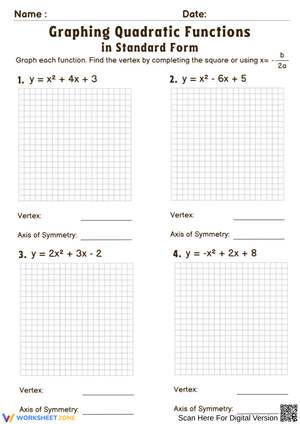
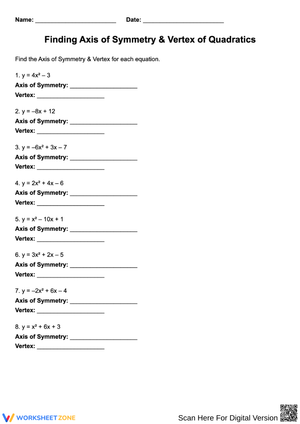
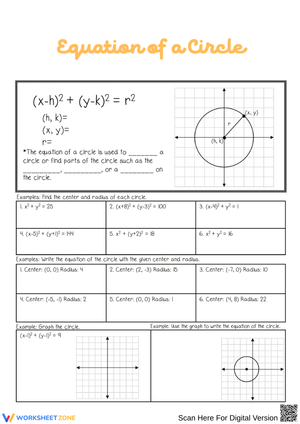
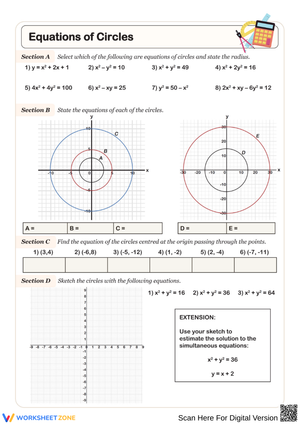
These quadratic function worksheets for 11th grade cover the full arc of the Algebra 2 parabola unit — form conversions, transformation analysis, complex roots, and optimization modeling — giving teachers a set of targeted, ready-to-use practice resources for every phase of instruction. Each worksheet targets a specific skill or concept, so teachers assign what students actually need rather than working through a fixed sequence from start to finish.
What Each Worksheet in the Set Targets
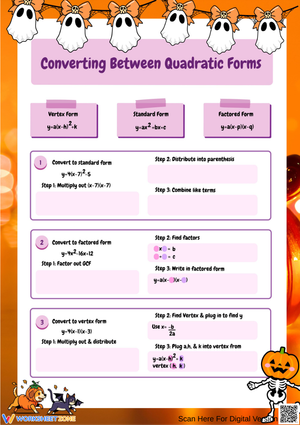
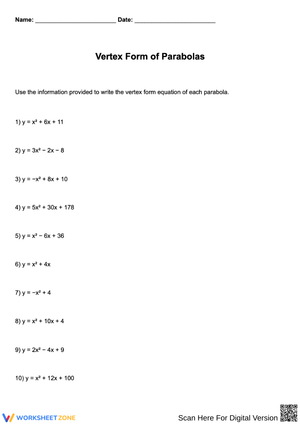
The organizing logic of these quadratic function worksheets for 11th grade is that a quadratic function is not one thing — it's the same relationship expressed three different ways, and facility with all three is what separates students who understand the topic from students who've memorized a procedure. Standard form (y = ax^2 + bx + c) connects to the quadratic formula and makes the y-intercept visible without any calculation. Vertex form (y = a(x - h)^2 + k) locates the maximum or minimum immediately. Factored form states the zeros outright. Students who work only in standard form hit a wall the moment a problem asks them to identify the vertex efficiently or graph a transformation without plotting points. The form-conversion worksheets — completing the square, expanding factored expressions, reading parameters from vertex form — address that gap directly, and each one asks students to explain what information the target form reveals, not just produce the conversion.
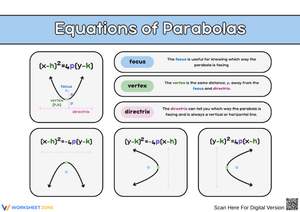
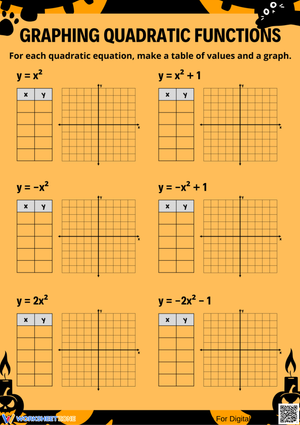
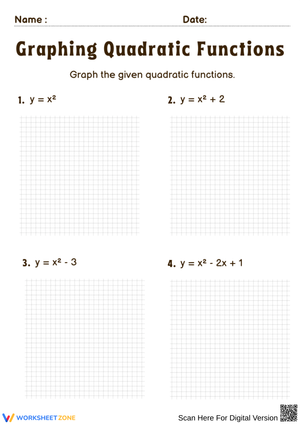
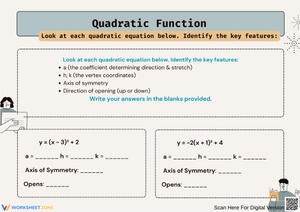
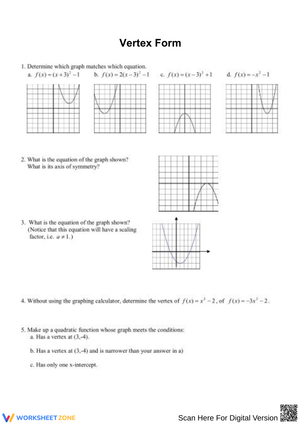
Transformation practice is the second strand. Each worksheet in this group asks students to analyze how changes in a, h, and k alter the graph of the parent function f(x) = x^2. The more demanding worksheets require students to predict the shape and vertex location before sketching — a task that exposes whether students understand parameter behavior or are simply pattern-matching from a table of values. One consistent observation: students handle vertical shifts correctly much earlier than horizontal shifts, because the sign convention in vertex form (x minus h, not x plus h) reads as counterintuitive until students have worked through enough problems to internalize why it works that way.
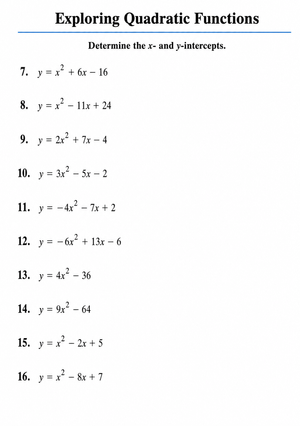
The discriminant strand pairs algebraic calculation with graphing tasks. When b^2 - 4ac is positive, the parabola crosses the x-axis at two distinct points. When it equals zero, the vertex sits exactly on the axis. When it's negative, the graph never intersects the x-axis — and the solutions are complex. Worksheets here have students compute the discriminant, predict the number of real x-intercepts, and then verify with a sketch or graphing tool. That pairing is where the connection between the algebra and the geometry tends to solidify, not the first time students encounter the discriminant formula in isolation.
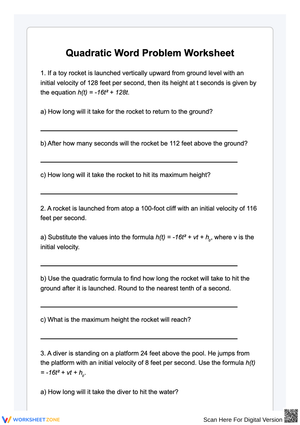
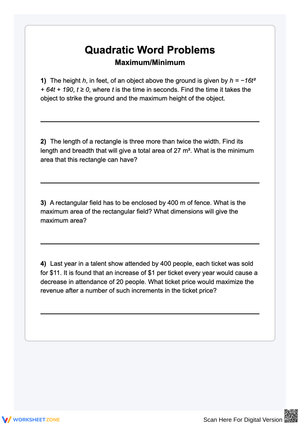
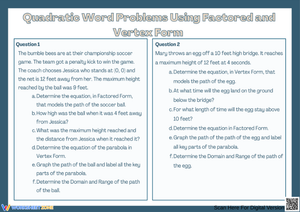
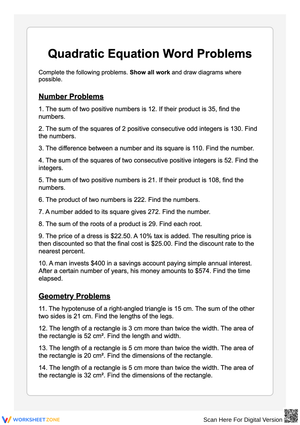
Modeling worksheets close the set: projectile motion problems asking for maximum height or time to landing, revenue optimization problems requiring students to find the price point that maximizes income, and area problems where a fixed perimeter constrains a rectangular space. All of them require students to build the quadratic from a verbal description before solving anything. The setup step — not the algebra — is where students most often stall, and these worksheets make that visible quickly.
How to Work These Worksheets Into Your Algebra 2 Unit Plan
The form-conversion worksheets work well as warm-up problems at the start of lessons where the day's instruction depends on fluent form-switching. A ten-minute opener — three expressions from standard to vertex form, three from factored to standard — gives students procedural activation before the lesson moves into graphing or modeling. These aren't review exercises; they're timed rehearsal that keeps conversion automatic rather than effortful when students encounter the forms in new contexts.
The transformation worksheets fit naturally into a paired or small-group activity — students compare their predictions about graph behavior before sketching, and the disagreements reveal exactly the misconceptions worth surfacing, usually the horizontal shift direction or the effect of a fractional a value on the parabola's width. For the complex-roots strand, these quadratic function worksheets for 11th grade pair the algebraic calculation with a graphing task on the same worksheet: students solve equations using the quadratic formula, then sketch or use a graphing tool to check whether each parabola actually crosses the x-axis. Teachers who assign only the algebraic problems consistently find that students can produce non-real solutions without understanding what those solutions mean geometrically.
The modeling worksheets fit best at the end of a unit as summative practice or as the entry point for a project-based extension. Assigning three or four problems as an end-of-lesson formative check — before moving on to systems involving quadratics — tells you quickly which students can set up a model independently and which are only fluent with the solving step.
Student Errors That Appear Across the Whole Unit
The most persistent error in completing the square is not arithmetic — it's an algebraic accounting mistake. Students add the squared term inside the parentheses correctly but forget to subtract the same value outside, producing a vertex form equation that is not equivalent to the original. A student who converts y = x^2 + 8x + 3 to y = (x + 4)^2 + 3 without subtracting 16 is not making a careless slip; they don't understand why balancing the equation requires that compensation. Asking them to expand the vertex form back to standard form and compare immediately corrects the answer and addresses the understanding gap at the same time.
In transformation problems, the horizontal shift error is almost universal on first exposure. In y = (x - 5)^2, students read the graph as shifting five units left because subtraction signals leftward movement. The actual shift is five units right. Pointing out the error is not enough — students need a self-checking strategy. A quick substitution (what x-value makes the expression inside the parentheses equal to zero?) gives them a method they can apply on their own, and it reinforces why vertex form behaves the way it does.
With complex roots, the most consequential error is treating i as a like term with real numbers. Students who arrive at 4 + 3i will sometimes attempt to add those terms, producing 7. This happens with enough regularity in 11th grade that a brief direct intervention — before students begin any independent practice on complex solutions — prevents significant reteaching time later.
Adjusting the Set for Students at Different Points in the Learning Curve
Students still building fluency with the quadratic formula do best starting with form-conversion and discriminant worksheets where the leading coefficient equals 1, b is even, and solutions are integers or simple fractions. Those constraints reduce the cognitive load enough that students can focus on the logic of the process rather than managing messy arithmetic at every step. Once they're moving confidently between forms, the worksheets where a is not equal to 1 are the appropriate next step.
Students who've mastered the core procedures are ready for the transformation prediction tasks and the modeling strand. The quadratic function worksheets for 11th grade in the optimization and modeling group don't provide the equation — they provide the situation, and students must construct the quadratic from scratch. That is a categorically harder task than solving a given equation, and it's a meaningful indicator of whether a student understands the function as a model rather than just a calculation to perform.
For students working below grade level, embedding a worked example directly in the worksheet — not on a separate reference card students will ignore — gives them a reference model they'll actually consult. For students working above grade level, the natural extension is connecting vertex form parameters to the broader family of function transformations, an observation that pays dividends when students reach rational and radical functions later in the course.
Standard Alignment
These worksheets align to the following Common Core State Standards for high school mathematics:
- CCSS.MATH.CONTENT.HSA.SSE.B.3b — Complete the square to rewrite a quadratic expression in vertex form. The form-conversion worksheets address this standard most directly. It's also the standard students most often struggle to demonstrate on assessments, because completing the square requires both procedural accuracy and algebraic reasoning about equivalence.
- CCSS.MATH.CONTENT.HSA.REI.B.4 — Solve quadratic equations by inspection, factoring, completing the square, and the quadratic formula. Each method appears in a dedicated worksheet rather than being collapsed into a single mixed-practice exercise, which gives students time to develop real fluency with each approach before encountering them together.
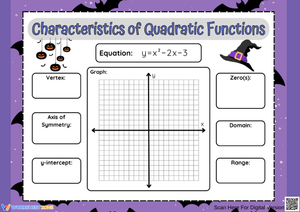
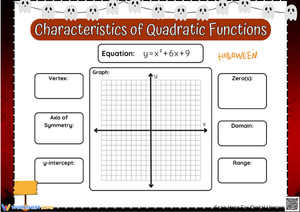
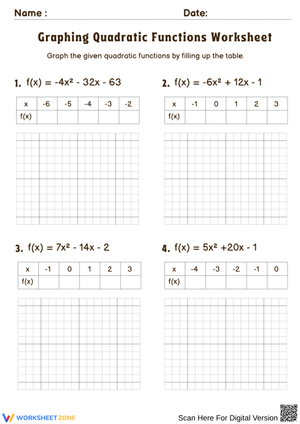
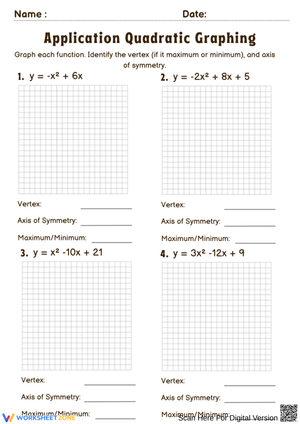
- CCSS.MATH.CONTENT.HSF.IF.C.7a — Graph quadratic functions and show intercepts, maxima, and minima. The transformation and graphing worksheets target this standard, with the more demanding exercises requiring students to predict graph behavior before picking up a pencil.
- CCSS.MATH.CONTENT.HSN.CN.C.7 — Solve quadratic equations with complex solutions. This standard appears late in most Algebra 2 sequences and typically receives less practice time than the real-roots material. The discriminant and complex roots worksheets give it dedicated space in the curriculum.
Frequently Asked Questions
How do you find the vertex when the function is in standard form?
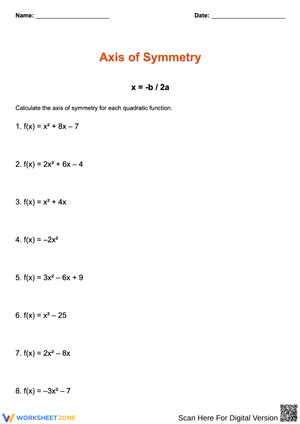
Use the formula x = -b / (2a) to find the x-coordinate of the vertex. That same value gives the equation of the axis of symmetry. Substitute it back into the original equation to find the corresponding y-coordinate. The resulting ordered pair is the vertex. This is faster than completing the square when you only need the vertex location — though students should understand that both approaches produce identical results and that choosing the method based on what the problem asks for is itself a useful habit.
What does the discriminant tell you, and when is it worth calculating separately?
The discriminant (b^2 - 4ac) tells you the number and type of roots before you carry out the full solution. A positive value means two distinct real roots — the parabola crosses the x-axis at two points. A value of zero means one repeated real root — the vertex sits exactly on the x-axis. A negative value means two complex roots — the parabola never touches the x-axis. Students should use it any time they need to determine the nature of the roots quickly, especially in multiple-choice problems and in real-world modeling situations where "no real solution" is itself the meaningful answer rather than an error to correct.
When does completing the square make more sense than the quadratic formula?
Completing the square is most efficient when the leading coefficient equals 1 and b is even — the arithmetic stays clean, and the process delivers vertex form as a byproduct, which is useful for graphing. When the leading coefficient is not 1 or b is odd, the quadratic formula is generally faster because completing the square generates awkward fractions at every step. Both methods reach the same solutions. Choosing based on the structure of the equation — rather than defaulting to one method for everything — is a mathematical judgment worth building deliberately at this level.
How do the parameters in vertex form affect the graph?
In y = a(x - h)^2 + k, the value of a controls direction and width: a negative a opens the parabola downward, an absolute value of a greater than 1 makes it narrower, and an absolute value of a between 0 and 1 makes it wider. The value of h shifts the graph horizontally — right when h is positive, left when h is negative, which is the reversal students almost always get wrong on first exposure. The value of k shifts the graph vertically. Together, h and k identify the exact position of the vertex, which is why vertex form is the most direct representation for analyzing and sketching transformations.