Logarithmic Functions Worksheets PDF for Grade 11
These logarithmic functions worksheets pdf for 11th grade give teachers a printable set of resources that moves students from reading logarithmic notation through evaluating expressions, applying properties, graphing, and solving equations — without spending a full class period hunting for material that actually fits the unit. The worksheets print cleanly, address the Algebra 2 logarithm sequence in targeted steps, and include enough variety to serve warm-ups, independent practice, reteach blocks, and review days.
Most 11th graders arrive at this topic with uneven exponent fluency. Some work through negative and fractional exponents without hesitation; others haven't fully consolidated inverse function notation from earlier in the course. That's the starting-point problem logarithm instruction always inherits. Several early worksheets in this set begin by reviewing exponential form before students are asked to convert or evaluate anything — a small structural choice that saves reteaching time mid-unit.
What's Inside the Set
The set breaks logarithmic content into the distinct moves students need to make. Rather than piling everything into undifferentiated mixed practice from day one, each worksheet concentrates on one or two connected ideas so the algebraic goal stays clear.
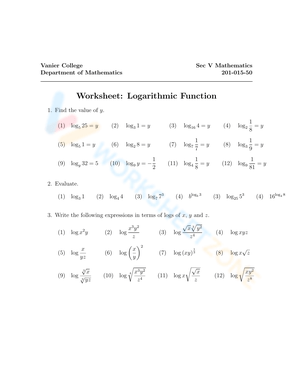
- Exponential-to-logarithmic conversion: students rewrite equations in both directions, then identify the base, exponent, and result — a check that they understand what a logarithm represents before touching a property.
- Evaluating exact values: problems range from familiar bases (base 10, base 2, base e) to less obvious ones, with room to show the exponential reasoning behind each answer rather than just circling a number.
- Product, quotient, and power properties: separate worksheets address expanding and condensing so students aren't trying to hold both directions in working memory at the same time.
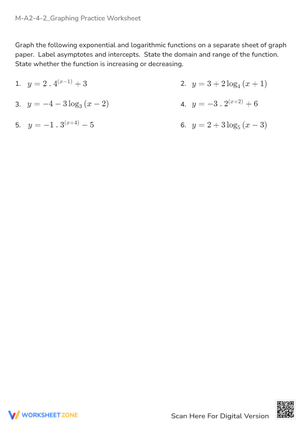
- Graphing logarithmic functions: included coordinate grids with prompts for domain, vertical asymptote placement, and the effect of horizontal and vertical shifts on the parent graph.
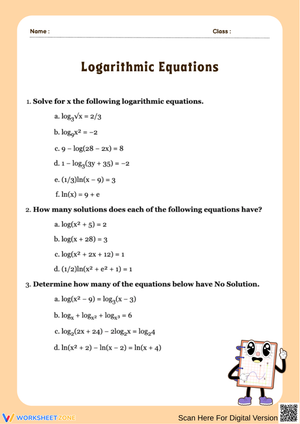
- Solving logarithmic equations: problems require students to combine logarithms, rewrite in exponential form, solve algebraically, and check for extraneous solutions before writing a final answer.
- Application contexts: a small number of items connect logarithms to exponential growth, decay, or pH-style models — enough to show the reasoning behind the algebra without turning the worksheet into a word-problem set.
The sequencing matters here. Fluency with evaluating logarithms transfers directly into property work, and property fluency is what makes equation solving less effortful. Worksheets that skip this progression tend to produce students who memorize steps without understanding which tool to reach for on a mixed problem.
Where Student Thinking Breaks Down With Logarithms
The most common error is distributing a logarithm across a sum: students write log(x + 4) = log x + log 4, applying the product property backward and to an addition that has no valid log rule. This appears consistently in student work even after direct instruction on the product property, because students pattern-match to the distributive property they've used for years. A worksheet that includes two or three deliberately wrong examples of this type — asking students to identify the error and correct it — surfaces the misconception faster than assigning ten additional routine problems.
Conversion errors have a specific shape worth knowing. A student might correctly convert 2^5 = 32 to log base 2 of 32 equals 5 in isolation, then write log base 2 of 5 equals 32 on a quiz when the problem starts from logarithmic form instead. The form is the same; the direction is reversed. Worksheets that require both conversion directions within the same problem set force that distinction into the open before it becomes a habit.
When solving equations, the extraneous solution error is nearly universal at first exposure. Students solve the algebra, get two candidate answers, and report both — because they haven't connected domain restriction to the definition of a logarithm. Building a dedicated check step into the worksheet format (a labeled row: "Is each solution in the domain? Show why.") reduces this error more reliably than reteaching the concept verbally.
How to Build These Worksheets Into Your Lesson Plans
The most practical use of logarithmic functions worksheets pdf for 11th grade is to tie each worksheet to a single lesson objective and stop there. A bell ringer asking students to convert five equations from exponential form takes about six minutes and gives immediate data before instruction begins. A properties worksheet can run as guided practice — worked in pairs for the first ten problems, then independently for the final five. That gradual release requires no additional materials and produces a natural transition into whole-class discussion of where the group got stuck.
Exit tickets are underused with this topic. A worksheet that ends with one equation-solving problem and asks students to mark any rejected answers and explain why each was excluded generates written reasoning that reveals far more than a correct numeric answer. Teachers can scan those explanations during transition or after class to identify who needs reteaching before the class moves to graphing.
One structural move worth trying: put a strategy-selection prompt at the top of any mixed-review worksheet — three or four methods listed (rewrite in exponential form, apply a property, check the domain, reach for a calculator) — and ask students to label each problem with the method before computing. Grade 11 students working on mixed logarithm practice often jump to computation before sorting what kind of problem they're looking at, and that labeling step slows the rush without adding more problems to the set.
Making This Set Work Across Different Readiness Levels
Logarithmic functions worksheets pdf for 11th grade serve a range of readiness levels when teachers make deliberate choices about entry points. For students who still struggle with exponent meaning or inverse function notation, assign the conversion worksheets with a small reference box listing exponential form alongside its logarithmic equivalent — not as a permanent shortcut, but as a temporary anchor that keeps unfamiliar notation from consuming all working memory while students process each problem's structure.
For students ready to move beyond procedural fluency, the graphing worksheets extend naturally. Rather than plotting a single parent function, ask them to graph three related functions — log base 2 of x, log base 2 of (x − 3), and negative log base 2 of (x − 3) — on the same coordinate grid and describe each transformation in writing. That task demands both graphing accuracy and the ability to connect algebraic structure to visual change, which is where stronger 11th graders often carry gaps they don't know they have.
A section-labeling structure within one worksheet (Part A for foundational review, Part B for standard-level practice, Part C for extension) lets teachers assign different entry points without creating separate documents. Students working at different points in the unit stay within the same content while the depth adjusts by section.
Standard Alignment
These worksheets address CCSS F-BF.5, which asks students to understand the inverse relationship between exponents and logarithms and use that relationship to solve problems. In classroom terms, that standard covers the full arc of logarithm instruction at this level: converting between forms, evaluating, applying properties, solving, and connecting back to exponential functions. The graphing worksheets also address F-IF.7e, which calls for graphing logarithmic and exponential functions and identifying key features — domain, intercepts, end behavior, and asymptotes. Most Algebra 2 courses place both standards within the same unit, so the worksheets sequence naturally across a two-to-three-week instructional block.
Frequently Asked Questions
Do these worksheets require a graphing calculator?
Early worksheets stay non-calculator so students build fluency with exact values and logarithm structure. Later worksheets — particularly those involving change-of-base problems or equations that don't reduce to clean whole-number solutions — assume calculator access. Each worksheet notes calculator expectations clearly so teachers don't need to manage that decision separately for each assignment.
How does this set differ from standard textbook exercises?
Textbook problem sets typically cover several skills in one numbered list, which makes it difficult to assign a single objective at a time. Each worksheet in this set concentrates on a narrow target, so teachers can assign exactly what a given lesson period needs without asking students to skip around a textbook page or work around problems that don't apply yet.
Are these appropriate for an honors or accelerated Algebra 2 course?
The standard-level worksheets fit regular Algebra 2 pacing. The extension problems — multi-step equation solving, transformed graphs, and application modeling — work for honors students as either core practice or challenge items. Teachers using logarithmic functions worksheets pdf for 11th grade in an accelerated course can move through the early conversion and evaluation worksheets quickly and spend more instructional time on graphing and equation-solving sets where conceptual depth matters most.
In what order should these worksheets be assigned during a logarithms unit?
Start with conversion and evaluation, then move to properties — expanding before condensing, because students consistently find the reverse direction harder — then graphing, then equation solving, and close with mixed review. That order mirrors how the algebra builds: students who can't evaluate logarithms will struggle to recognize when they've solved an equation correctly, and students who skip property work before equation solving tend to guess and check rather than reason algebraically.
Clear All