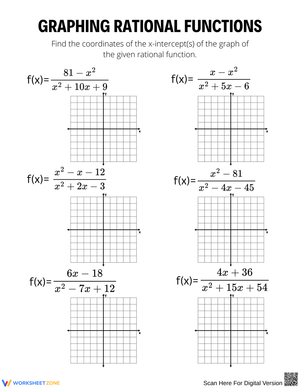
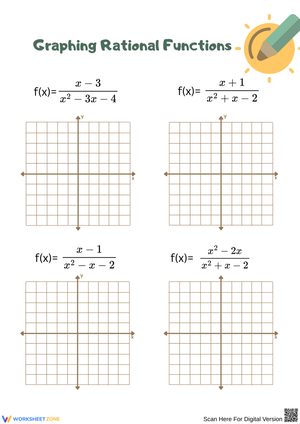
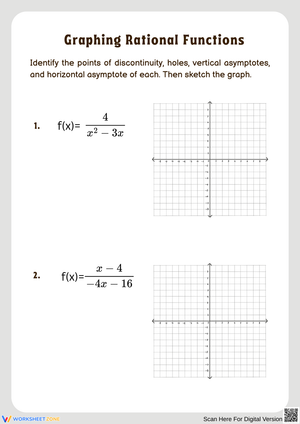
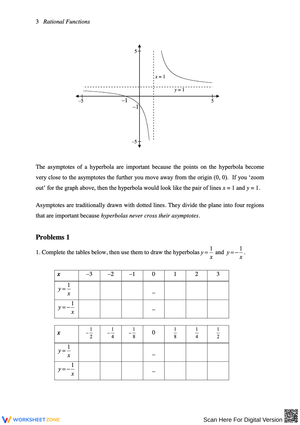
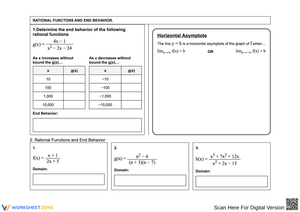
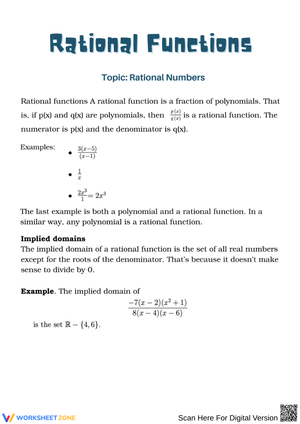
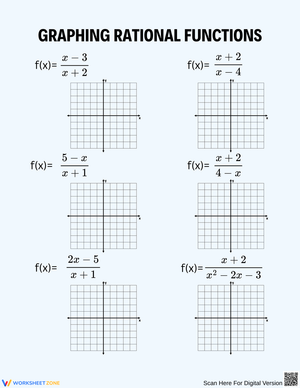
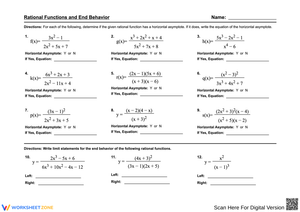
Rational functions printable worksheets for 11th grade give teachers a targeted way to build the layered conceptual and procedural skills this topic demands — factoring, asymptote identification, domain restrictions, and graphing — without asking students to hold all of it in mind at once. The resources described here break that complexity into discrete, printable practice so teachers can sequence guided and independent work across a two-to-three week unit.
The Specific Skills These Worksheets Build
Each worksheet focuses on one primary skill area so students build competency in isolation before combining concepts. The full set covers:
- Vertical asymptote identification: Students factor the denominator fully and locate x-values where the function is undefined — a step they must complete before any graphing begins.
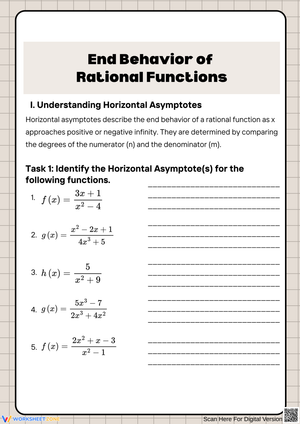
- Horizontal and oblique asymptote analysis: Students apply degree-comparison rules. When the numerator degree is less than the denominator degree, the horizontal asymptote is y = 0. Equal degrees produce the ratio of leading coefficients. When the numerator degree is exactly one greater than the denominator degree, polynomial long division yields a slant asymptote.
- Removable discontinuities: Students identify shared factors between numerator and denominator, cancel them, and mark the resulting hole as an open circle at the correct coordinate on their graph.
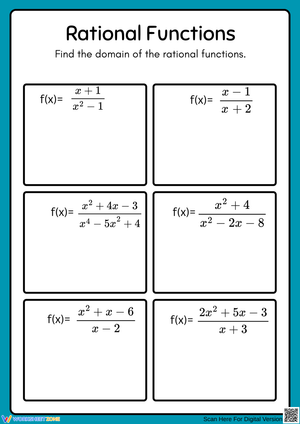
- Domain and range in interval notation: Students account for both vertical asymptotes and holes when writing the domain, then reason through range restrictions from the graph's behavior.
- Solving rational equations: Students clear fractions by multiplying through the least common denominator, solve the resulting polynomial equation, and substitute every solution back into the original to catch extraneous roots.
- Graphing from scratch: Students work a structured sequence — factor, find intercepts, locate discontinuities, determine end behavior, plot test points, and sketch the curve.
Mistakes Students Make That These Worksheets Surface
The error that shows up most consistently is conflating holes with vertical asymptotes. Both involve x-values that make the denominator zero, but students who haven't internalized why the factoring step matters will mark a vertical asymptote at x = 3 in a function like (x − 3)(x + 2) divided by (x − 3)(x − 1) without noticing that the (x − 3) factor cancels. The graph they draw shows dramatic asymptotic behavior where there should be only a small open circle. These worksheets include paired problems built specifically so both features appear in the same function, forcing students to locate and distinguish them rather than treat them as equivalent.
Extraneous solutions are the second predictable failure point. Students who correctly multiply through the least common denominator and solve the resulting quadratic often stop there, treating both roots as final answers. In reviewed student work, roughly a third of students who reach the correct equation miss the check step and include extraneous solutions in their answer. Any worksheet that doesn't explicitly prompt that substitution step will see it disappear under time pressure. Each equation-solving worksheet in this set includes a labeled row for "Check: substitute into original" so the step is never optional.
A smaller but durable error: students who can correctly state the horizontal asymptote rule will sometimes apply it to the wrong ratio. When degrees are equal, the asymptote is the ratio of the leading coefficients — not the constant terms, not a sum of all coefficients. Problems that isolate this comparison, separate from full graphing tasks, correct the confusion faster than general practice does.
Building These Worksheets Into Your Lesson Sequence
A "build-then-analyze" structure works well across the unit. Spend the first several days on procedural fluency — factoring and asymptote identification worksheets in the order listed above. Once students have that foundation, bring in the error analysis worksheet where a fictional student's work contains three deliberate mistakes: a missed hole, an incorrect asymptote call, and an unchecked extraneous solution. The discussion when students compare their corrections is usually more productive than another round of standard problems. Placing that error analysis in the middle of the unit rather than the end produces stronger retention — students are still forming habits at that point, not reviewing them.
Warm-up use also adds real value. A single rational function projected at the start of class, with the prompt "List every feature you can identify," takes about four minutes and previews whichever worksheet is coming that day. Students who finish early can attempt a rough sketch from their feature list — low-stakes graphing before the formal worksheet begins. Collecting those warm-up responses takes thirty seconds and shows which students need a quick check-in before independent work starts.
These rational functions printable worksheets for 11th grade also fit naturally into end-of-unit review blocks. Rather than reassigning every worksheet, pull two or three problems from across the set and project them as a cumulative check. That keeps review targeted and gives teachers a quick read on where gaps remain before the summative assessment.
Standard Alignment
The worksheets align with two primary standards. HSA-APR.D.6 addresses rewriting rational expressions in equivalent forms — which governs the factoring, simplification, and hole-identification work students do before graphing. HSF-IF.C.7d requires students to graph rational functions and identify zeros, asymptotes, and end behavior — which governs the graphing and analysis worksheets. In classroom terms, these two standards are sequential rather than parallel: the APR work happens first, and the IF work builds on top of it. Sequencing the worksheets by skill automatically moves students through both standards in the right order.
Adjusting the Worksheets for a Range of Learners
For students still building fluency with polynomial factoring, the graphing worksheets are harder than they need to be — the obstacle is the prerequisite skill, not the rational function concepts themselves. Provide the numerator and denominator pre-factored on those students' copies so they can focus on asymptote and hole identification. That removes the factoring barrier without changing the 11th-grade skill target.
The same rational functions printable worksheets for 11th grade can be extended for students who finish quickly and accurately: ask them to reverse-engineer. Given a graph with two vertical asymptotes, one hole, and a horizontal asymptote of y = 2, write a rational function that produces those features. Most students find this significantly harder than the forward direction, and it reveals whether they understand the structure or just the procedure. It also requires no additional materials — only a blank line added at the bottom of the worksheet.
Students who struggle specifically with interval notation rather than with rational function concepts benefit from a reference card clipped to the domain and range worksheet. It keeps them moving through the content while the notation becomes more automatic over repeated use — a cleaner fix than grading the notation separately.
Frequently Asked Questions
How are holes different from vertical asymptotes, and how do these worksheets help students distinguish them?
Both features occur at x-values where the original denominator equals zero. The difference is whether the same factor also appears in the numerator. When it does, the factor cancels and leaves a removable discontinuity — an open circle on the graph — rather than the unbounded behavior of a vertical asymptote. These worksheets pair problems where both features appear in the same function, so students must locate each type independently before sketching. After working through several of those paired problems, the reasoning transfers to unfamiliar functions.
What prerequisite knowledge do students need before starting this set?
Students need reliable fluency with polynomial factoring — trinomials, difference of squares, and grouping — along with experience simplifying algebraic fractions. Polynomial long division matters specifically for the oblique asymptote worksheets. Running a short diagnostic on those skills at the start of the unit tells teachers who needs targeted support before rational function content creates compounding confusion.
Why do extraneous solutions appear, and is this a problem students can be trained to catch?
Multiplying both sides of a rational equation by the least common denominator can introduce solutions that make the original denominator zero — values that are undefined in the original but valid in the transformed equation. The check step catches them every time, and students can absolutely be trained to perform it consistently. The key is building the check into the worksheet format as a required row, not as an afterthought. When the structure demands it, students do it.
Can these worksheets work as homework, or are they better assigned in class?
The graphing worksheets work better in class, where a teacher can intercept an incorrect asymptote call before it becomes a full incorrect sketch. The equation-solving worksheets — particularly those focused on extraneous solutions — are reasonable homework once students have seen the check step modeled in class. The rational functions printable worksheets for 11th grade in this set are labeled by skill and format, so teachers can make that assignment call worksheet by worksheet rather than treating the entire set the same way.












 Interactive Worksheet Maker
 Quiz Maker
 Word Search Maker
 Crossword Puzzle Maker
 Word Scramble Generator
 Sentence Scramble Generator
 Handwriting Worksheet Generator
 Name Tracing Generator
 Fill In The Blank Generator