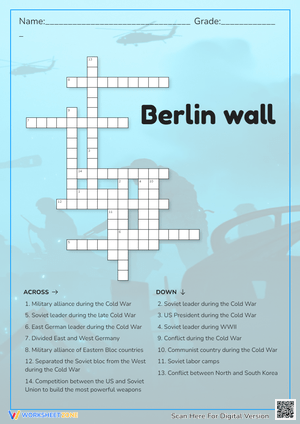
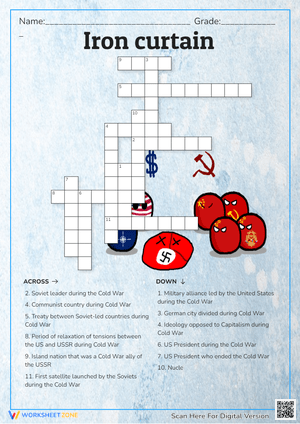
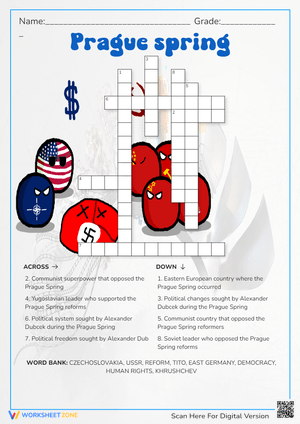
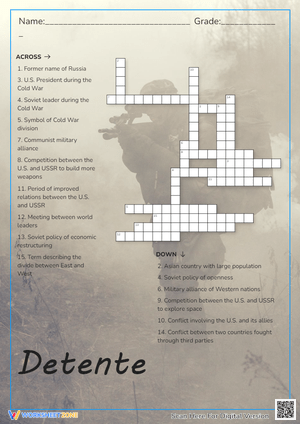
These 10th grade world history worksheets resources give teachers a ready set of analytical tools covering the modern era — Enlightenment through the contemporary world — without requiring hours of assembly time each unit. The set spans intellectual and political revolutions, industrialization, global imperialism, the world wars, and Cold War ideological conflict. Each worksheet targets a discrete skill or content area, so teachers can match the right activity to wherever a unit needs reinforcement or extension.
Historical Periods and Skills Across the Set
Five content clusters organize the activities in this 10th grade world history worksheets set, matching the sequence most modern world history courses follow.
- Enlightenment and Democratic Revolutions: Comparison charts and annotated primary source excerpts asking students to trace how Locke's and Rousseau's ideas traveled into the American, French, and Latin American revolutions — and where those revolutions diverged from one another.
- Industrial Revolution and Imperialism: Map-based worksheets showing European colonial expansion alongside data tables on raw material extraction. Students mark contested territories, identify economic motivations, and explain why specific regions became targets of imperial control.
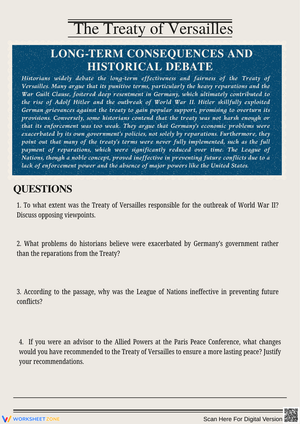
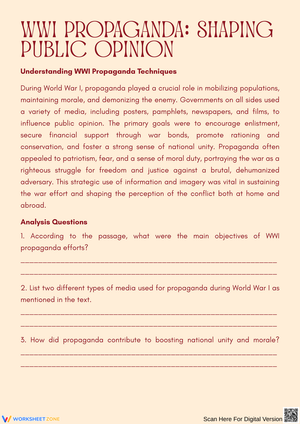
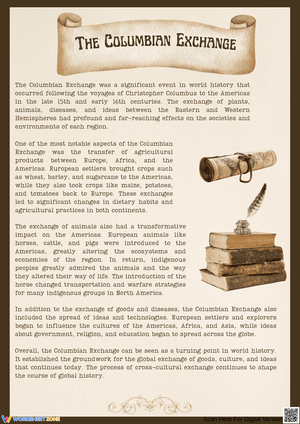
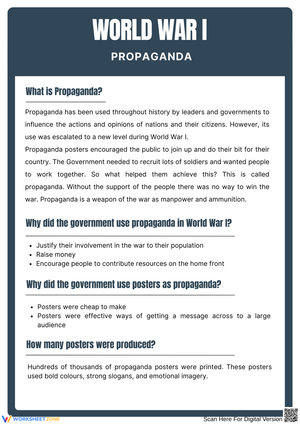
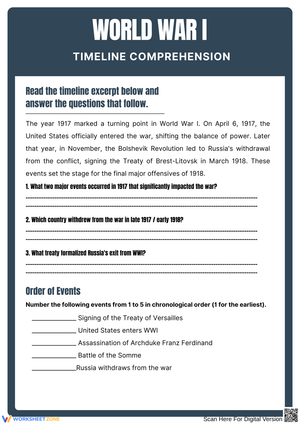
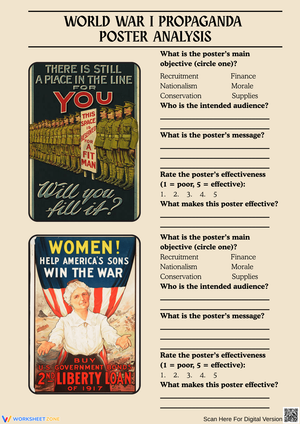
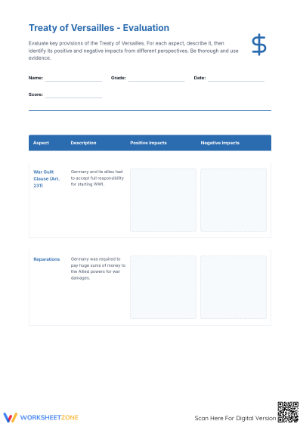
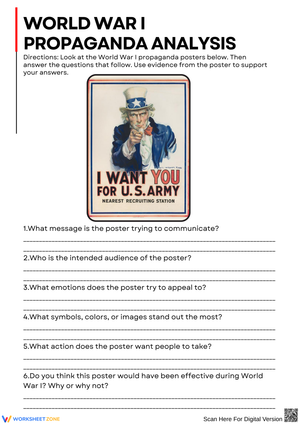
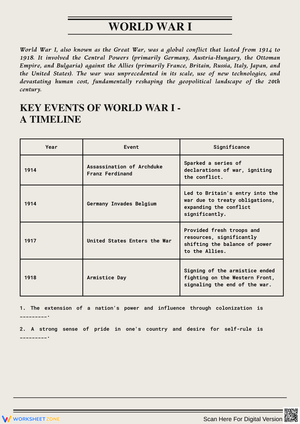
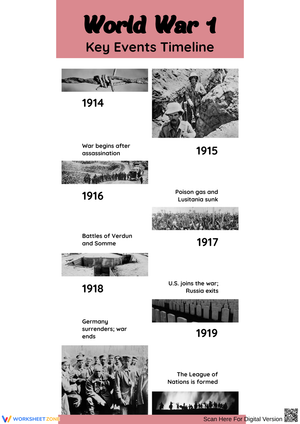
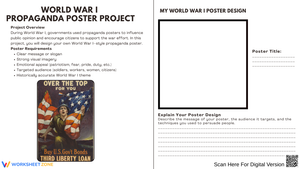
- World War I and World War II: Document-based question (DBQ) worksheets built around propaganda posters, treaty excerpts, and personal correspondence. Students practice sourcing and contextualizing before they build argument-level claims.
- Cold War: Political cartoon analysis worksheets, proxy war mapping activities, and comparison worksheets contrasting U.S. and Soviet foreign policy rhetoric across specific decades.
- Contemporary Global Developments: Short-text analysis worksheets connecting decolonization, globalization, and ongoing regional conflicts to their twentieth-century roots.
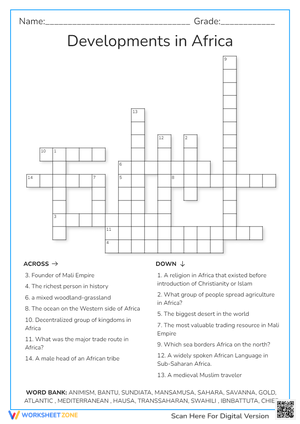
Vocabulary-building worksheets thread through every cluster. Terms like totalitarianism, mercantilism, and sovereignty appear not only in definition exercises but in sentence-level and example-level tasks — students have to work with the words, not just copy them.
Frequent Student Errors Worth Watching For
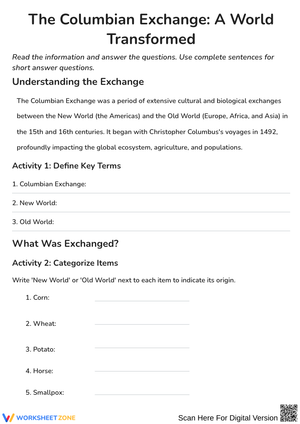
The most persistent error in DBQ work is document summary dressed up as argument. A student writes "Document 3 says workers faced dangerous conditions" and moves on, treating the quotation as the point rather than as evidence for a claim. The DBQ worksheets in this set interrupt that habit by requiring students to identify the author's purpose and intended audience before they write a word of analysis. That intermediate step separates the sourcing task from the argumentation task and breaks the summary loop before it becomes fixed.
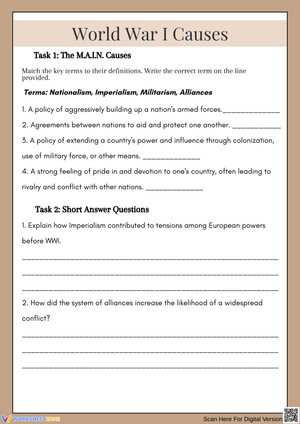
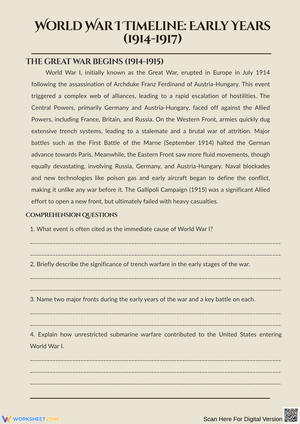
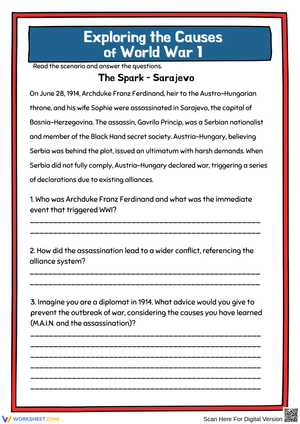
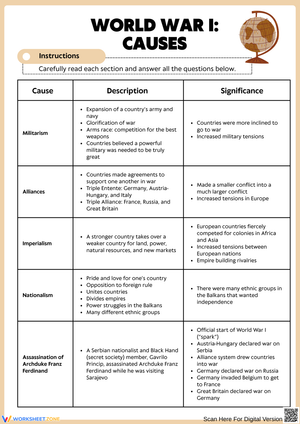
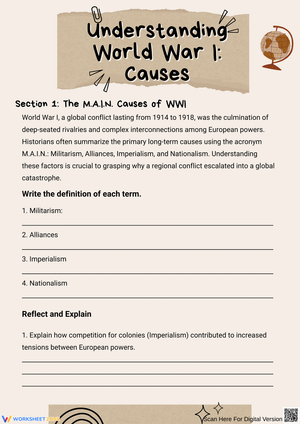
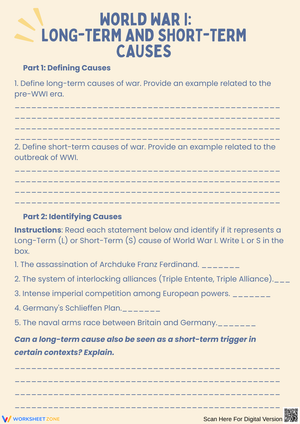
A second error shows up in causation work: students consistently prioritize triggers over underlying conditions. Asked to explain the outbreak of World War I, most tenth graders lead with the assassination of Franz Ferdinand and stop there. The cause-and-effect graphic organizer worksheets ask students to sort contributing factors into long-term structural causes, short-term precipitating events, and immediate triggers. That three-category structure makes it nearly impossible to let a single event carry the full explanatory weight.
Map worksheets expose a third pattern. Students often read imperial maps as if colonial borders were fixed and settled, not realizing that many boundaries on a standard "Partition of Africa" map were drawn at European conference tables with no relationship to existing political structures on the ground. Annotation tasks in this set ask students to distinguish between claimed, administered, and actively contested territory — a distinction that rarely appears in textbook coverage but matters directly for understanding twentieth-century independence movements across Africa and Asia.
Building These Worksheets Into Your Lesson Plans
The most effective classroom use for these worksheets is as the analytical center of a lesson block, not as finishing work. Assigning a primary source worksheet for the last ten minutes after a lecture produces shallow responses — students are managing time pressure, not thinking through evidence. Using the worksheet as the main event, with a brief direct-instruction frame before it, yields noticeably stronger written responses.
DBQ worksheets work well staged across two class periods. On day one, students work through the sourcing and contextualizing questions individually, then spend about ten minutes comparing observations with a partner. Day two opens with a short whole-class discussion of the strongest contextualizing points before students move into argumentative writing. This two-day sequence mirrors the staged thinking that AP World History graders reward, but it builds analytical habits that hold regardless of whether students sit for an AP exam.
One pairing strategy worth building into the Industrial Revolution unit: match an 1800s parliamentary report on child labor with a current news article on labor conditions in contemporary manufacturing supply chains. Students who find the nineteenth-century language impenetrable engage immediately with the modern parallel, and that engagement pulls them back into the historical document with a real reason to work through it. The historical worksheet becomes legible because the contemporary one established why it matters.
Standard Alignment
These worksheets align to the NCSS College, Career, and Civic Life (C3) Framework at the 9-12 band. The DBQ and primary source worksheets address D2.His.16.9-12, which asks students to integrate evidence from multiple historical sources and interpretations into a reasoned argument — each worksheet builds that skill by separating the sourcing, contextualizing, and claim-building steps rather than presenting them simultaneously. The cause-and-effect graphic organizer worksheets connect to D2.His.15.9-12, which specifically asks students to distinguish between long-term causes and triggering events when developing a historical argument. Teachers building toward the D4 communication standards will find the vocabulary and short-answer worksheets provide the precise language practice those expectations require.
The primary source methodology follows the approach developed by the Stanford History Education Group's Reading Like a Historian program, which treats historical thinking as four discrete moves: sourcing, contextualizing, corroborating, and close reading. Teachers familiar with that program will recognize the question structures in the primary source worksheets immediately.
Adjusting the Set for a Range of Learners
For students who need additional support with primary sources, the most effective adjustment is pre-annotating the document — underlining the most relevant sentences and adding marginal glosses for vocabulary like sovereignty or suffrage — before distributing the worksheet. This reduces the decoding burden without eliminating the analytical task. Students still source, contextualize, and build claims; they just aren't stopped cold by archaic sentence constructions that run across five subordinate clauses.
For advanced students, several worksheets include an extension question at the close that asks students to connect the historical scenario to a present-day equivalent and argue for or against historical continuity. There is no clean textbook answer to these questions, which means students cannot fake their way through with a summary — they have to take a position and defend it with evidence from both the worksheet and their own knowledge. Word banks support struggling students on vocabulary worksheets; sentence starters on the DBQ worksheets reduce blank-page paralysis on open-ended writing prompts without removing the analytical requirement. Students with IEP accommodations can work with a reduced document set — two sources instead of four — which maintains the corroboration skill while keeping the cognitive load manageable.
Frequently Asked Questions
What historical eras do these worksheets cover?
The set covers the modern era of world history — roughly the seventeenth century through the early twenty-first — organized around five content clusters: Enlightenment and democratic revolutions, the Industrial Revolution and imperialism, the world wars, the Cold War, and contemporary global developments. Teachers running a traditional full-year course will find worksheets that fit most major units without gaps.
Do these worksheets need to be used in a specific order?
No. Each worksheet addresses a standalone skill or content focus. A teacher running a semester-long focus on the twentieth century can use the World War I, World War II, and Cold War worksheets without touching the Enlightenment or Industrial Revolution materials. The modular format is deliberate.
How do these worksheets support DBQ preparation?
A downloadable 10th grade world history worksheets set in this format breaks DBQ practice into discrete steps — sourcing, contextualizing, identifying the author's purpose, then building toward a claim — rather than presenting students with a full multi-document prompt from the start. Teachers preparing students for the AP World History: Modern exam will find that progression familiar. For non-AP courses, the same step-by-step structure teaches historical thinking without the high-stakes framing, and the individual worksheets distribute well across a unit rather than functioning as a single summative task at the end.
Why does the PDF format matter for these resources?
PDF preserves map formatting, table layouts, and primary source text exactly as intended regardless of device or operating system. A map worksheet exported as a Word document will reflow and shift elements on different machines; the same worksheet saved as a 10th grade world history worksheets file prints identically every time. That consistency is especially important when students are annotating maps or working with side-by-side document comparisons where layout directly affects readability.












 Interactive Worksheet Maker
 Quiz Maker
 Word Search Maker
 Crossword Puzzle Maker
 Word Scramble Generator
 Sentence Scramble Generator
 Handwriting Worksheet Generator
 Name Tracing Generator
 Fill In The Blank Generator




 BACK TOSCHOOL