10th Grade D-Day worksheets: World History Resources
These 10th grade d day worksheets files hand teachers the maps, casualty data, and primary-source excerpts needed to walk sophomores through June 6, 1944, without reducing it to a list of beach names to memorize. The set covers the planning behind Operation Overlord, the five Normandy landing zones, and the firsthand accounts that make the invasion feel real to students who otherwise treat World War II as a chapter to get through.
What Students Work Through in the Set
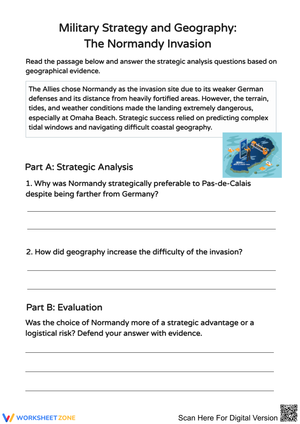
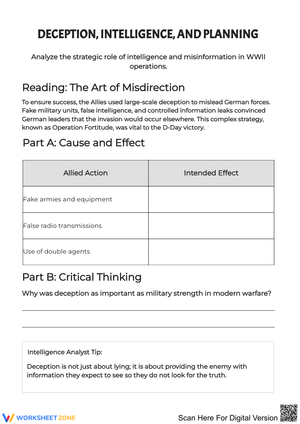
Each worksheet targets a different layer of the invasion rather than rehashing the same overview. Students trace the Allied armada's route across the English Channel, label Utah, Omaha, Gold, Juno, and Sword, and connect the geography of each beach to the casualty figures that followed. Other worksheets pull students into the deception side of the campaign — Operation Fortitude, the inflatable tanks and fake radio chatter that convinced German command the real blow would fall at Pas-de-Calais.
The document-analysis worksheets are where the thinking gets sharper. Students read Eisenhower's "Order of the Day," mark the verbs he chose, and explain how a commander writes to men he is about to send into fire. A separate worksheet asks them to weigh how the Higgins boats and the Mulberry harbors changed what was tactically possible against the concrete bunkers and beach obstacles of the Atlantic Wall. The questions push students past summary toward evaluation: not what happened, but why this technology mattered against that defense.
Where These Fit in a World History Unit
Most teachers slot the D-Day material into the back half of a WWII unit, after students already understand the European theater and the stakes of a second front. I use the map worksheet as a Monday opener — quiet, individual work that gets every student oriented before any discussion begins. The primary-source worksheets land better midweek, once students have enough context to argue about reliability and perspective.
A 10th grade d day worksheets works well as the backbone of a jigsaw. Split the class into five groups, assign each a beach, and have them become the resident experts on its terrain, the units that landed there, and the losses they took. Omaha groups always end up with the heaviest story, and that asymmetry is the point — when groups regroup to teach each other, the uneven casualty picture across the five sectors becomes obvious in a way no lecture delivers. From there the same data feeds a mock press conference, where students take roles as Allied commanders, war correspondents, and French civilians and have to defend positions using numbers they gathered themselves.
Misreadings and Gaps Worth Catching Early
Tenth graders carry a few predictable misconceptions into this topic. The most common is treating D-Day as the moment the war ended, when it was the start of an eleven-month campaign that ran through the liberation of Paris and into 1945. Students also flatten "the Allies" into "the Americans," ignoring the British and Canadian forces who took Gold, Juno, and Sword. The casualty worksheet helps here because the numbers force students to account for all five beaches, not just the two they have seen in films.
Another gap shows up around the French civilian experience. Students assume Normandy welcomed the invasion cleanly, and they are surprised to learn that Allied bombardment leveled historic towns and killed civilians. The worksheets drawn from museum educator resources give you a structured way to raise that without sensationalizing it. Finally, when students analyze Eisenhower's message, many read it as straightforward cheerleading and miss that he wrote — and pocketed — a separate note accepting blame for failure. Pointing them to that detail reshapes how they read the whole document.
Adjusting the Material for a Range of Learners
For students who freeze in front of a dense primary source, shorten the Eisenhower excerpt to its two strongest sentences and supply a word bank for the analysis questions. Readers who need more can take the full text plus the comparison task — lining up Eisenhower's public order against a soldier's journal entry from the same morning. The map worksheet differentiates naturally: a base version asks students to label the five beaches, while an extension asks them to explain why the element of surprise mattered more than a shorter crossing would have. A well-built 10th grade d day worksheets gives you these entry points without making the tiered versions look obviously different on a student's desk, which matters more in a tenth-grade room than people admit.
Standard Alignment
This material supports the Common Core literacy standards for history and social studies at grades 9–10, particularly RH.9-10.1, which asks students to cite specific textual evidence from primary and secondary sources, and RH.9-10.2, which calls for determining the central ideas of a source and summarizing how key events develop. The document-based questions on each worksheet are written to produce exactly that kind of evidence-cited response. RH.9-10.9, comparing how two sources treat the same event, maps directly onto the worksheet that sets Eisenhower's order beside a soldier's account. In classroom terms, these standards are why the worksheets ask students to quote and weigh sources rather than simply recall the date of the invasion.
Frequently Asked Questions
Why did the Allies choose Normandy over the shorter crossing at Pas-de-Calais?
German command expected the attack at Pas-de-Calais because it sat closest to England, and they fortified it accordingly. The Allies fed that assumption through Operation Fortitude. Normandy offered wide beaches suited to a mass landing, sat more lightly defended, and preserved the surprise the whole operation depended on.
How did weather nearly cancel the invasion?
The plan needed a full moon for the nighttime paratrooper drops and a low dawn tide to expose the beach obstacles. A storm rolled into the Channel in early June and forced Eisenhower to push the launch back twenty-four hours. A narrow break in the front let the operation go on June 6, though the seas were still rough enough to swamp landing craft and amphibious tanks.
What did the French Resistance contribute?
The Resistance supplied intelligence on German troop positions and coastal defenses, and in the hours before the landings they cut telephone lines, tore up rail track, and jammed communications. That sabotage slowed the German ability to rush reinforcements toward the beaches.
How should I handle the printing for the map and photo worksheets?
Print the maps and primary-source photographs at high contrast. Faint terrain lines and washed-out images defeat the analysis tasks, since students can't read a beach gradient or a defensive position they can barely see. A clean black-and-white copy usually serves the historical work better than a low-quality color print.
Clear All