10th Grade Treaty of Versailles printable worksheets
These 10th grade treaty of versailles printable worksheets resources give history teachers a focused set of standalone activities covering one of the most consequential diplomatic settlements of the modern era. The set moves from the competing visions at the Paris Peace Conference through the specific terms imposed on Germany, the redrawn map of Europe and the Middle East, and the Senate's rejection of the League of Nations. Each worksheet stands alone, so teachers can pull individual activities for bell ringers, document analysis sessions, or argument-writing practice without running the full set in sequence.
What Each Worksheet Targets
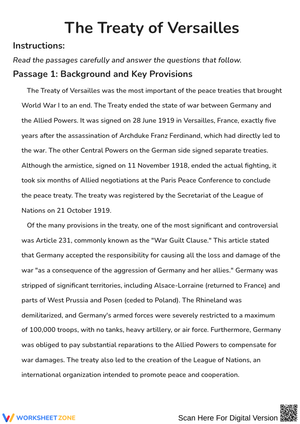
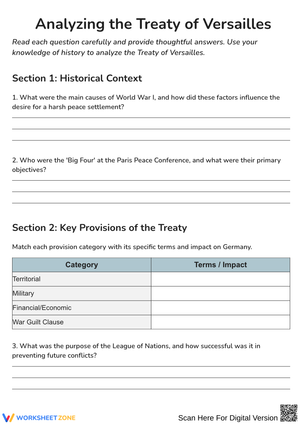
The core historical thinking skills here are document analysis, comparative argument, and geographic interpretation. Students work directly with primary source excerpts — Article 231 (the War Guilt Clause), sections of Wilson's Fourteen Points, reparations schedules — not classroom-simplified paraphrases. One worksheet asks students to annotate a passage from the treaty itself, marking each provision as territorial, military, financial, or organizational. Another presents the Fourteen Points alongside the actual treaty text and asks students to identify, clause by clause, where Wilson's proposals were accepted, modified, or rejected entirely.
The 10th grade treaty of versailles printable worksheets set also includes map-based exercises where students label the post-1919 borders of Europe, mark newly created nations like Czechoslovakia and Yugoslavia, and trace the Polish Corridor separating East Prussia from the rest of Germany. A separate worksheet works through the economic consequences of reparations, asking students to examine German inflation data from the early 1920s and connect it back to specific treaty provisions. Biographical profile worksheets on Wilson, Clemenceau, Lloyd George, and Orlando give students the context to argue which leader's vision most shaped the final document — and where each leader's goals were overruled.
Mistakes Students Make That These Worksheets Surface
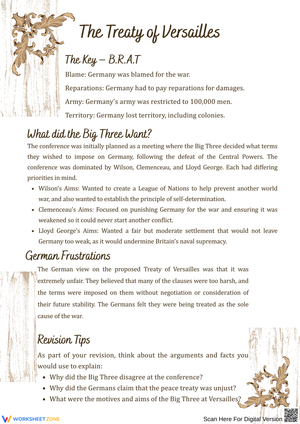
The most persistent error at this level is collapsing "the Allies" into a single unified actor. Students write sentences like "the Allies decided to punish Germany" without recognizing that Wilson spent much of the Paris negotiations pushing back against Clemenceau's demands for maximum reparations and long-term military dismemberment. Worksheets that ask students to assign specific treaty provisions to specific leaders — "which negotiator most wanted this clause, and why?" — break that habit by forcing students to treat the Big Four as individuals with contradictory national interests rather than a united front.
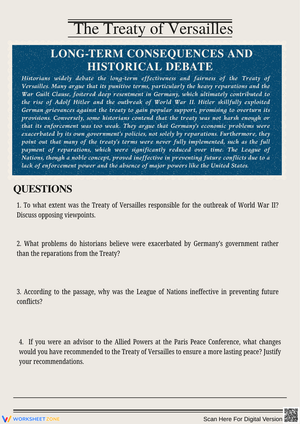
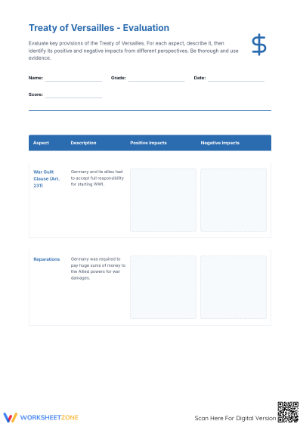
The War Guilt Clause generates a different problem. Many 10th graders read Article 231 and accept its language at face value, concluding that Germany really was solely responsible for the war. When asked to explain why the clause produced such fury among the German public, those students struggle — they cannot account for the outrage because they accepted the treaty's framing rather than seeing Article 231 as a legal instrument inserted specifically to justify reparations. Pairing the clause with a short excerpt from a German newspaper editorial printed in July 1919 reframes the exercise and gives students a reason to interrogate the document's purpose rather than its literal claims.
On the mapping worksheets, a subtler issue appears regularly: students imagine that ethnic and linguistic communities occupied clean, separate zones across Central Europe. That assumption makes it genuinely hard for them to explain why the post-Versailles borders generated immediate tension, because they drew the map as though the demographic picture was tidy and self-evident. Discussing the intermingled populations in Silesia or the Sudetenland before students complete the map exercise produces far sharper written responses.
Sequencing These Worksheets Through a Unit
The most productive entry point is the Fourteen Points comparison worksheet, run the day before students encounter the treaty text. That sequencing gives students a baseline expectation — what Wilson promised — so they experience the gap between intention and outcome the same way a contemporary observer might have. It takes roughly two class periods and works as a conceptual anchor for everything that follows. Students who complete this exercise first arrive at the document analysis with real questions already formed.
The 10th grade treaty of versailles printable worksheets activities built around economic consequence — the reparations schedules and inflation data — belong later in the unit, after students have processed the War Guilt Clause and understand why Germany was made financially liable. Using those worksheets too early, before the legal framework is established, produces a lot of "why does this number matter?" confusion. Save them for day three or four, when students have enough context to connect a figure on a chart to a specific political grievance that extremist movements later exploited.
The biographical profiles work well as 15-minute bell ringers across four class sessions — one leader per day — before the full document analysis begins. After students have built individual portraits of Wilson, Clemenceau, Lloyd George, and Orlando, a short silent negotiation exercise pays off: groups write their demands on a shared document and respond to other groups in writing rather than debating aloud. The written format slows the process down in a productive way, and students who shut down in verbal debate find a genuine entry point. Debriefing against the actual treaty outcomes shows students how close their group's compromise came to what happened in Paris in 1919.
Standard Alignment
These worksheets align with CCSS.ELA-LITERACY.RH.9-10.6, which asks students to compare the point of view of two or more authors on related topics — exactly what the Fourteen Points-versus-treaty comparison worksheet requires. They also address CCSS.ELA-LITERACY.RH.9-10.8, which covers assessing the reasoning and evidence behind an author's claims, a skill directly exercised when students examine why Article 231 was drafted and what legal work it was meant to accomplish. In most state pacing guides and College Board AP World History Modern frameworks, the Treaty of Versailles falls within the interwar period unit, typically placed in the second semester of a 10th-grade course after the causes and conduct of WWI have been covered.
Adjusting These Worksheets for a Range of Learners
Students who are still developing document-reading fluency do better starting with the biographical profile worksheets, which use shorter texts and structured prompts before asking for independent analysis. Moving those students to the Fourteen Points comparison after they have some familiarity with the historical actors gives them a framework to hang treaty language on. For students who freeze when handed a dense primary source without orientation, providing a brief summary of each article section before the annotation task gives them enough footing to engage analytically — they are still marking the text and making judgments, just with a clearer starting point.
Advanced students can take the reparations data worksheet further with an extended task: build a causal argument connecting specific treaty provisions to specific political developments in Germany between 1919 and 1933, accounting for intermediate steps rather than jumping directly from reparations to the Nazi rise. That kind of multi-step causal reasoning keeps strong historians genuinely engaged rather than processing familiar material on autopilot. The 10th grade treaty of versailles printable worksheets set carries enough variation in cognitive demand to serve both ends of a mixed class without requiring two entirely separate lesson plans.
Frequently Asked Questions
Is the treaty text excerpted or reproduced in full?
The worksheets use carefully selected excerpts — Article 231, the military restrictions in Articles 159–213, and relevant sections of Part I covering the League of Nations Covenant. Reproducing all 440 articles in a classroom setting is not practical, and targeted excerpts keep student attention on the provisions most directly tied to post-war instability and the political conditions that shaped the interwar period.
Do these worksheets work for both standard and honors 10th-grade courses?
Yes. The biographical profiles and annotation exercises suit standard-level students who are building primary source habits. The Fourteen Points comparison and reparations data worksheets demand more rigorous argument construction and are well matched to honors or pre-AP students who need more than identification tasks. A mixed-ability class can run both without either group sitting through work that is not a genuine stretch.
Can individual worksheets be used outside a full Treaty of Versailles unit?
The mapping worksheet stands on its own in a lesson focused on post-WWI borders. The League of Nations worksheet connects naturally to a broader unit on international organizations or 20th-century U.S. foreign policy. Most worksheets assume some familiarity with WWI causes and major powers, so dropping them into a course that has not covered that background tends to produce thin, context-free responses.
How long does each worksheet take in class?
Most run 20–35 minutes. The Fourteen Points comparison and the extended causal argument worksheet typically need closer to 40 minutes, especially when students write full paragraph responses rather than note-form answers. The biographical profiles hold up as bell-ringer tasks at around 15 minutes each and work particularly well during the days immediately before a primary source analysis session.
Clear All