These electronegativity printable worksheets for 10th grade put concrete, ready-to-use practice into teachers' hands: trend identification across periods and groups, Pauling-scale interpretation, bond classification by electronegativity difference, and the connection between partial charges and molecular polarity. Each worksheet targets a specific slice of the topic rather than trying to cover everything at once, which makes it easier to assign the right task at the right moment in a bonding unit.
Core Skills Each Worksheet Develops
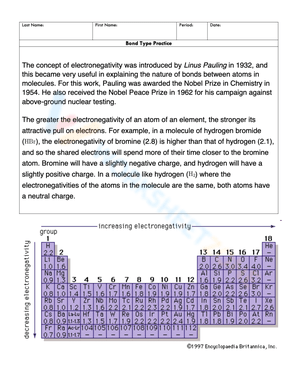
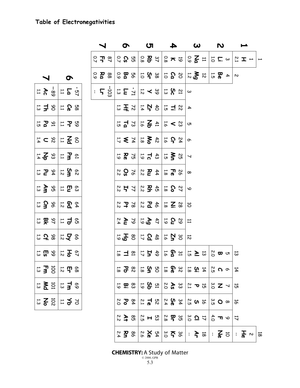
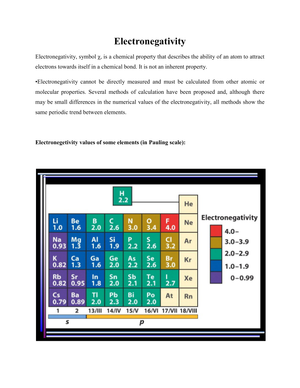
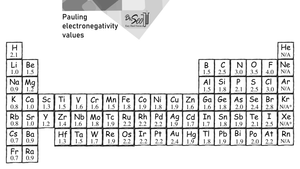
The set moves students through the central ideas in a deliberate sequence. Trend worksheets ask students to rank elements within a period or group, predict which atom in a given pair draws shared electrons more strongly, and explain the underlying reasoning in terms of effective nuclear charge and atomic radius. From there, students work with the Pauling scale directly — reading electronegativity values from a data table, comparing pairs, and filling in partially completed tables that require reasoning rather than simple lookup.
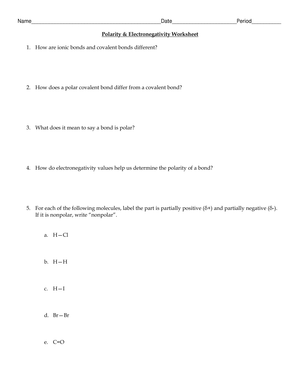
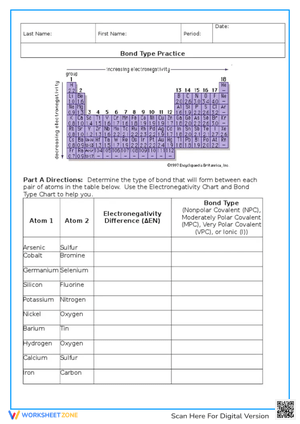
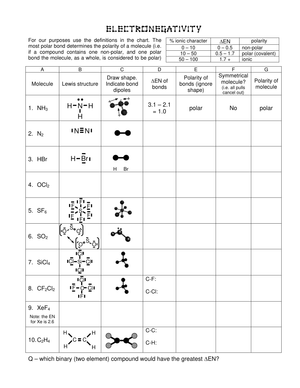
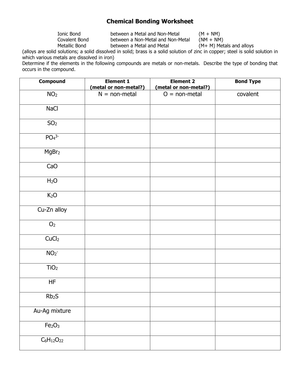
Bond classification worksheets have students subtract the lower electronegativity value from the higher for a series of element pairs and apply the standard thresholds: a difference less than 0.4 signals a nonpolar covalent bond, a difference between 0.4 and 1.7 signals polar covalent, and a difference greater than 1.7 signals ionic. That arithmetic is straightforward, but the reasoning students must supply — explaining why H–F is polar covalent while Na–Cl is ionic — is where real understanding becomes visible. A final set of activities extends into molecular polarity, asking students to consider both bond polarity and molecular geometry before assigning dipole arrows.
Frequent Student Errors Worth Catching Early
The most persistent error is treating electronegativity as synonymous with electron affinity. Both quantities describe an atom's pull on electrons, but electron affinity measures the energy change when a free atom in the gas phase gains an electron, while electronegativity describes that pull within an existing bond. Students who never fully separate these definitions will confidently answer electron affinity questions when they think they're addressing electronegativity — a confusion that surfaces on unit tests and leaves students baffled about why their answer was marked wrong.
A second common error involves the subtraction direction. Some students subtract the larger electronegativity value from the smaller, produce a negative number, and misclassify the bond. A brief reminder to always work with the absolute difference corrects this quickly. Also worth watching: students who apply trend direction correctly along a period but reverse it within a group, writing that electronegativity increases going down because "there are more electrons." The actual mechanism — increased electron shielding and a larger atomic radius reducing the nucleus's pull on bonding electrons — needs explicit reinforcement, not just the memorized rule.
How to Work These Worksheets Into a Bonding Unit
The trend identification worksheet fits well as guided practice the day after direct instruction on periodic trends. Pair students and give them a printed periodic table alongside the worksheet; the goal is to predict first, then verify — building the habit of checking reasoning against data. The bond classification worksheet works as a 15-to-20-minute formative check: six to eight element pairs, one answer per pair, submitted before the bell. Results tell you quickly whether the class needs another look at the 0.4 threshold or whether students are ready to move into polarity.
The molecular polarity worksheet belongs later in the unit, after students have encountered VSEPR or at least seen a few molecular geometry examples. Assigning it before students have mental images of bent versus linear molecules produces surface-level answers that won't hold up under questioning. One effective use of the electronegativity printable worksheets for 10th grade is to assign the trend and classification worksheets as Monday warm-up reviews after students have spent the weekend away from the material — spaced retrieval catches the gaps before they widen into genuine misunderstanding.
Standard Alignment
These worksheets support NGSS HS-PS1-1 and HS-PS1-2. HS-PS1-1 calls on students to use the periodic table as a model for predicting the properties of elements, including bond formation — the trend worksheets address this directly by requiring students to use table position as evidence. HS-PS1-2 focuses on constructing explanations for the properties of ionic, covalent, and metallic solids, which requires exactly the bond classification and polarity reasoning practiced here. Teachers working in states with NGSS-aligned frameworks will find these worksheets map cleanly onto the disciplinary core ideas for atomic and molecular structure at the high school level.
Adjusting the Worksheets for Different Readiness Levels
Students who struggle with the underlying periodic trends benefit from working through ranking tasks before they encounter numerical values at all. Have them sequence elements within a single period by trend direction — without looking up Pauling values — before introducing the scale. Once they can reliably predict direction, the numbers function as confirmation rather than starting point. For these students, the bond classification worksheet works best as a structured exercise where electronegativity values are pre-filled and the task narrows to calculating differences and labeling bond types.
Advanced students who finish the classification tasks quickly can dig into why the 0.4 and 1.7 cutoffs are conventions rather than hard chemical laws — some bonds near 1.7 display genuine mixed ionic-covalent character, and that nuance is worth a class discussion. You can also direct them to extend any of the electronegativity printable worksheets for 10th grade in the set by writing a brief justification for each bond classification in terms of electron distribution, rather than simply labeling the bond type. That extra layer converts a practice task into an explanation task and raises the cognitive demand without requiring a different worksheet entirely.
Frequently Asked Questions
How do students classify bonds using electronegativity differences?
Students subtract the smaller electronegativity value from the larger for a bonded pair, then apply the standard thresholds. A difference less than 0.4 indicates a nonpolar covalent bond, a difference from 0.4 to 1.7 indicates polar covalent, and a difference greater than 1.7 indicates ionic. The worksheets walk students through this process with a worked example before asking them to apply it independently to additional pairs.
What is the difference between electronegativity and electron affinity, and why does it matter here?
Electron affinity is a measurable energy value — the energy change when an isolated neutral atom gains one electron. Electronegativity is a relative, dimensionless index describing how strongly a bonded atom pulls shared electrons toward itself. Students who blur these two concepts often give correct-sounding answers to the wrong question on assessments. The set includes a comparison section early on so teachers can address this distinction before it calcifies into a persistent misconception.
Can these worksheets be used without a printed periodic table?
Most worksheets include a partial data table with the electronegativity values students need for that specific task, so a full periodic table isn't required for every problem. The trend identification worksheets are built around the table's structure, however, so having a printed table available — or a classroom wall chart — improves the experience considerably. Teachers using the electronegativity printable worksheets for 10th grade in a setting without easy table access can pre-annotate the included data table before distributing.
At what point in a bonding unit should these worksheets appear?
Trend and definition worksheets belong early — within the first two class periods on periodic trends. Bond classification worksheets follow once students have seen the Pauling scale and practiced reading it. The molecular polarity extension fits after VSEPR has been introduced. Assigning all the worksheets in a single sitting flattens the conceptual progression; spreading them across the unit keeps each task matched to what students have actually been taught.












 Interactive Worksheet Maker
 Quiz Maker
 Word Search Maker
 Crossword Puzzle Maker
 Word Scramble Generator
 Sentence Scramble Generator
 Handwriting Worksheet Generator
 Name Tracing Generator
 Fill In The Blank Generator