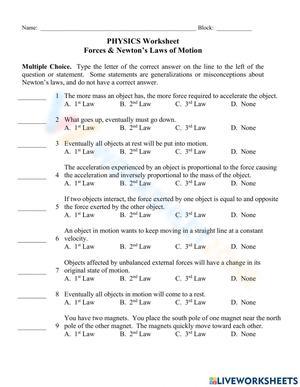
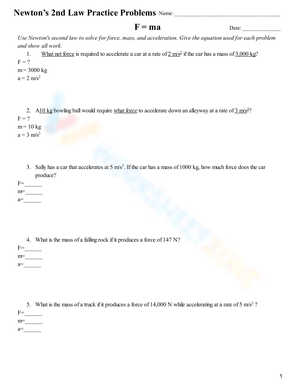
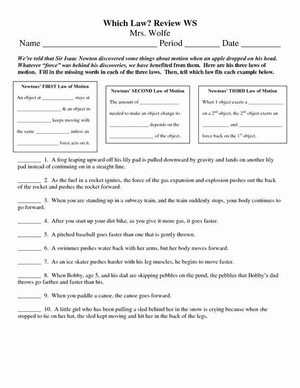
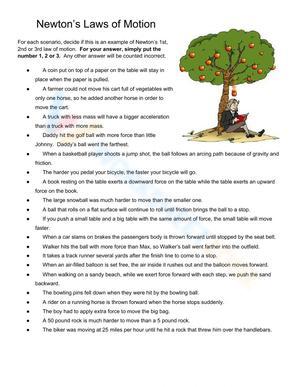
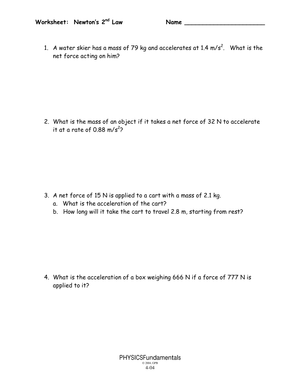
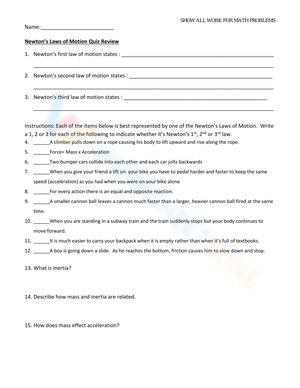
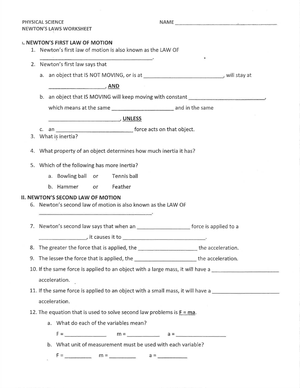
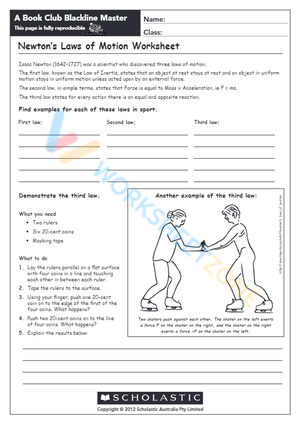
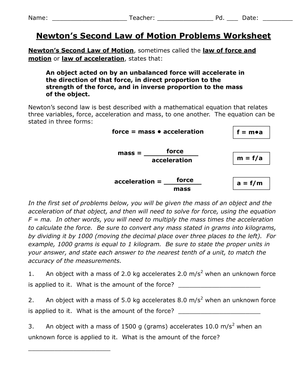
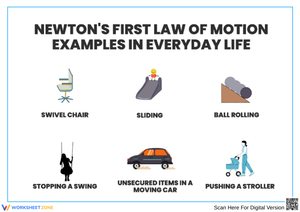
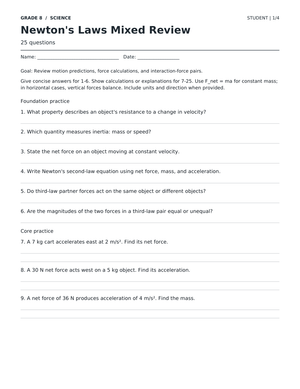
These newtons laws worksheets for 10th grade close the gap between students who can recite F = ma and students who can actually apply it when friction is present, direction matters, and the problem doesn't name which variable to solve for. Each worksheet targets a specific section of the unit — inertia and equilibrium, net force and acceleration, action-reaction pairs, and free-body diagram construction — so teachers can place them precisely where student understanding needs reinforcement.
What the Set Covers
The worksheets cover all three laws with enough variety in problem type to prevent the mechanical pattern-matching that gets students through a quiz but leaves them unable to explain what their answer means. Across the set, students:
- Underline all forces acting in a written scenario before setting up any calculation
- Draw and label free-body diagrams for physical situations ranging from a textbook at rest on a desk to a car decelerating on a wet road
- Rearrange F = ma to isolate mass, force, or acceleration depending on what the problem provides
- Name both objects in every action-reaction pair — not just restate the third law in general terms
Equilibrium problems appear in both static and dynamic contexts, so students learn to recognize that zero net force does not mean the object is not moving. That distinction shows up on every major force-and-motion assessment and is reliably missed when practice only ever shows objects sitting still.
Where Students Get Stuck: Error Patterns Across All Three Laws
The Third Law misconception is persistent. Students who can correctly recite "equal and opposite" will still draw both action and reaction arrows on the same free-body diagram — which makes the diagram useless and the downstream algebra wrong. The worksheets address this by requiring students to explicitly name Object A and Object B before drawing any arrows. That naming step surfaces the error in a way that rereading the law never does.
The Second Law brings a different problem: students treat mass and weight as interchangeable. A student who plugs 500 g directly into F = ma gets an answer 1,000 times smaller than the correct value — and because the resulting decimal often looks plausible, many students don't catch it until the paper comes back graded. Several problems in the set give measurements in grams specifically so students have to make the conversion deliberately. The First Law problems reveal a subtler confusion: students describe inertia as "the force keeping an object moving." Seeing that phrase in student writing is a reliable indicator that they haven't yet separated inertia as a property of matter from force as an interaction between objects. No amount of calculation practice fixes that gap — it needs direct conceptual attention first.
Free-Body Diagrams and the Vector Direction Problem
FBDs are worth extended practice time at this stage because every force problem in 10th grade and beyond — inclined planes, two-body systems, circular motion — depends on the diagram being correct before any algebra starts. Each worksheet that includes FBD work asks students to list all forces present before drawing, using a consistent labeling convention: Fg for gravity, FN for normal force, Ff for friction, FT for tension. Students who skip the listing step and draw from memory consistently omit friction on inclined surfaces or draw the normal force pointing straight up rather than perpendicular to the surface.
Vector direction causes arithmetic errors that look like algebra errors. Students adding a 40 N forward push and a 15 N opposing friction force will sometimes add the magnitudes to get 55 N rather than subtracting. Several worksheets use a signed-number convention — positive values for rightward and upward forces, negative for leftward and downward — so students assign direction before doing any arithmetic. That habit transfers directly to the more demanding problems that appear in unit exams.
Building These Worksheets Into Your Unit Plan
The most effective placement for these resources is immediately after a demonstration or brief simulation, not before. Running a low-friction cart demonstration first — or giving students 8–10 minutes with a PhET forces simulation — builds a physical anchor. The worksheet then formalizes what they observed rather than introducing abstract relationships from scratch. Using the worksheet cold, before any concrete experience with the phenomena, tends to produce rote algebra disconnected from physical meaning.
The newtons laws worksheets for 10th grade fit well into a standard 45-minute period when the opening 10–12 minutes go to a short demonstration and class discussion, and the remaining time is independent or paired work. For the Third Law worksheet specifically, small-group round-robin practice is worth trying: one student identifies Object A, a partner identifies Object B and states what force each exerts on the other, and a third student checks the FBD arrows. That structure forces all three cognitive moves to happen explicitly, which is harder to shortcut than solo work.
Standard Alignment
NGSS HS-PS2-1 is the primary standard these worksheets address. It requires students to use mathematical representations to support claims about the relationship between net force, mass, and acceleration for a macroscopic object. That standard typically lands in 10th grade because it assumes students can already manipulate algebraic equations — skills that arrive in 9th grade math — and now need to apply that algebra in a scientific context. The worksheets satisfy the Practices component of HS-PS2-1 by requiring students to write units at every step and confirm dimensional consistency, which produces exactly the kind of mathematical evidence a unit portfolio or lab notebook check asks for. The action-reaction identification exercises also support HS-PS2-3, which specifically addresses Newton's Third Law for macroscopic collisions and interactions.
Adapting the Set for Students at Different Entry Points
For students who haven't consolidated unit conversion from 9th grade, a reference card listing gram-to-kilogram and centimeters-per-second-squared-to-meters-per-second-squared conversions keeps the lesson focused on force-and-motion reasoning rather than arithmetic derailment. Unit conversion has its own place in the curriculum; during a Newton's Laws unit, it shouldn't be the obstacle that prevents students from reaching the actual physics.
Students who work through the core problems quickly benefit from a variable-swap extension. Given a scenario where a 12 kg box accelerates at 3 m/s² under an applied force with 8 N of friction, ask them what happens to acceleration if friction increases by 25%. That question requires treating the equation as a relational system rather than a plug-and-chug procedure — a meaningfully harder cognitive task. On the other end, students who freeze when a problem introduces two forces in opposite directions usually need one concrete first step made explicit: write the sign convention at the top, then list each force with its sign before touching the algebra. The newtons laws worksheets for 10th grade work well when teachers annotate selected problem directions with that explicit first step for students who need a more structured entry into the problem before working independently.
Frequently Asked Questions
Do these worksheets include problems where multiple forces act in the same or opposite directions?
Net force calculation — combining two or more forces with direction — is a core part of the set. Students must determine the vector sum of all forces acting on an object before applying F = ma. Problems range across forces pointing in the same direction, forces opposing each other, and situations where friction or air resistance acts against an applied force, so students practice the full combination scenarios they will see on a unit assessment.
How do these worksheets connect to lab work?
The most productive sequence is lab or demonstration first, worksheet second, formal assessment third. After students run a force-sensor lab measuring how acceleration changes as mass increases while force stays constant, they use a worksheet to apply that relationship to scenarios they haven't physically tested. That transfer from specific lab conditions to novel written problems is what assessments actually measure — the worksheet is the practice space between the two.
My 10th graders saw F = ma in 9th grade. Will this feel like review?
Students who can recite F = ma often can't correctly apply it when friction is present, when the problem gives weight instead of mass, or when three forces act in different directions. The newtons laws worksheets for 10th grade are organized so that the first two or three problems in each set are accessible, and the later problems require multi-step reasoning. Students who breeze through the opening problems almost always slow down when the problem introduces an unlabeled direction or asks them to isolate a variable they haven't recently solved for.
What if students get the math right but can't explain what the answer means?
Several worksheets include a brief written component after the calculation — not a paragraph response, just a single sentence completion: "The acceleration changes because ___." That prompt catches students who are executing procedures without conceptual understanding. A student who writes the correct number but completes the sentence with "because the force is bigger" reveals that the reasoning isn't there yet, even though the arithmetic worked out. That information guides the next instructional move more reliably than a score alone.












 Interactive Worksheet Maker
 Quiz Maker
 Word Search Maker
 Crossword Puzzle Maker
 Word Scramble Generator
 Sentence Scramble Generator
 Handwriting Worksheet Generator
 Name Tracing Generator
 Fill In The Blank Generator