


























1 / 3
0
Views
0
Downloads

0.0
0
Save
0 Likes
Share
Polarity and Electronegativity in Chemical Bonds
0 Views
0 Downloads
Paste this activity's link or code into your existing LMS (Google Classroom, Canvas, Teams, Schoology, Moodle, etc.).
Students can open and work on the activity right away, with no student login required.
You'll still be able to track student progress and results from your teacher account.
Information
Description
What It Is:
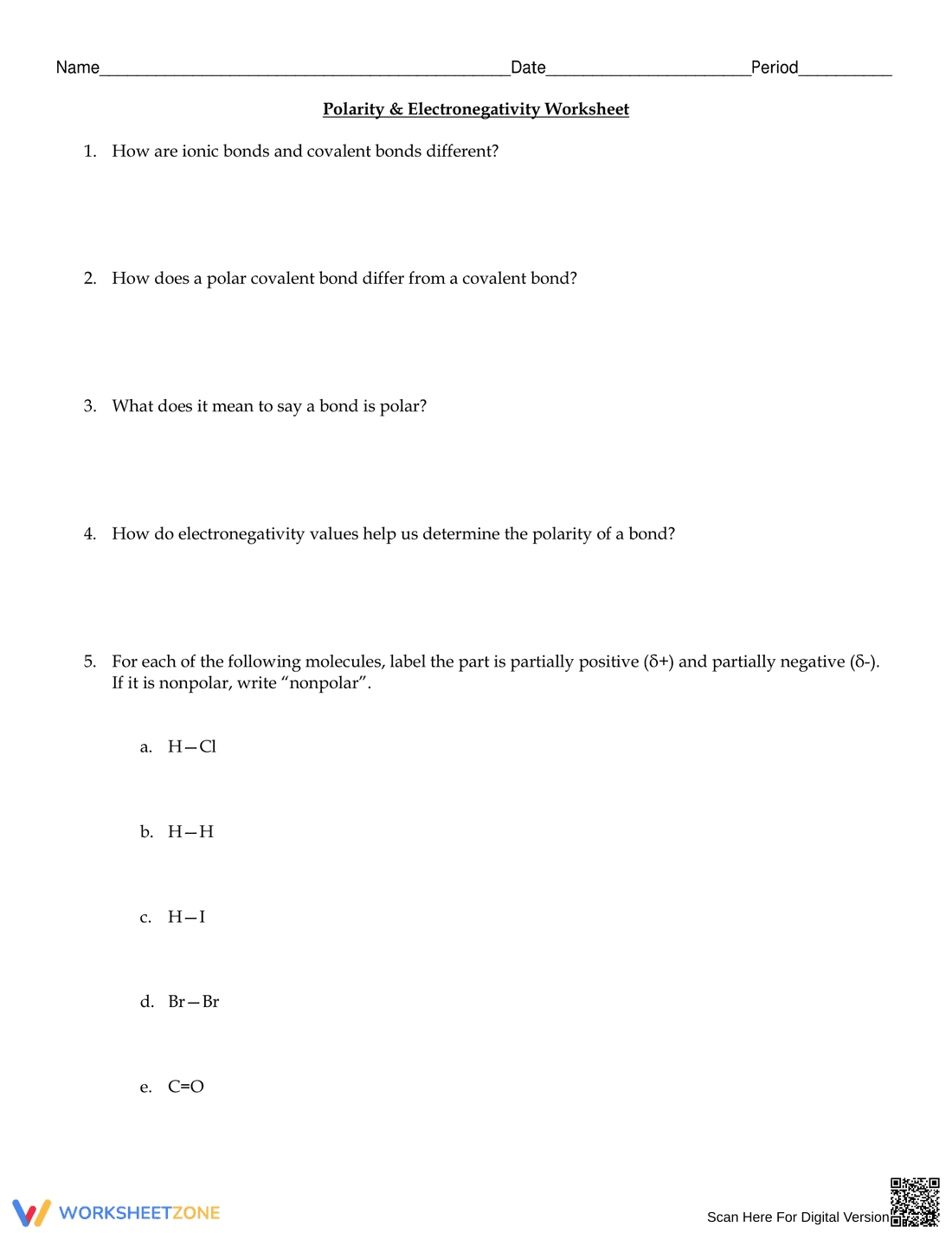
This is a 'Polarity & Electronegativity Worksheet' containing five questions. The first four questions are open-ended, asking about the differences between ionic and covalent bonds, polar and nonpolar covalent bonds, the meaning of a polar bond, and how electronegativity helps determine bond polarity. The fifth question requires students to label molecules (H-Cl, H-H, H-I, Br-Br, and C=O) as partially positive, partially negative, or nonpolar.
Grade Level Suitability:
This worksheet is suitable for high school chemistry students (Grades 9-12). The concepts of polarity, electronegativity, and bond types are typically introduced in high school chemistry courses. The questions require an understanding of chemical bonding principles.
Why Use It:
This worksheet helps students solidify their understanding of chemical bonding, electronegativity, and polarity. It encourages critical thinking by requiring students to compare and contrast different types of bonds and apply their knowledge to predict the polarity of molecules. It reinforces the relationship between electronegativity and bond polarity.
How to Use It:
Students should first review the concepts of ionic and covalent bonds, electronegativity, and polarity. They can then answer the open-ended questions based on their understanding. For the fifth question, students should use electronegativity values to determine the partial charges on each atom in the molecule or identify if the molecule is nonpolar.
Target Users:
This worksheet is intended for high school chemistry students, chemistry teachers, and homeschool educators teaching chemistry concepts. It can be used as a classwork assignment, homework assignment, or review activity.
This is a 'Polarity & Electronegativity Worksheet' containing five questions. The first four questions are open-ended, asking about the differences between ionic and covalent bonds, polar and nonpolar covalent bonds, the meaning of a polar bond, and how electronegativity helps determine bond polarity. The fifth question requires students to label molecules (H-Cl, H-H, H-I, Br-Br, and C=O) as partially positive, partially negative, or nonpolar.
Grade Level Suitability:
This worksheet is suitable for high school chemistry students (Grades 9-12). The concepts of polarity, electronegativity, and bond types are typically introduced in high school chemistry courses. The questions require an understanding of chemical bonding principles.
Why Use It:
This worksheet helps students solidify their understanding of chemical bonding, electronegativity, and polarity. It encourages critical thinking by requiring students to compare and contrast different types of bonds and apply their knowledge to predict the polarity of molecules. It reinforces the relationship between electronegativity and bond polarity.
How to Use It:
Students should first review the concepts of ionic and covalent bonds, electronegativity, and polarity. They can then answer the open-ended questions based on their understanding. For the fifth question, students should use electronegativity values to determine the partial charges on each atom in the molecule or identify if the molecule is nonpolar.
Target Users:
This worksheet is intended for high school chemistry students, chemistry teachers, and homeschool educators teaching chemistry concepts. It can be used as a classwork assignment, homework assignment, or review activity.


