These 10th grade forces motion and machines printable worksheets give physics teachers a ready set of targeted resources covering Newton's laws, kinematics, simple machines, and work-energy relationships—the content most high school physics courses pack into the first full mechanics unit. Each worksheet isolates a specific skill or concept, which means teachers can pull exactly what the class needs on a given day without sorting through unrelated problems.
Concepts and Skills Across the Set
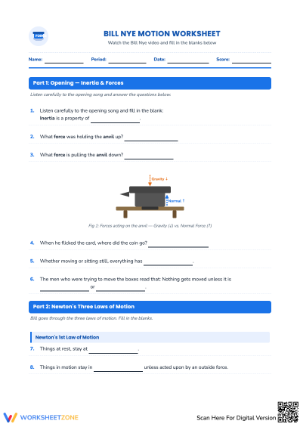
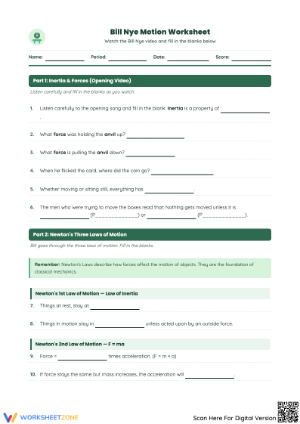
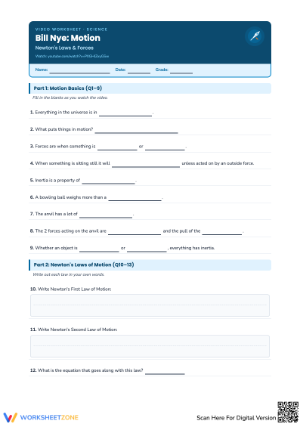
The worksheets address Newton's three laws individually before combining them. The first-law worksheet presents scenarios—a hockey puck continuing across ice, a book sliding off a braking car's back seat—and asks students to identify the forces acting and explain why motion changes or does not. The second-law worksheet moves into F=ma calculations that include friction as a separate force, requiring students to resolve net force before applying the formula. Third-law worksheets focus exclusively on identifying action-reaction pairs, which sounds straightforward until students have to name the specific object each force acts on in a rocket launch or a swimmer pushing off a wall.
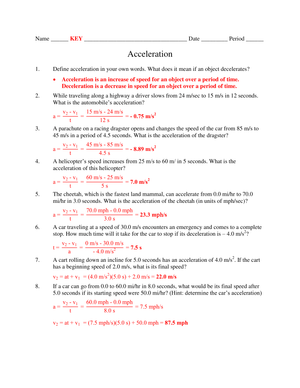
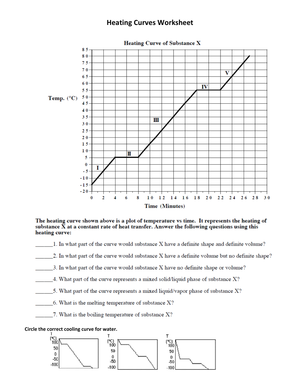
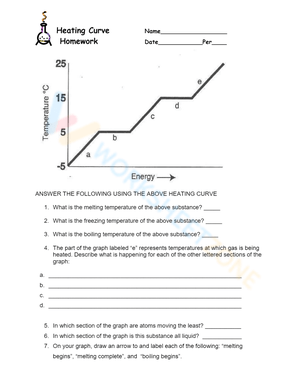
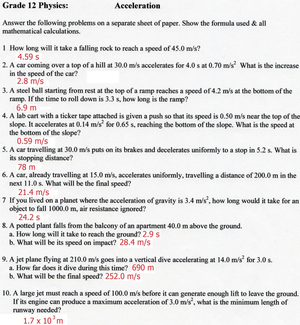
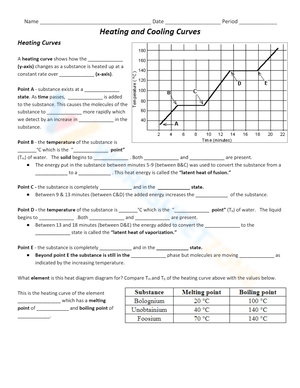
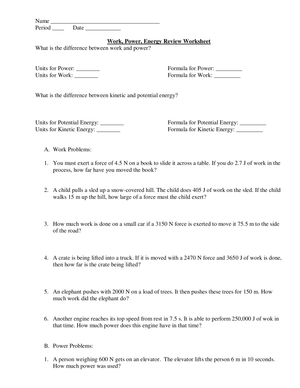
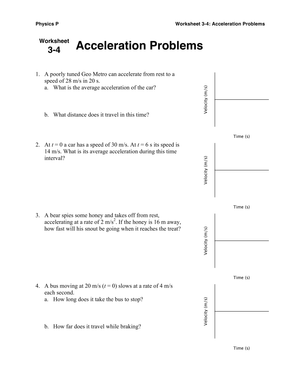
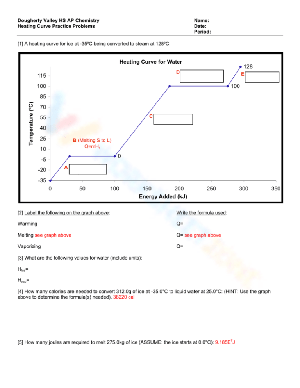
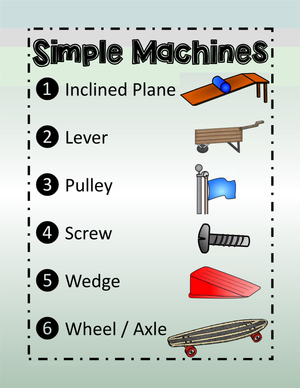
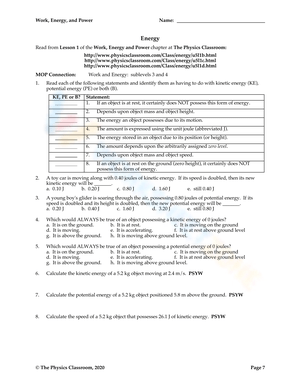
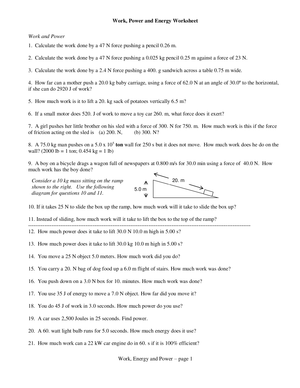
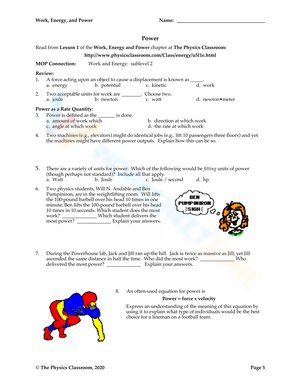
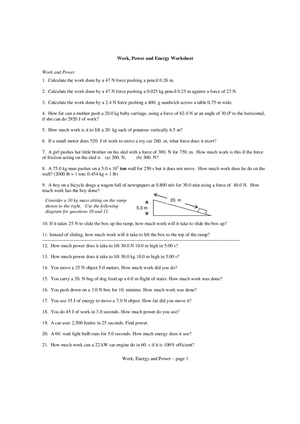
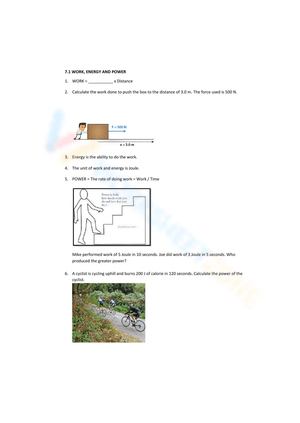
Kinematics worksheets center on graph interpretation: reading slope from a position-time graph as velocity, extracting acceleration from the slope of a velocity-time line, and calculating displacement from the area under the curve. The machines section covers levers, pulleys, and inclined planes—students calculate Ideal Mechanical Advantage from geometry, Actual Mechanical Advantage from force ratios, and then efficiency by comparing the two. Work, power, and energy worksheets round out the set with problems requiring students to distinguish scientific work from its everyday meaning. Holding a crate stationary does no work in a physics calculation regardless of the physical effort involved, and students need repeated exposure to that distinction before it sticks.
Errors Worth Anticipating Before You Hand These Out
Newton's third law produces the most reliable misconception in this unit. Students read "equal and opposite" and conclude that the two forces cancel, producing zero net force. They assign both the action and the reaction to the same object. The labeling tasks in these worksheets surface that confusion directly: students must write both the force and the object it acts on, which forces them to confront the fact that a person pushing a wall and the wall pushing back involve two separate objects—not one system in equilibrium.
Mass-weight conflation is the second consistent problem. Students import 9.8 m/s² into F=ma even when gravity has no role in the problem. A student solving for the acceleration produced by a horizontal 40 N push on a 5 kg cart will often write 40 = 5 × 9.8, pulling in gravitational acceleration by habit. These worksheets include several horizontal-force problems specifically to interrupt that pattern before it becomes automatic.
In the machines section, students frequently calculate AMA higher than IMA, sense something is wrong, and then reverse their formula to make the numbers agree—rather than identifying which force value they inverted. The efficiency worksheets include a brief self-check note: in a real machine, AMA is always less than or equal to IMA because friction always costs energy. That reminder stops the algebraic scramble that otherwise consumes half a class period before the actual error gets identified.
How to Fit These Worksheets Into Your Instructional Week
Free-body diagram worksheets work well as five-minute openers during the Newton's laws segment. Run one every morning for four days in a row. By day three, you will have a clear picture of which students are still placing the normal force in the wrong direction on inclined surfaces—that error does not appear on a test, it appears on a warm-up, which gives you time to correct it before the unit assessment arrives. Collect the papers on day four and scan specifically for the inclined-plane problems; that is where mistakes cluster most reliably.
For simple machines, a station rotation pairs well with the machines worksheets. Set up a ramp with a spring scale, a block-and-tackle pulley with masses, and a first-class lever with washers—one station each. Students record their own measured force values and then complete the worksheet calculations using real data. When AMA calculated from their spring scale readings comes out lower than IMA calculated from the geometry, they encounter friction as a measurable discrepancy rather than a textbook footnote. That moment of "mine doesn't match the formula" carries more instructional weight than any worked example on a slide.
Kinematics graph worksheets work best as spaced retrieval rather than immediate follow-up to instruction. Assign them two or three days after the motion-graph lesson rather than the same afternoon. Students who return to graph interpretation on day three of the unit retain the slope-as-velocity relationship more reliably than students who complete a worksheet within an hour of first seeing the concept.
Standard Alignment
The 10th grade forces motion and machines printable worksheets in this set align to NGSS HS-PS2-1, which requires students to analyze data supporting the claim that Newton's second law describes the mathematical relationship between net force, mass, and acceleration. The free-body diagram and net force calculation worksheets map directly to that standard's mathematical and computational thinking practice. HS-PS2-3 covers applying scientific principles to minimize or maximize force and energy in engineered systems—its instructional home in this set is the simple machines and mechanical advantage content. The work-power-efficiency worksheets connect to HS-PS3-3, which involves designing devices that convert energy under real-world constraints. In a standard semester-long physics course, this cluster of standards typically falls in the second quarter, after motion description and before wave and energy transfer topics.
Differentiating Across Ability Levels in the Same Class
The 10th grade forces motion and machines printable worksheets span a natural difficulty range—from conceptual identification tasks at one end to multi-step calculation problems at the other—and that split simplifies differentiation considerably. Students who are still working through algebra can start with the force-identification and free-body diagram worksheets, which require no arithmetic. They draw vectors, label force types, and classify motion states. That work builds the physics framework before the formulas arrive and gives struggling learners a meaningful entry point rather than an exercise they cannot start.
Students who are comfortable with F=ma and ready for a greater challenge should work through the inclined-plane problems with friction and the compound-machine efficiency calculations. Those problems require resolving forces into components, applying multiple formulas in sequence, and interpreting numerical results physically—skills that appear on AP Physics 1 and on standardized physics assessments. Pairing those worksheets with a brief written explanation task—"describe why your AMA is lower than your IMA using conservation of energy reasoning"—adds a disciplinary literacy demand without pushing content beyond the unit boundaries.
For English language learners and students with heavier reading demands, the word problems in the machines and work-energy worksheets benefit from a simple three-step organizer provided alongside: identify the knowns, identify the unknown, select the formula. Providing that structure as a separate slip—rather than rewriting the worksheet itself—keeps the cognitive load on the physics content rather than on parsing dense problem text.
Frequently Asked Questions
Can these worksheets support a course that introduces forces before kinematics?
Yes. Because each worksheet is a standalone resource, teachers are not locked into a fixed teaching sequence. The Newton's laws, free-body diagram, and machines worksheets have no dependency on the kinematics content and can be assigned in any order relative to motion graphs. The one sequencing note worth observing: the work and power worksheets assume students already understand velocity and displacement as quantities, so those work better after kinematics than before it.
Do the machine worksheets require physical equipment to be useful?
No. Every worksheet provides the input and output force values and the relevant distances, so students can complete all calculations from the given data alone. That said, the calculations are more meaningful after at least one hands-on demonstration. Students who have used a spring scale to measure actual effort force on a pulley—and seen that their AMA falls short of the IMA calculated from the geometry—approach the worksheet problems with a more grounded sense of what the numbers represent.
How do these worksheets treat the IMA versus AMA distinction?
Both values are calculated separately throughout the machines worksheets. Students derive IMA from the geometric properties of each machine—the length-to-height ratio for an inclined plane, the number of supporting rope segments for a pulley, the lever arm ratio for a lever. AMA comes from the ratio of resistance force to effort force. Efficiency follows from comparing the two. That structure is deliberate: collapsing IMA and AMA into a single "mechanical advantage" value, as some textbooks do, hides the friction effect and makes efficiency an abstract percentage rather than a traceable energy loss. Separating the two calculations makes the physics visible in the numbers.
Are these appropriate for an integrated science course, or only for a dedicated physics class?
Both settings work, with some selection. The conceptual worksheets—force identification, Newton's first and third law labeling tasks, and basic IMA calculations—fit a 10th grade integrated science mechanics unit without adjustment. The more demanding worksheets—multi-force inclined plane problems with friction components, compound machine efficiency, and full kinematics graph analysis requiring both slope and area calculations—are better matched to a dedicated physics course. Teachers in integrated settings typically use 10th grade forces motion and machines printable worksheets from the conceptual end of the set and treat the heavier calculation problems as extension work rather than core instruction.












 Interactive Worksheet Maker
 Quiz Maker
 Word Search Maker
 Crossword Puzzle Maker
 Word Scramble Generator
 Sentence Scramble Generator
 Handwriting Worksheet Generator
 Name Tracing Generator
 Fill In The Blank Generator