10th Grade Momentum and Impulse worksheets
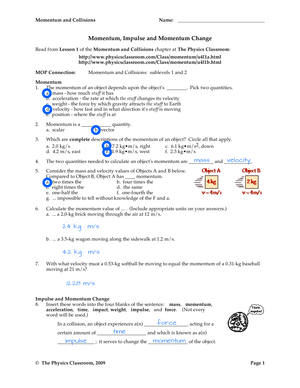
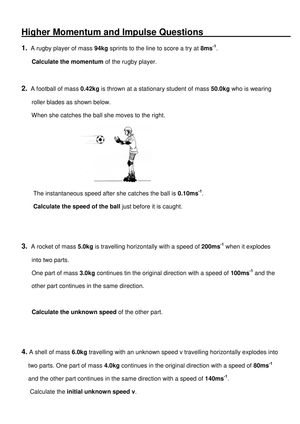
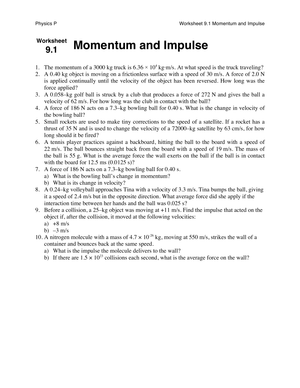
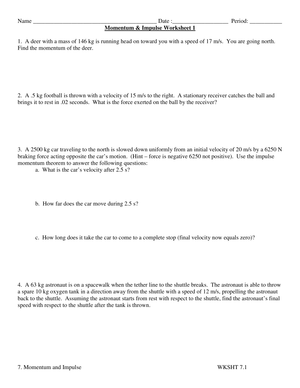
These 10th grade momentum and impulse worksheets give physics teachers a set of standalone practice resources built around p = mv calculations, the Impulse-Momentum Theorem, conservation of momentum in collisions, and force-time graph interpretation. Grade 10 is often the first time students work with momentum as a signed vector quantity — not as a vocabulary term, but as something they have to track with correct units and direction through multi-step problems. The set spans single-concept exercises and multi-variable word problems, including automotive safety scenarios and sports applications where the physics is immediately visible.
What Students Practice Across the Set
The worksheets build from the ground up. Early exercises focus on applying p = mv correctly — identifying mass in kilograms, velocity in meters per second, and recognizing that kg·m/s and N·s are equivalent units. That equivalence trips students up more than teachers expect: when the p = mv worksheets use kg·m/s and the impulse formula introduces Newtons, students treat impulse and momentum as dimensionally different quantities unless the connection is made explicit early.
From there, each worksheet advances into the Impulse-Momentum Theorem, with problems that ask students to calculate the force required to stop a moving object in a given time interval or determine the velocity change produced by a known force. Applied problems draw from car crashes, sports collisions, and padding materials — contexts that anchor the algebra to something students can picture. One worksheet addresses elastic versus inelastic collisions, asking students to apply conservation of momentum equations to solve for unknown post-collision velocities. Another requires students to calculate impulse from a force-time graph by finding the area under the curve — a graphing task that connects directly to the kind of data analysis work students encounter in AP Physics the following year.
The set also includes a conceptual worksheet that asks students to compare inertia and momentum in written responses, without numbers. It's a deliberately low-calculation task that surfaces persistent language confusion: students who can solve the equations correctly still describe momentum as "just inertia when something is moving," which indicates incomplete understanding worth addressing before the unit exam.
Student Errors That Surface Consistently in This Unit
Sign convention errors are the most predictable failure point in this unit. Students learn early that velocity is a vector and assign positive and negative values with confidence on the basic worksheets. Then collision problems introduce two objects moving in opposite directions, and a significant portion of students abandon the sign convention entirely — assigning positive values to both. A student who correctly writes v₁ = +8 m/s for a cart moving right will write v₂ = +5 m/s for the cart approaching from the left. When the conservation equation produces a nonsensical result, the student assumes arithmetic error rather than vector error. Catching this pattern requires asking students to draw and label direction diagrams before setting up the equation, not after.
The force-time graph task produces a second reliable error. Students have practiced reading graphs by computing slope throughout kinematics, and that habit is strong. When the task asks for area instead, many students calculate rise over run and arrive at units of N/s. They often don't recognize N/s as meaningless in this context — the answer looks like a number, so they move on. Naming the unit problem before distributing the worksheet, not as an afterthought, prevents most of these.
A third misconception worth addressing directly: students who understand that kinetic energy is not conserved in an inelastic collision will sometimes extend that reasoning to momentum, concluding that momentum is also lost. Keeping the phrase "total momentum of the system" in every problem setup helps students locate what is and isn't changing, but explicit discussion before the collision worksheet matters more than any formatting choice in the problems themselves.
Fitting These Worksheets Into Your Physics Block
Before distributing the first impulse worksheet, run a two-minute demonstration: drop a golf ball onto a hard floor, then onto a thick foam pad. Ask students what changed. That physical moment — watching the ball bounce sharply versus land softly — gives students a concrete anchor for the time variable in J = FΔt. Students who see that demonstration before working through airbag problems set up the equation more reliably, because they've already processed what "increasing time of impact" looks like in a physical system rather than just in a formula.
The basic p = mv and Impulse-Momentum Theorem worksheets work well as warm-up problems during the first ten minutes of class immediately following direct instruction. The conservation of momentum worksheet runs better as a paired activity — the vector sign errors described above are easier to catch when students talk through their setup before writing the equation. After a cart-and-force-sensor lab, the graphical analysis worksheet gives students a structured way to apply their own empirical data on the same day they collected it, which tightens the connection between the lab and the underlying theory.
For end-of-unit review, pulling five problems from the 10th grade momentum and impulse worksheets and using them as an exit ticket gives teachers clear formative data before the exam. Awarding partial credit for correct formula setup and unit labeling — even when the arithmetic goes wrong — keeps students focused on the physics reasoning rather than treating each worksheet as a calculation exercise only.
Standard Alignment
These worksheets address two NGSS performance expectations. HS-PS2-2 requires students to use mathematical representations to support the claim that total momentum is conserved in a system with no net external force; the conservation of momentum and collision worksheets map directly onto this expectation. HS-PS2-3 asks students to apply physics principles to evaluate devices that minimize force during a collision — the automotive safety problems, where students analyze how airbags extend collision time to reduce peak force, address this expectation precisely. A 10th grade momentum and impulse worksheets that covers both HS-PS2-2 and HS-PS2-3 gives teachers everything needed to address the full mechanics strand at this level within a single resource set. Both standards appear in state frameworks built on or adapted from NGSS, so these materials carry across most high school physics curricula in the United States.
Adjusting the Worksheets for a Range of Learners
For students still solidifying their algebra, the early p = mv worksheets work well alongside a reference card listing the formula, standard units, and a worked example. Reducing the unit-conversion demand lets those students concentrate on the physics reasoning without getting stalled in dimensional analysis. That support is temporary — pulling the reference card before the collision problems appear matters, because the relationship between kg·m/s and N·s becomes central to checking answers once students are working with the Impulse-Momentum Theorem.
Students who move through the core problems quickly benefit from the 10th grade momentum and impulse worksheets extensions involving two-object collisions where both post-collision velocities are unknown, requiring students to set up and solve simultaneous equations. Force-time graph problems with non-rectangular shapes — triangles or trapezoids — add geometric decomposition without changing the underlying physics concept. These aren't filler problems; they maintain engagement for students who have already identified the standard pattern and need additional mathematical complexity to stay challenged.
The conceptual worksheet — inertia versus momentum comparisons in written form — works in two directions for differentiation. For students who missed several days and need to rebuild their footing before returning to numerical work, it provides a reentry point that doesn't require formula recall. For students working ahead, it opens genuine edge-case discussions: does a stationary object with mass have momentum? Those aren't trick questions — they're the kind of conceptual precision that separates functional fluency from real understanding.
Frequently Asked Questions
How do airbags apply the Impulse-Momentum Theorem?
The change in momentum a passenger experiences during a crash is determined by the car's speed and the passenger's mass — neither of which the airbag controls. What the airbag controls is time. Since impulse equals force multiplied by time (J = FΔt), and the required impulse is fixed by the crash, spreading the collision over a longer interval forces the peak force down proportionally. The airbag doesn't change how much momentum is transferred; it changes how quickly that transfer happens.
What is the actual difference between an elastic and an inelastic collision?
Elastic collisions conserve both total momentum and total kinetic energy. Inelastic collisions conserve total momentum but not kinetic energy — some of that energy converts to heat, sound, or permanent deformation. Perfectly elastic collisions are a theoretical model; real collisions lose at least some kinetic energy. A perfectly inelastic collision, where the objects stick together after impact, represents the extreme case where kinetic energy loss is greatest while momentum conservation still holds.
Does conservation of momentum require the complete absence of all forces on the system?
No — only net external forces matter. Internal forces between objects within the defined system cancel out by Newton's third law and don't change the system's total momentum. An external force applied from outside the system boundary does change total momentum. In many collision problems, friction is treated as negligible because the collision happens fast enough that friction accumulates very little impulse over that short interval — but in problems with longer time scales, ignoring friction produces incorrect results.
Why do students need to know that kg·m/s and N·s are equivalent units?
When students apply p = mv, momentum carries units of kg·m/s. When they apply J = FΔt, impulse carries units of N·s. Students who don't recognize these as identical units treat impulse and momentum as dimensionally incompatible quantities and conclude their answers can't be compared against each other — which makes the Impulse-Momentum Theorem feel like two disconnected formulas rather than one coherent relationship. The unit equivalence isn't a side note; it's the conceptual glue that holds the theorem together.
Clear All