10th grade acceleration worksheets give physics teachers a focused set of practice resources for one of the most reliably confusing concepts in a forces-and-motion unit. Students at this level need sustained contact with the fact that velocity can change in three distinct ways — speeding up, slowing down, and changing direction — not just a formula to memorize. The resources here build all three cases into calculation, graph, table, and scenario work so that understanding stays consistent across formats.
The Core Skills These Worksheets Target
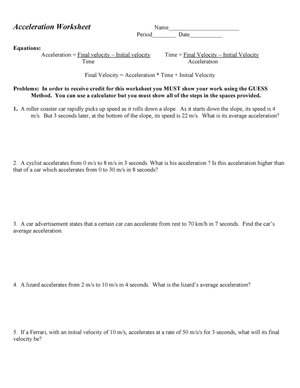
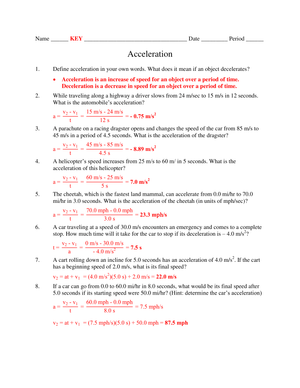
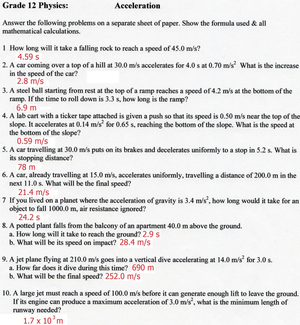
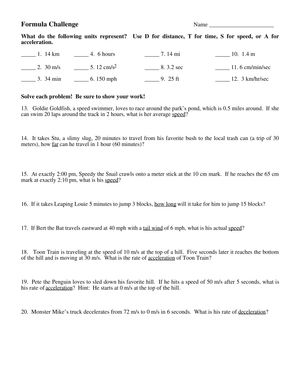
Each worksheet centers on acceleration as the rate of change of velocity over time, beginning with the formula a = (vf - vi) / t and the variable identification that must come before any calculation. That extraction step — deciding which value in a word problem is the initial velocity, which is the final, and where elapsed time appears — is where many 10th graders first stumble. A problem like "a cyclist goes from 4 m/s to 13 m/s over 3 seconds" is simple enough in isolation, but students working quickly will sometimes subtract in the wrong order or misread elapsed time as final time. Practice that requires unit labeling and step-by-step substitution catches those errors before they become ingrained.
- Applying a = (vf - vi) / t with units carried through every calculation step
- Extracting initial velocity, final velocity, and time from word problems and data tables
- Writing answers correctly in m/s² and interpreting both the magnitude and the sign
- Distinguishing positive, negative, and zero acceleration across real motion situations
- Reading velocity-time graphs to identify acceleration, constant velocity, and deceleration intervals by slope
- Recognizing that a change in direction counts as acceleration even when speed stays the same
- Explaining motion in words, not only in calculations
Student Errors That Calculation Practice Alone Doesn't Fix
The most persistent misconception at this level is treating acceleration as synonymous with speeding up. A student can correctly compute a = (12 - 20) / 4 = -2 m/s² and still insist in the follow-up question that "the car isn't accelerating because it's slowing down." The computation went right; the conceptual understanding didn't shift. Worksheets that pair each calculation with a short written prompt — "describe what is happening to the car's motion based on the sign of your answer" — force students to reconcile the math with their reasoning, and that's when the gap becomes visible and teachable.
Sign errors are the second consistent pattern. Students drop the negative from a result, reverse the subtraction order instinctively, or treat it as a sign of their own arithmetic mistake rather than meaningful directional information. On a velocity-time graph, this appears when students look at a downward slope and write "the object stopped" instead of "the object decelerated." Both errors respond better to explanation prompts embedded directly in the worksheet than to reteaching after a quiz has already surfaced them.
Building These Worksheets Into Your Lesson Sequence
10th grade acceleration worksheets fit the full lesson cycle rather than sitting only at the end as review. In the first few days after introducing the formula, a single calculation item at the start of class — just one, not a full warm-up block — does more to stabilize retention than spacing all review to homework. During direct instruction, a worksheet with a printed formula and labeled variable slots lets students follow along with substitution without spending mental energy on problem setup; once students are comfortable, that structure comes off and the problems move toward less explicit formats.
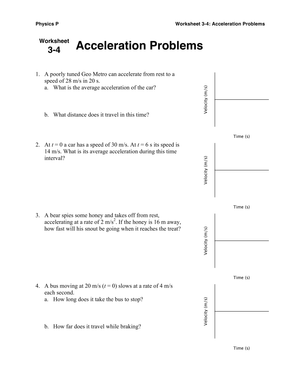
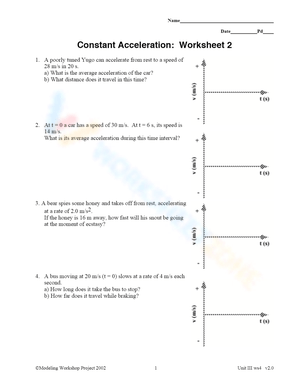
Mid-lesson graph work earns its place here. A velocity-time graph that asks students to identify which segment shows the greatest acceleration, which shows zero acceleration, and which shows deceleration gives the teacher a live read on whether graph interpretation is keeping pace with computation. Pairing one calculation item with one short-answer explanation as an exit check takes under five minutes and reveals who is ready to move forward before the next lesson begins.
One sorting move worth trying: organize questions by representation rather than strictly by difficulty. One formula item, one table item, one graph item, and one scenario item in a short set shows whether a student understands acceleration across formats or only recognizes it in familiar calculation problems. That distinction matters more than a difficulty ranking when you are deciding which students need reteaching and on what specific representation.
Standard Alignment
These resources connect directly to NGSS HS-PS2-1, which asks students to apply mathematical representations to describe the relationship among net force, mass, and acceleration. Before students can reason about F = ma in any meaningful way, they need a stable, working definition of acceleration — what it is, how to calculate it from velocity data, and how to read it from a graph. The 10th grade acceleration worksheets in this set sit in the instructional sequence just before Newton's second law is introduced, building the conceptual and procedural foundation that force analysis requires. Teachers who sequence kinematics before dynamics will find HS-PS2-1 the primary standard in view, with the work here serving as prerequisite knowledge for the force unit that follows.
Reaching Students at Different Levels of Readiness
Students still building formula confidence need structured support: a formula reference at the top of the worksheet, variable boxes already labeled, and word problems where the known values are clearly identified in the problem text. A step-by-step guided format keeps the learning target on acceleration reasoning rather than on navigating problem structure. Once students demonstrate basic fluency, those supports come off and the problems shift toward less explicit setups.
Students ready for deeper work get more from unfamiliar formats than from more of the same calculation items. A data table with four time points, a velocity-time graph where one segment has an unlabeled axis, or a multi-step scenario where a car accelerates, holds speed, then brakes all require interpretation rather than pattern-matching. Error-analysis items work especially well as extension tasks: provide a worked solution containing a sign error or incorrect unit conversion and ask students to locate, explain, and correct it. That task requires understanding what the answer means, not just what procedure produced it. 10th grade acceleration worksheets that include error-analysis questions alongside standard calculation problems give teachers a more complete picture of where each student actually stands on the concept.
Frequently Asked Questions
Do students need prior knowledge of Newton's laws to use these worksheets?
No. The worksheets work from the kinematic definition of acceleration — rate of change of velocity — without requiring any background in force or mass. They work well in a unit that addresses motion description before introducing Newton's second law, which aligns with the sequencing that NGSS HS-PS2-1 typically supports. Students encounter force later; what they need here is a reliable understanding of what acceleration means and how to calculate it from velocity and time data.
How do I address the sign convention problem when students resist negative acceleration?
The most direct approach is to use short explanation prompts rather than only marking answers wrong. When a student computes a negative value and then contradicts it in a written response, that contradiction becomes the teaching point. Worksheets that require students to write one sentence interpreting their answer — before moving to the next problem — surface this conflict during practice, not on the assessment when it costs points and there's no time to address it.
How much class time does each worksheet typically take?
Most worksheets in the set take between 15 and 25 minutes for independent work, depending on student readiness and the mix of item types included. Shorter sections — a single graph item or a calculation paired with an explanation prompt — can be pulled out and used as five-minute warm-ups or exit checks without working through the full worksheet.
Can these work for mixed-ability classes without building separate materials from scratch?
Yes. The variation in item type — from structured calculation to open-ended graph interpretation to error analysis — lets teachers assign different sections to different groups using one worksheet rather than constructing parallel materials. The error-analysis and written-explanation items function naturally as extension work for students who finish the calculation section early, without requiring a separate differentiated version.












 Interactive Worksheet Maker
 Quiz Maker
 Word Search Maker
 Crossword Puzzle Maker
 Word Scramble Generator
 Sentence Scramble Generator
 Handwriting Worksheet Generator
 Name Tracing Generator
 Fill In The Blank Generator