Biological Molecules worksheets for 10th Grade Biology
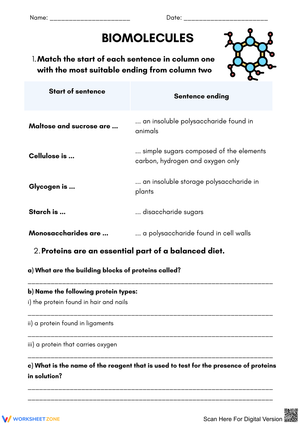
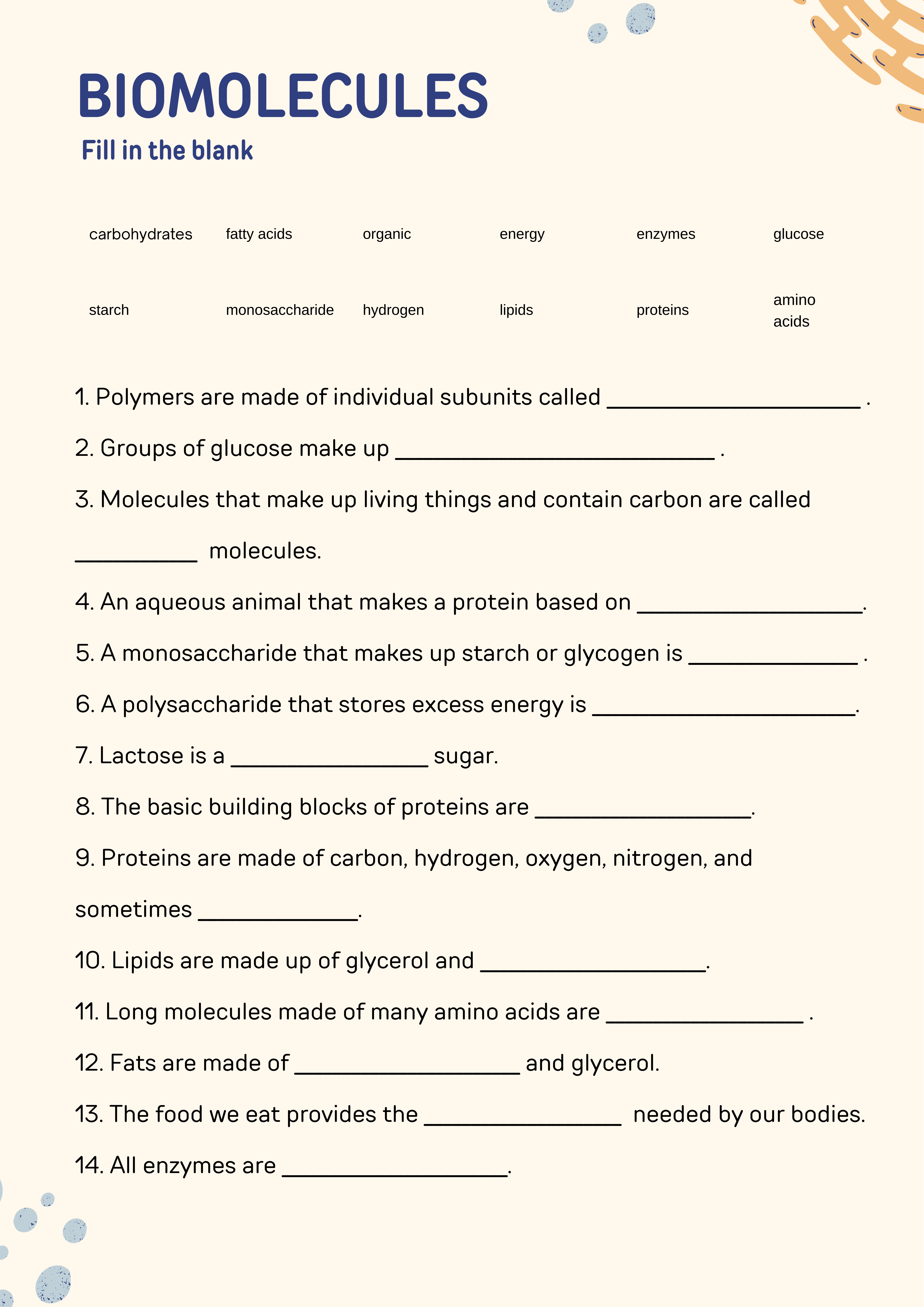
These biological molecules worksheets for 10th grade give teachers a structured, ready-to-use set covering all four macromolecule groups—carbohydrates, lipids, proteins, and nucleic acids—along with the condensation and hydrolysis reactions that connect them. Each worksheet is designed to move students from recall into application, a progression that matters in biochemistry, where identification is only half the work.
Why Biochemistry Hits Differently in 10th Grade
Tenth graders encounter biological molecules at the point in their biology education when chemistry and life science genuinely collide. Most have a working concept of atoms and bonds from physical science, but they haven't yet been asked to think about living systems in molecular terms. The abstraction gap is real: a student can dissect a frog, sketch a cell, or describe mitosis with some visual anchor to reality. Asking that same student to picture a peptide bond forming between two amino acids—or explain why a nonpolar fatty acid tail repels water—requires a different kind of thinking. These worksheets address that gap directly, using labeled structural diagrams and comparison tables as scaffolds that give students something concrete to work from before the abstractions make sense on their own.
Biochemistry also sets the conceptual table for every unit that follows. Students who internalize the monomer-to-polymer logic here will find DNA replication, protein synthesis, and cellular respiration far less opaque later in the year. That's the real instructional payoff of spending time on this material in week three rather than rushing through it.
The Specific Skills Targeted Across the Set
Each worksheet focuses on a distinct area rather than attempting to cover everything at once. Across the full set, students practice the following:
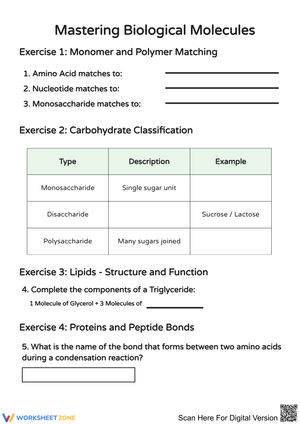
- Identifying the monomer and polymer for each macromolecule group, and distinguishing lipids as aggregates rather than true polymers — a distinction that consistently trips up students who try to force lipids into the same template as the other three groups.
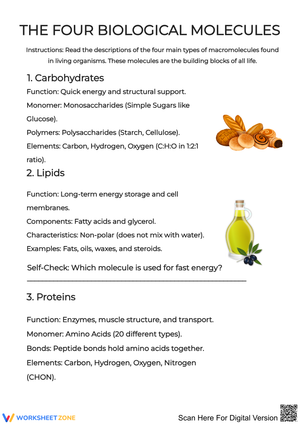
- Tracing the elements present in each macromolecule: carbon, hydrogen, and oxygen in carbohydrates and lipids; those same three plus nitrogen in proteins; and carbon, hydrogen, oxygen, nitrogen, and phosphorus in nucleic acids.
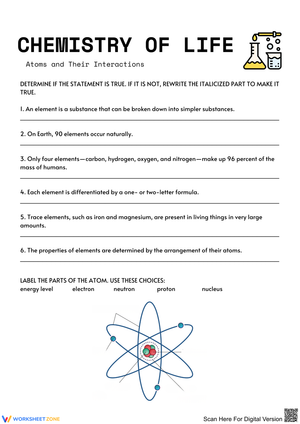
- Labeling structural diagrams — glucose rings, amino acid R-groups, nucleotide components, and the phospholipid bilayer arrangement — to develop the visual-to-concept connection that biochemistry demands.
- Completing comparison tables that place all four groups side by side, with columns for monomer, polymer, key elements, and primary biological function.
- Explaining dehydration synthesis and hydrolysis using both diagrams and written responses, including identifying which atoms leave or enter in each reaction.
- Applying enzyme concepts by labeling active sites, predicting the effect of temperature or pH shifts on enzyme shape, and connecting enzyme behavior back to protein structure.
- Analyzing a nutrition label to identify which macromolecules are present and in what relative amounts — an activity that brings the abstract gram counts on a cereal box into direct contact with the monomer-polymer chemistry students are building in class.
Frequent Student Errors Worth Watching For
The monomer-polymer table is where the most predictable errors appear. Students will correctly write "glucose" as the monomer for starch and glycogen, then write "glucose" again for cellulose without registering that the structural difference between starch and cellulose comes from the orientation of those glucose bonds — not from a different monomer. They've memorized the answer without understanding what determines function at the polymer level. Worksheets that ask students to mark the type of glycosidic bond or describe why humans can digest starch but not cellulose push past that surface-level recall.
Lipids cause a different kind of confusion. Because lipids don't follow the clean monomer-polymer pattern of the other three groups, students who have internalized "macromolecule = polymer" will either invent a lipid polymer or leave that column blank and assume they've done something wrong. An explicit note in the worksheet prompt — and a brief classroom discussion before students begin — prevents that detour.
On the dehydration synthesis diagram tasks, students consistently circle the wrong atoms when identifying the water molecule released. They'll mark an entire hydroxyl group on one monomer and an entire hydrogen on the other, rather than recognizing that one hydrogen comes from one monomer and one hydroxyl from the other, together forming H₂O. Having students write out the full bond-formation step in a short-answer box, rather than just circling atoms on a diagram, surfaces this misunderstanding quickly.
Building These Worksheets Into Your Lesson Plans
The set sequences most naturally across a two- to three-week biochemistry unit. A workable arrangement: open week one with carbohydrates and lipids, since both rely heavily on the monomer-polymer framework and give students early practice with the comparison table format. Use the nutrition label worksheet as a mid-week checkpoint rather than saving it for the end — students who see the grams-of-carbohydrate figure on a food label translated into thousands of linked glucose units tend to hold onto the condensation reaction concept far more reliably than students who encounter the diagram in isolation.
Week two works well for proteins and enzymes. The enzyme worksheet functions effectively as a transition piece — it consolidates protein structure content while opening the door to the cellular processes unit that often follows. Nucleic acid worksheets belong in week three, paired with whatever introductory work you're doing on DNA structure before moving into replication. The cumulative review worksheet is best used two days before the unit assessment rather than the night before, giving you a class period to address the error patterns the review surfaces.
For the 8-minute window before dismissal on Fridays, the matching-format worksheets — monomers to polymers, molecule names to functions — work as low-stakes retrieval practice that doesn't require teacher setup. Students complete them independently, you do a quick show-of-hands check on the two or three items most commonly missed, and everyone leaves with a mental refresh of the week's vocabulary.
Adjusting the Worksheets for a Range of Learners
The most reliable differentiation move with this content is controlling the scaffold level rather than changing the task itself. For students who need additional support, run the comparison table with two columns pre-filled — monomer and one function example — so the cognitive load sits on retrieving and organizing information rather than on figuring out what the table is even asking. Add a word bank to the diagram labeling tasks. Students who freeze when they see an unlabeled amino acid structure with no vocabulary options will make little productive progress; giving them the terms and asking them to place them correctly shifts the work back to understanding rather than retrieval under pressure.
For students who are ready for more, remove the word bank, replace fill-in-the-blank items with open-ended prompts ("Explain why a phospholipid is an effective building material for a cell membrane"), and add a short reading passage from a primary or secondary science source with annotation instructions. The same learning targets apply to both versions, which keeps your gradebook data meaningful across the class.
Standard Alignment
This set aligns with NGSS HS-LS1-6, which falls under the From Molecules to Organisms: Structures and Processes performance expectations. That standard asks students to construct an explanation based on evidence for how the structure of DNA determines the structure of proteins, which drives the function of the cell. Biological molecules content is the prerequisite that makes HS-LS1-6 accessible — students cannot engage meaningfully with how base sequences code for amino acid sequences if they don't yet understand what amino acids are or how peptide bonds form. Teachers who need to document instructional alignment in unit plans can cite HS-LS1-6 as the anchor standard, with the macromolecule worksheets serving as the foundational content that makes the standard's deeper performance expectations reachable.
Frequently Asked Questions
What content should a biological molecules worksheet for 10th grade actually include?
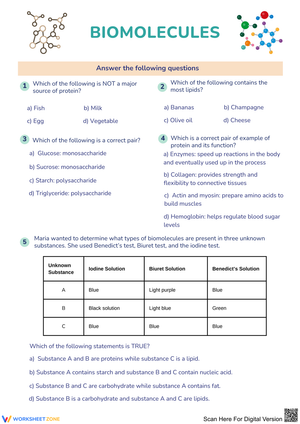
At minimum: monomers and polymers for all four macromolecule groups, the elements present in each, dehydration synthesis and hydrolysis reactions with both a diagram task and a written explanation, and at least one application question that connects the chemistry to a biological context — digestion, cell membrane function, or enzyme activity. A worksheet that stops at identification misses the conceptual work the 10th grade standards are actually after.
How do these worksheets fit into a unit that also includes cell biology content?
They work best as a lead-in. Teaching macromolecules before the cell membrane unit means students already have the phospholipid bilayer vocabulary when it appears in a new context. The same is true for proteins before enzyme kinetics and nucleic acids before DNA replication. Running the biochemistry worksheets in the first two to three weeks of the course creates a conceptual foundation rather than a standalone chemistry detour.
Is the nutrition label analysis worksheet appropriate for all learners, or only advanced students?
It works across levels when the task is framed correctly. For students still building confidence with the core vocabulary, the prompt focuses on identification — find the carbohydrates, the lipids (labeled as total fat), and any protein listed, and match each to its macromolecule group. For students ready for more, the prompt adds a calculation or analysis layer: if one serving contains 30 grams of carbohydrates and glucose has a molecular weight of 180 g/mol, roughly how many glucose units are in one serving? Both uses of the same worksheet target the same standard.
Clear All