10th Grade Macromolecules printable worksheets
Utilizing 10th grade macromolecules printable worksheets provides students with the structured practice they need to master this topic. These resources guide learners through the intricate world of organic chemistry as it applies to living organisms, ensuring they can identify and explain the functions of essential biological molecules. Mastery of this unit sets the stage for success in subsequent topics, including cellular respiration, photosynthesis, and molecular genetics.
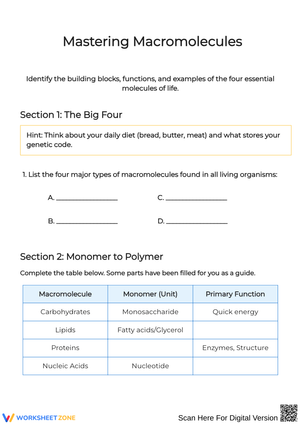
The Four Primary Biological Macromolecules
To succeed in biology, students must thoroughly understand the four main classes of biomolecules. Each plays a distinct and vital role in cellular function, structural integrity, and overall organism survival.
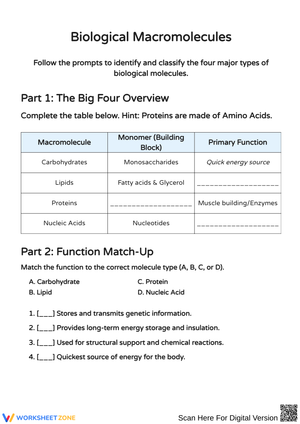
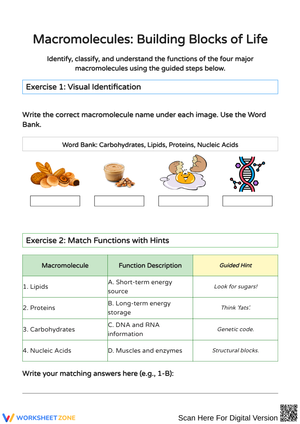
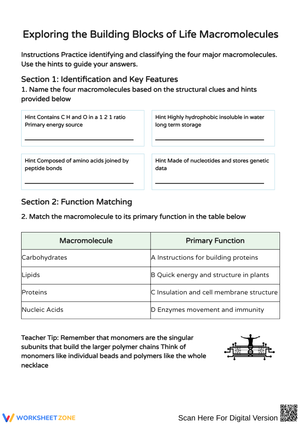
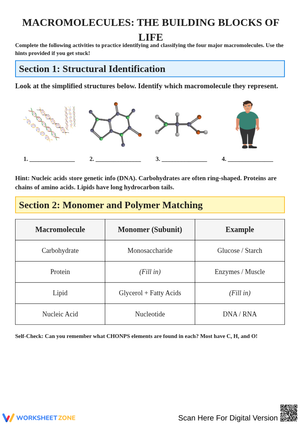
Carbohydrates: These molecules serve as the primary energy source for living things and provide structural support in certain organisms. Worksheets often ask students to identify monosaccharides, like glucose and fructose, and understand how they combine to form complex polysaccharides. Students will learn to differentiate between energy storage molecules, such as glycogen in animals and starch in plants, and structural molecules like cellulose in plant cell walls.
Lipids: Lipids are essential for long-term energy storage, thermal insulation, and forming the structural foundation of cell membranes. Practice materials help students differentiate between triglycerides, phospholipids, and steroids. Phospholipids are particularly important, as their hydrophilic heads and hydrophobic tails create the selectively permeable barrier of the cell membrane. Worksheets also explore the structural differences between saturated and unsaturated fatty acids.
Proteins: Composed of amino acid chains, proteins execute most cellular functions. They act as structural components in muscle tissue, transport molecules like hemoglobin, and serve as biological catalysts known as enzymes. For example, enzymes like lactase speed up chemical reactions that would otherwise occur too slowly to sustain life. Students will use diagrams to see how the sequence of amino acids dictates the final three-dimensional shape and function of the protein.
Nucleic Acids: DNA and RNA are responsible for storing, transmitting, and expressing genetic information. Worksheets typically focus on the structure of nucleotides, highlighting the five-carbon sugar, phosphate group, and nitrogenous base components that make up the genetic code. Students will practice identifying the double helix structure of DNA and comparing it to the single-stranded structure of RNA.
Monomers, Polymers, and Chemical Reactions
Understanding how macromolecules are built and broken down is a core component of the curriculum. Students must grasp the relationship between individual building blocks, known as monomers, and the larger, complex structures they form, called polymers. This relationship is fundamental to understanding how organisms acquire nutrients and build cellular structures.
Dehydration synthesis is the process where monomers link together, releasing a water molecule in the process. This anabolic reaction requires energy and is responsible for building muscle, storing energy as fat, and replicating DNA. Conversely, hydrolysis is the catabolic reaction that breaks polymers apart by adding water. This process releases energy and is the primary mechanism behind digestion. Visualizing these chemical reactions is much easier when students can label diagrams and trace the movement of atoms on paper.
These concepts align directly with the Next Generation Science Standards (NGSS) HS-LS1-6, which emphasizes the role of carbon in forming these complex organic molecules. Carbon's unique ability to form four covalent bonds allows for the incredible diversity of molecular structures necessary for life. By working through targeted exercises, students can map out carbon backbones and identify functional groups that give each molecule its specific chemical properties.
Classroom Implementation
Integrating these materials into your daily lesson plans can significantly improve student comprehension and retention. Teachers can use these printables as introductory guided notes, collaborative group activities, or independent review assignments before a unit exam. They also serve as excellent scaffolding tools for differentiated instruction, allowing teachers to provide varying levels of support based on student needs.
To make abstract molecular concepts highly concrete, pair your macromolecule worksheets directly with physical nutrition labels from the school cafeteria or students' favorite snacks. Have students highlight the total carbohydrates, dietary fiber, sugars, proteins, and fats on the label, then immediately map those real-world items to the chemical structures on their worksheet. This bridges the gap between microscopic chemistry and their daily lives, dramatically increasing engagement and retention of the material.
Another effective strategy is setting up laboratory preparation stations. Before conducting chemical indicator tests, such as using Benedict's solution for simple sugars, iodine for starch, or the Biuret test for proteins, students can complete a pre-lab worksheet. This ensures they understand the theoretical background, the purpose of positive and negative controls, and the expected color changes before handling any chemical reagents in the lab.
Frequently Asked Questions
1. What are the specific monomers for each of the four macromolecules?
Carbohydrates are built from monomers called monosaccharides, such as glucose. Proteins are constructed from monomers known as amino acids. Nucleic acids are made of monomers called nucleotides. Lipids are unique because they do not have a single true monomer in the same way as the others, but they are generally composed of glycerol molecules and fatty acid chains.
2. How do dehydration synthesis and hydrolysis differ in biological systems?
Dehydration synthesis builds larger molecules (polymers) by removing a water molecule to form a new covalent bond between monomers. This process stores energy. Hydrolysis does the exact opposite; it breaks down polymers into smaller monomers by adding a water molecule to cleave the chemical bonds, a process that typically releases energy and is essential for digestion.
3. Why is carbon considered the fundamental building block of life?
Carbon has four valence electrons, allowing it to form stable covalent bonds with up to four other atoms simultaneously, including other carbon atoms. This unique chemical property enables the formation of long chains, branched structures, and complex rings, creating the diverse organic molecules required for the structure and function of all living organisms.
4. How does the sequence of amino acids determine a protein's final shape?
The specific order of amino acids in a polypeptide chain dictates how the molecule will fold. Interactions between the variable side chains (R-groups) of the amino acids, such as hydrogen bonding, ionic bonds, disulfide bridges, and hydrophobic interactions, cause the protein to fold into a precise three-dimensional structure. This final shape ultimately determines the protein's specific biological function.
5. What is the primary difference between saturated and unsaturated fats?
Saturated fats have single bonds between all carbon atoms in their fatty acid chains, allowing them to pack tightly together and remain solid at room temperature (like butter). Unsaturated fats contain one or more double bonds between carbon atoms, creating a kink or bend in the chain. This bend prevents tight packing, making unsaturated fats liquid at room temperature (like olive oil).
Clear All