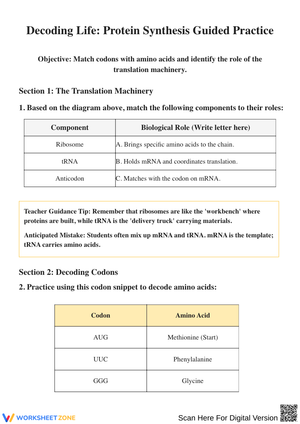
Transcription and translation worksheets for 10th grade give biology teachers a clear way to check whether students can move from vocabulary recognition to actual protein synthesis practice. In many lessons, students can repeat that DNA leads to RNA and RNA leads to protein, but they still mix up where each step happens, which molecule is being read, and how codons connect to amino acids. A focused worksheet helps slow that thinking down and makes each step visible.
In a Grade 10 biology classroom, this topic usually works best when students complete short, connected tasks rather than one long block of reading. Effective worksheet sets often begin with labeling and matching, move into sequence conversion, and finish with application questions. That structure lets teachers see whether errors come from core vocabulary, confusion about base-pairing rules, or trouble using a codon chart.
What strong worksheet practice should include
The most useful worksheet materials do more than ask students to define terms. They should guide students through the actual sequence of events and show how each molecule has a specific job. For Grade 10 instruction, teachers usually want a balance of direct practice and thinking tasks.
- Vocabulary review: DNA, gene, mRNA, tRNA, ribosome, codon, anticodon, amino acid, and polypeptide.
- Location questions: where transcription occurs and where translation occurs in a eukaryotic cell.
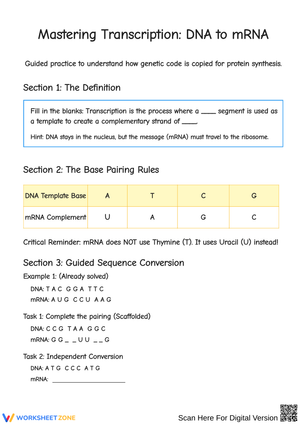
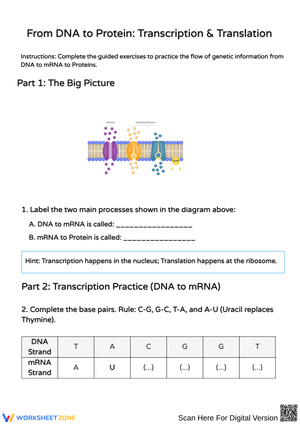
- Base-pairing practice: converting DNA bases into mRNA bases accurately.
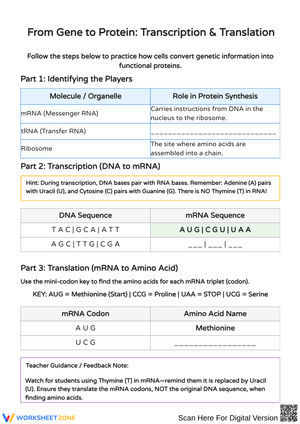
- Codon chart use: decoding mRNA codons into the correct amino acids.
- Comparison tasks: sorting replication, transcription, and translation by purpose, molecules involved, and product.
- Error analysis: finding mistakes in a worked example and explaining the correction.
- Mutation connections: identifying how a changed base can alter a codon and possibly a protein product.
When these elements are combined, the worksheet becomes more than seatwork. It becomes a quick formative assessment that shows where a student is breaking down in the process.
Core concepts students should practice
Teachers often see the same problem areas during this unit. Students may confuse codons with anticodons, think tRNA carries genetic instructions instead of amino acids, or forget that the codon chart is read from mRNA rather than DNA. Good worksheet design brings these likely errors to the surface.
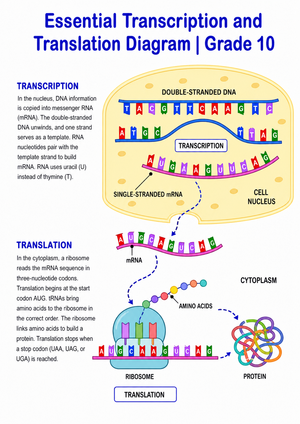
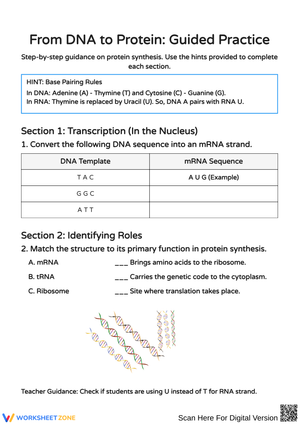
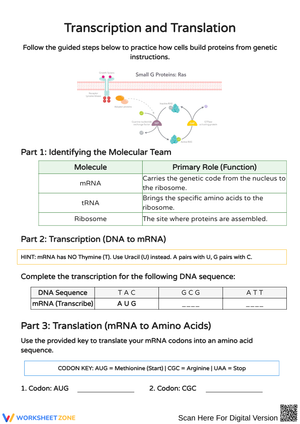
One high-value task is a step-by-step conversion item. Students start with a short DNA sequence, transcribe it into mRNA, divide the mRNA into codons, and then use a genetic code table to identify the amino acid sequence. This kind of item reveals whether students understand the order of the process, not just the definitions.
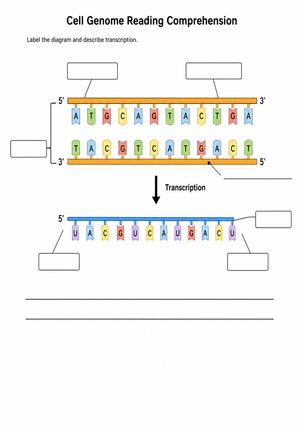
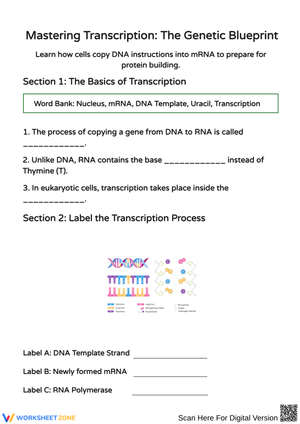
Another useful task is labeling a diagram that includes the nucleus, ribosome, mRNA strand, tRNA molecules, anticodons, and the growing amino acid chain. Diagram work gives visual learners a way to connect structure and function, and it helps teachers check whether students understand which parts belong to transcription and which belong to translation.
Compare-and-contrast questions are also valuable in Grade 10. Asking students to sort statements into transcription or translation, or into both, strengthens precision. For example, students can identify which process uses ribosomes, which produces mRNA, and which uses codons to build a protein.
How these worksheets support biology instruction
Protein synthesis can feel abstract because students cannot directly observe it in the classroom. Worksheets make the invisible steps concrete. By writing the bases, circling codons, and tracking amino acids one at a time, students begin to see that the process follows rules rather than random guessing.
These resources also fit several classroom purposes. Teachers can use them for direct instruction follow-up, independent practice, station work, homework, reteaching, quiz review, or early finisher work. Because the topic includes both vocabulary and procedures, worksheet practice gives teachers a fast way to separate students who need content review from students who are ready for mutation analysis or more complex questions.
Source information from MedlinePlus Genetics notes that genes carry instructions for making proteins, while the National Human Genome Research Institute explains the specific roles of transcription and translation in that pathway. That sequence makes worksheet practice especially useful because students are not just memorizing isolated facts; they are learning how biological information is expressed.
What to look for when choosing a worksheet
Not every worksheet on this topic is equally useful. The best options for Grade 10 biology are accurate, clearly sequenced, and focused on the intended skill. If a page includes too many steps at once without examples, students may guess rather than reason through the process.
- Clear directions: students should know whether they are working from DNA, mRNA, or tRNA.
- Reasonable sequence length: short strands are better for checking understanding than very long strands that create copying errors.
- Visible support tools: include or pair with a codon chart when translation is required.
- Balanced question types: mix recall, labeling, and application instead of relying on only one format.
- Space for thinking: students should be able to show each step rather than write only a final answer.
Teachers may also want worksheet sets that include answer keys or partial models. Those tools save grading time and make small-group reteaching easier after the first round of practice.
Frequently Asked Questions
1. What is the difference between transcription and translation?
Transcription copies a gene’s DNA sequence into mRNA. Translation happens at the ribosome, where the mRNA codons are read and amino acids are linked to form a polypeptide. Students need practice because the processes are connected but not the same.
2. How do students use a codon chart on a worksheet?
Students first transcribe DNA into mRNA if needed. Then they break the mRNA into codons, read each codon on the chart, and record the matching amino acid. The key point is that the chart is used with mRNA codons, not directly with DNA.
3. What prior knowledge should students have before this activity?
Students should understand basic DNA structure, base-pairing rules, and the role of genes in carrying instructions. It also helps if they already know that proteins are built from amino acids and that cells use coded information to make them.
4. How can teachers differentiate this worksheet practice?
Teachers can shorten the sequences, provide word banks, or include partially completed examples for students who need support. For extension, add mutation questions, ask students to explain errors in sample work, or have them compare transcription and translation in written responses.
Transcription and translation worksheets give Grade 10 biology teachers a practical way to teach, review, and assess one of the most important ideas in life science. With strong sequence practice, clear visuals, and targeted application questions, these resources help students turn vocabulary into real understanding of how genetic information becomes protein.












 Interactive Worksheet Maker
 Quiz Maker
 Word Search Maker
 Crossword Puzzle Maker
 Word Scramble Generator
 Sentence Scramble Generator
 Handwriting Worksheet Generator
 Name Tracing Generator
 Fill In The Blank Generator