Tangents to Circles PDF Worksheets for 10th Grade
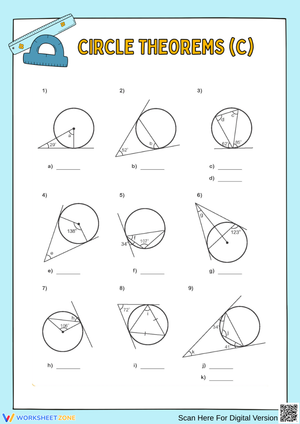
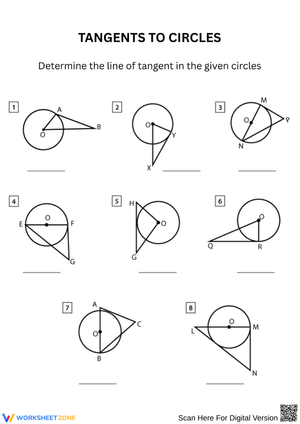
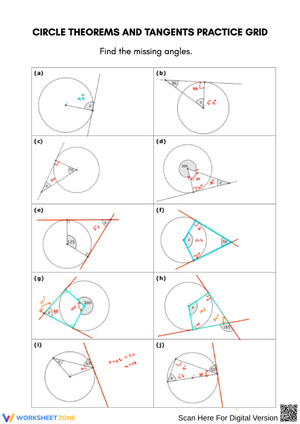
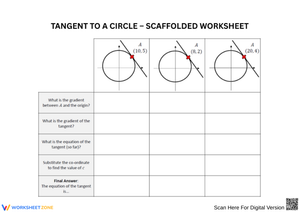
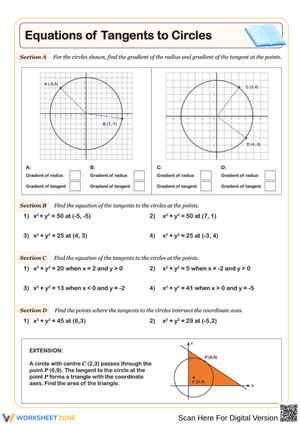
These tangents to circles pdf worksheets for 10th grade give geometry teachers a set of resources covering the radius-tangent perpendicular relationship, the two-tangent theorem, Pythagorean applications, and circumscribed polygon problems — moving students from diagram identification all the way to multi-step algebraic reasoning. Every worksheet includes clearly labeled figures so students focus on the geometry rather than decoding ambiguous drawings.
What Students Practice Across the Set
The earlier worksheets establish foundational vocabulary. Students mark the point of tangency, distinguish tangent lines from secants and chords in mixed diagrams, and identify when a radius drawn to a tangency point forms a right angle. These aren't trivial tasks — students who can recite the definition still make errors when a diagram shows a tangent approaching from an unexpected angle or when the point of tangency isn't explicitly labeled.
From there, the skill demands increase:
- Applying the radius-tangent perpendicularity theorem to establish a right angle and orient the correct triangle before calculating
- Using the Pythagorean theorem to find missing lengths — radius, tangent segment, or the distance from the circle's center to an external point
- Setting up and solving algebraic equations from the two-tangent theorem, where tangent segments drawn from a common external point are equal in length
- Finding perimeters of circumscribed triangles and quadrilaterals by tracking congruent segment pairs at each vertex
- Applying the converse of the Pythagorean theorem to determine whether a given segment is actually tangent to a circle
The final worksheets introduce common tangents — lines simultaneously tangent to two distinct circles — requiring students to construct auxiliary rectangles and solve within the resulting right triangles. That demand is a genuine step up from the single-circle problems earlier in the set.
Frequent Student Errors Worth Catching Before the Unit Test
The most persistent problem across the Pythagorean applications is hypotenuse misidentification. Students who have a² + b² = c² memorized will still plug the tangent segment in as c rather than recognizing that the line from center to external point is the hypotenuse. The confusion is visual: in most diagrams, the tangent segment runs horizontally and the center-to-external-point line runs at a diagonal — and students trained on standard textbook triangle orientations read diagonal as hypotenuse. The reliable correction is requiring students to mark the right angle symbol at the point of tangency before writing any numbers, then identify the side directly opposite it as c. That one mechanical step, done consistently, catches the error before it produces wrong answers.
Circumscribed polygon problems produce a different mistake. Students state the two-tangent theorem correctly, then lose track of which partial segments belong to which vertex as they work around the shape. The theorem isn't the failure point — the bookkeeping is. The approach that works best is requiring students to label each small partial segment with a distinct variable letter before writing any equation. Some problems in the set build that labeling step directly into the instructions, and those are worth assigning before the ones that leave students to organize independently.
There is also a conceptual assumption worth surfacing early: many students believe that any line touching a circle is tangent. Several worksheets include diagrams where a shallow-angle secant could be mistaken for a tangent, placed there so teachers can identify and correct that assumption before it produces errors on assessments.
Working These Worksheets Into Your Lesson Sequence
Direct instruction before the first worksheet is essential. Once students can identify the point of tangency on a board diagram and watch a radius being drawn to it perpendicularly, transition into the identification worksheet and work through the first two problems together. That brief co-construction — three to four minutes — gives a real read on whether the class is ready to work independently before anyone spends time guessing at what the diagram is asking.
For station rotation, the tangents to circles pdf worksheets for 10th grade divide naturally by problem type: one station on perpendicularity and right triangle setup, one on two-tangent algebraic equations, one on circumscribed polygon perimeters. Students who finish a station early can compare setups with a partner rather than waiting, keeping the room moving without constant teacher re-direction. Several of the shorter problems — one diagram, one unknown — work well as exit tickets in the last few minutes of class, giving quick formative data on which students have the perpendicularity theorem automatic and which are still working out the triangle orientation every time.
Assigning the Pythagorean application worksheets the evening after first instruction also creates productive spaced retrieval. Students must reconstruct the right triangle from memory at home, which does more for long-term retention than a second in-class worked example at the end of the same lesson would.
Adapting the Set for Students at Different Levels
Students who are still uncertain about the Pythagorean theorem need a reference structure showing the right triangle labeled with center, point of tangency, and external point before they attempt any calculation. This removes an algebra barrier so the geometric reasoning can develop without it. Once the triangle setup becomes automatic, the reference comes off the desk. The geometry doesn't change — the entry point does.
The tangents to circles pdf worksheets for 10th grade also include problem types that push further for students who move through the standard problems quickly. Circumscribed quadrilateral problems require tracking four pairs of congruent segments around the polygon simultaneously — a different cognitive demand than the single-vertex case. The two-circle common tangent problems require constructing auxiliary rectangles and solving embedded right triangles, and they extend naturally into a trigonometry application: once side lengths are established, students can calculate the angle between the two tangents at the external point using sine and cosine. The problem structure supports that extension cleanly, even when it isn't built into the worksheet instructions.
Standard Alignment
HSG.C.A.2 directly governs the radius-tangent perpendicularity relationship and the properties of tangent lines — the content at the center of most worksheets in this set. The two-tangent theorem proof, which applies Hypotenuse-Leg triangle congruence to establish that tangent segments from a common external point are equal, also connects to HSG.SRT.B.5, which requires students to use congruence and similarity reasoning to solve geometric problems. These two standards are typically addressed together in 10th-grade geometry, and the worksheets cover both without requiring separate lesson objectives — the algebraic two-tangent problems satisfy SRT.B.5 even when the posted goal for the day is C.A.2.
Frequently Asked Questions
Why does my student keep treating the tangent segment as the hypotenuse?
Because in most standard diagrams, the tangent segment is oriented horizontally and the line from center to external point runs at a diagonal — and students default to reading diagonal as hypotenuse. The actual hypotenuse is always the side opposite the right angle, which in these problems is always at the point of tangency. Teaching students to mark that right angle first, then circle the side directly across from it, solves this faster than re-explaining the theorem from the beginning.
Do students need formal triangle congruence experience before the two-tangent theorem worksheets?
For the calculation-focused problems, students need only the theorem's conclusion: two tangent segments from the same external point are equal. But when the tangents to circles pdf worksheets for 10th grade include "explain why" or "prove that" prompts, students need to recognize that the two right triangles formed share a hypotenuse and have equal radii as legs — making them congruent by the Hypotenuse-Leg theorem — and that congruent triangles yield equal corresponding parts. That's the proof knowledge those specific problems require. Full formal proof fluency helps, but it isn't a prerequisite for the calculation-based majority of the set.
How do circumscribed polygon problems differ from standard two-tangent problems?
In a standard two-tangent problem, one external point generates one pair of equal segments. In a circumscribed polygon, every vertex is an external point with its own pair of tangent segments. Students who solve the single-vertex case cleanly still need deliberate practice on the polygon version because the task shifts from applying one theorem once to applying it three or four times in coordination around a perimeter. These worksheets treat circumscribed polygons as a distinct skill rather than a simple extension of the single-point problem.
Are these worksheets useful for SAT or state geometry exam review?
The Pythagorean applications and two-tangent algebraic problems appear on both the SAT and ACT. The setup these worksheets practice — identifying the right angle at the point of tangency, forming the correct triangle, solving for an unknown side — matches the structure of circle theorem problems that appear regularly in the math sections of both tests. Circumscribed polygon perimeter problems are less common on national tests but appear on several state end-of-course geometry exams, making them worth covering for students preparing for those assessments.
Clear All