Arcs and Chords PDF Worksheets for 10th Grade
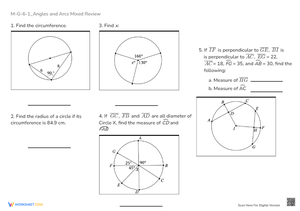
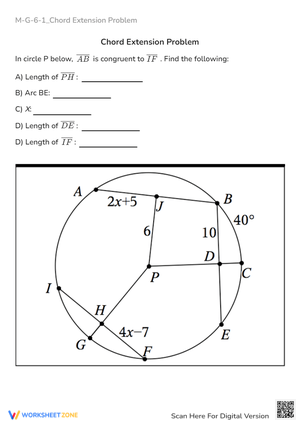
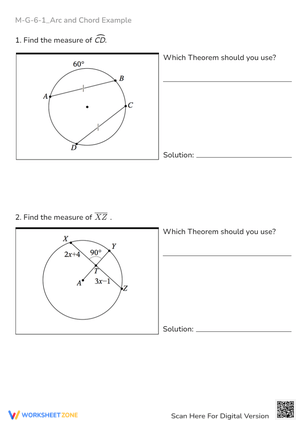
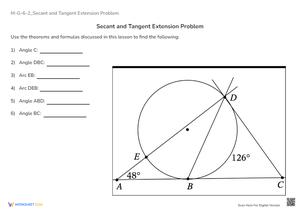
Arcs and chords pdf worksheets for 10th grade give geometry teachers printable, diagram-based practice that bridges circle vocabulary and circle reasoning — the point in most geometry sequences where students stop naming parts and start working through theorem-based relationships. The set covers arc naming, arc measure from central angles, chord comparison, and perpendicular radius properties, mixing computation and written justification across each worksheet.
The Skills Targeted Across the Set
The practice splits across three layers that build on one another. The first is recognition: students identify minor arcs, major arcs, and semicircles from labeled circle diagrams and match arc notation to the figure correctly. The second is computation: finding arc measure from a central angle, determining chord length when supplementary information appears in the figure, and setting up equations when arc expressions involve variables. The third is reasoning: applying theorems — congruent chords intercept congruent arcs, a radius perpendicular to a chord bisects both the chord and its arc — and explaining those conclusions in writing rather than just recording a number.
Each worksheet holds problems from at least two of those layers. That mix matters because students who handle vocabulary cleanly often stall the moment a diagram asks them to choose between two applicable relationships rather than retrieve one definition.
Errors Worth Catching Before They Stick
The most persistent mistake involves the congruent-chord theorem. Students can state it correctly and still apply it to chords that belong to two different, non-congruent circles sharing the same diagram. They are not wrong about the theorem — they misread the setup. A quick warm-up showing chords drawn inside two visually different circles, before students open the main practice worksheet, catches this before it becomes a quiz error.
A second consistent problem is directionality with the perpendicular bisector relationship. When a radius meets a chord at a right angle, students remember the radius bisects the chord but forget it simultaneously bisects the arc. They compute the chord halves correctly, then assign unequal measures to the two arcs by default. Writing both conclusions side by side on the board — chord bisected, arc bisected — before students begin a worksheet reduces that gap noticeably.
There is also a notation problem that appears in nearly every 10th grade class: a student writes arc AB meaning the minor arc but shades or marks the major arc on the diagram. The written answer and the visual do not match. Consistent labeling conventions across these worksheets make that disconnect visible quickly — a teacher can catch it by scanning the figure rather than waiting until the final numerical answer.
Where These Fit in a Geometry Unit and How to Sequence Them
Most geometry sequences reach arcs and chords after students have worked with central angles and basic circle vocabulary. That placement makes arcs and chords pdf worksheets for 10th grade most productive as a bridge resource — assign the first worksheet from the set on Day 1 of the chord-arc section to assess whether students are reading notation correctly before moving into theorem work. Reserve the mixed-relationship worksheets for Days 3 and 4, after students have seen the perpendicular bisector theorem demonstrated at least once.
- Bell ringer: three diagram problems on arc naming — takes about five minutes and surfaces notation gaps before the lesson moves forward
- Mini-lesson follow-up: four to six computation items on arc measure from central angles, done independently while the teacher circulates
- Partner work: a mixed-relationship worksheet where pairs must agree on which theorem applies before computing — the discussion reveals theorem confusion that silent independent work hides
- End-of-period review: the last eight to ten minutes of class work well with a short computation set; students stay on task without needing heavy reading when energy is low
- Substitute plans: each worksheet stands alone, includes diagrams, and needs no setup explanation beyond the printed directions
Standard Alignment
These worksheets address CCSS.MATH.CONTENT.HSG-C.A.2, which requires students to identify and describe relationships among inscribed angles, radii, and chords. In classroom terms, that standard shows up the moment a student must explain why a chord at a specific distance from the center produces a particular arc measure — not just calculate it. The worksheets include open-response items alongside numerical problems, covering both the computational and explanatory demands the standard requires.
Adjusting the Worksheets Across Readiness Levels
The cleanest differentiation strategy with arcs and chords pdf worksheets for 10th grade is keeping the same circle diagram for the whole class and varying the question demand. Students working toward grade level identify and label arcs and chords, compute arc measures from given angles, and solve single-step equations. Students working at or above grade level take the same figure and produce written justifications — "The two chords are congruent because the arcs they intercept are marked congruent in the diagram, and the converse of the theorem applies." Same diagram, different cognitive demand, and no student receives a visibly different handout.
For students who freeze on multi-step problems, a two-move annotation helps: first mark or circle the chord-arc pair involved, then set up the equation. Students write that first decision directly on the worksheet before computing. This keeps them from trying to hold theorem identification and algebraic execution in working memory at the same time — a load that breaks down frequently in 10th grade when students are still building fluency with both.
Frequently Asked Questions
What prior knowledge do students need before these worksheets are productive?
Students should be comfortable reading labeled geometric diagrams, using arc notation correctly — including the difference between arc AB and angle AOB — and setting up basic algebraic equations. They do not need prior experience with inscribed angles or tangent lines; those come later in most geometry sequences. The vocabulary students need — chord, arc, central angle, radius, diameter — should be in place from earlier circle lessons. Congruence language and two-step equation solving are the two background skills that matter most once students move past the naming problems into theorem work.
Are these worksheets better suited for in-class use or homework?
Diagram-heavy items that ask students to annotate figures work better in class, where a teacher can catch a mislabeled arc before the error is written in and reinforced. Computation items — those that supply all necessary measures within the problem — assign cleanly as homework since students can self-check with an answer key. Arcs and chords pdf worksheets for 10th grade support both uses across the set, so teachers can split by problem type: annotate in class, compute at home.
How long should I budget for one of these worksheets during a class period?
A focused worksheet of eight to ten items takes most 10th graders between fifteen and twenty minutes when they have seen the relevant theorems in a direct instruction segment first. Students still uncertain about which theorem applies will need closer to twenty-five minutes on mixed-relationship worksheets. A two-to-three-minute pair-share checkpoint at the midpoint of those longer sets lets students catch theorem-selection errors before finishing independently, which cuts the volume of identical mistakes teachers face during grading.
Clear All