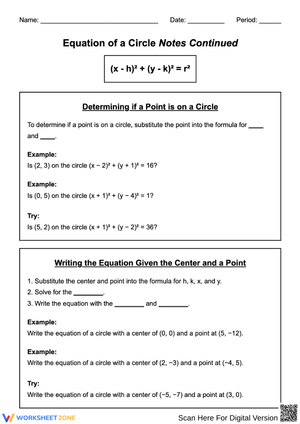
10th Grade Equation of a Circle PDF Worksheets
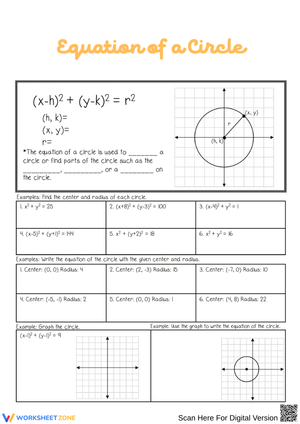
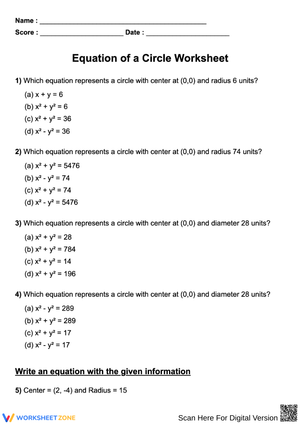
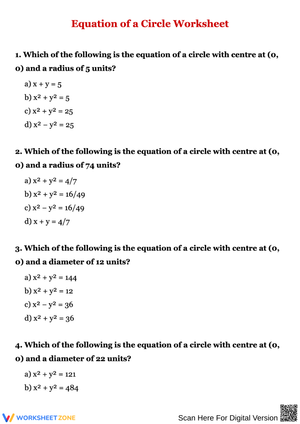
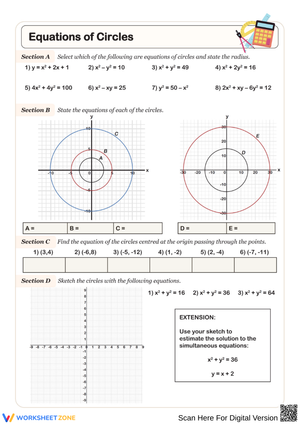
These 10th grade equation of a circle pdf worksheets give geometry teachers a set of print-ready resources built around standard form — (x − h)² + (y − k)² = r² — the equation students spend several lessons learning to read, write, and graph. Each worksheet targets one or two related moves: reading the center and radius from an equation, graphing a circle on a coordinate grid, writing equations from graphs, or constructing standard form from a word description. The coordinate grids print cleanly, directions are unambiguous, and answer keys make checking fast.
What These Worksheets Ask Students to Do
The skills across the set move from direct identification toward application. Students start with equations already in standard form and name the center and radius. From there, tasks shift to writing the equation after examining a provided graph, then to producing both the equation and a labeled sketch from a word description. A set of challenge items asks students to convert from general form, where completing the square is required before the center and radius become visible.
- Read center and radius from standard form — including equations where the center falls in two or more quadrants and the radius is not a perfect integer
- Graph circles on a coordinate grid with enough space to mark the four cardinal radius points and label the center explicitly
- Write equations from graphs by identifying the center coordinates and counting the radius from center to circumference
- Build equations from verbal descriptions — for example, a circle centered at (−3, 5) with a diameter of 8, where students must calculate the radius before writing the equation
- Convert from general form for classes that carry the topic into completing-the-square territory
Three Student Errors Worth Catching Before the Quiz
This topic produces the same mistakes across almost every Grade 10 class, and they cluster into three types. The most common is sign reversal on the center. When students see (x + 4)², a significant portion record a center x-coordinate of 4 instead of −4. They are reading the visible digit rather than reasoning about what value makes the binomial equal zero. The error feels invisible to them because they did extract two numbers from the equation — they just extracted them incorrectly, and nothing in the format signals the mistake.
The second mistake is confusing r with r². When the right side of an equation is 49, many students write radius = 49 and then count 49 units from the center on the grid. The result is a circle that overshoots any standard grid, but students often accept this result without pausing to check its reasonableness. Building a structured first step — isolate r², take the square root, then graph — reduces this error measurably. Some teachers add a labeled box directly on the worksheet: "r² = ___, so r = ___."
The third appears during graphing: students plot the center correctly and then draw the arc freehand without first marking the four points that sit exactly one radius length above, below, left, and right of center. The result is an oval or an imprecisely placed curve that passes through none of the verifiable anchor points. Thirty seconds of modeling — plot center, mark four cardinal points, then connect — eliminates most of the graphing errors that appear in actual student work.
Getting the Most from These Worksheets in a Geometry Block
A strong entry point is a ten-minute mini-lesson where students see how each piece of (x − h)² + (y − k)² = r² maps onto the coordinate plane — where the center coordinates come from, why the signs appear reversed inside the parentheses, and why the right side holds r² rather than r. Moving immediately into a worksheet focused only on identification keeps students practicing while the reasoning is still fresh. Assigning a mixed-skill worksheet first fragments attention across too many task types before any one of them is solid.
Station rotations work well here because each task type separates naturally. One station handles reading equations and naming center and radius. A second asks students to sketch circles on a grid. A third presents graphs and requires writing the equation from scratch. Because the format across 10th grade equation of a circle pdf worksheets stays consistent — clear directions, labeled grids, numbered problems — students can rotate with minimal re-explanation, and teachers get uninterrupted time to sit with the group still struggling with sign reversal or the radius-squared confusion.
For sub plans, this is a reliable choice within a geometry unit. The task is self-contained, the answer key travels with the set, and a substitute does not need to explain the underlying math — just direct students to the directions. Teachers returning the next day can use the completed work as an immediate formative check before deciding whether to continue or reteach.
Standard Alignment
These worksheets address CCSS HSG-GPE.A.1, which asks students to derive the equation of a circle using the Pythagorean Theorem and to use completing the square to recover center and radius from general form. In classroom terms, this standard appears near the end of most geometry units on coordinate relationships — after students have worked with distance and midpoint formulas and before they encounter conic sections more broadly in a pre-calculus course. Worksheets that stay in standard form address the first part of the standard. Those that include general-form conversion address the completing-the-square requirement and work best after students have practiced that algebraic technique elsewhere in the unit.
Adjusting the Set for a Range of Learners
For students still building confidence with coordinate graphing, start with equations that use integer centers and small perfect-square values for r² — for example, (x − 2)² + (y + 1)² = 9, where the radius is 3 and straightforward to count. Pre-label the axis values so students focus on the equation rather than on setting up the grid. Separating the identification step from the graphing step — have students write the center and radius before drawing anything — prevents errors caused by skipping steps under time pressure rather than actual conceptual gaps.
Students who handle standard form fluently move to problems with irrational radii (r² = 18, so r = 3√2), diameter-endpoint problems where the midpoint formula is required before writing the equation, or items that ask whether a specific point lies on, inside, or outside a given circle. These extensions stay within the same geometric framework without requiring a separate lesson. When a class spans both levels, assigning differentiated 10th grade equation of a circle pdf worksheets by task type — rather than distributing separate labeled packets — keeps the distinction low-key and the lesson pacing unified.
Frequently Asked Questions
How many worksheets should I assign before a quiz on this topic?
Most Grade 10 students need three to four separate practice sessions before a graded assessment. One worksheet focused on identification, one on graphing, and one on mixed equation-writing tasks covers the range well. A short mixed-review session the day before the quiz — focused specifically on sign reversal and the r-versus-r² distinction — does more for retention than assigning a longer packet all at once.
Do students need separate graph paper, or do these worksheets include coordinate grids?
Graphing worksheets in quality sets include printed grids sized to match the radius values in the problems. This matters more than it might seem: a grid that runs only to ±5 is useless for a problem with a radius of 9. Check that the grid dimensions accommodate the largest radius in the problem set before printing a class set.
Do these worksheets work for digital annotation tools like Kami or Google Drive?
PDF format handles digital annotation adequately in tools like Kami, Adobe Acrobat Reader, and Google Drive. Students can type coordinates and equations into text boxes or use drawing tools to work on the grid. The practical limit is graphing precision — sketching an accurate circle freehand on a touchscreen is harder than on paper, so digital use suits equation-identification and equation-writing tasks better than graphing tasks. Many teachers use 10th grade equation of a circle pdf worksheets as printed materials for graphing problems and upload the same files digitally for identification and writing practice.
What is the most effective way to use answer keys with this topic?
Post the answer key after students have completed the work, not before. For sign-reversal errors and the r-versus-r² confusion, having students locate and correct their own mistakes produces stronger retention than simply presenting the right answer. A two-minute self-correction step at the end of independent practice — students mark each item and write a brief note on what they changed — is worth the time.
Clear All