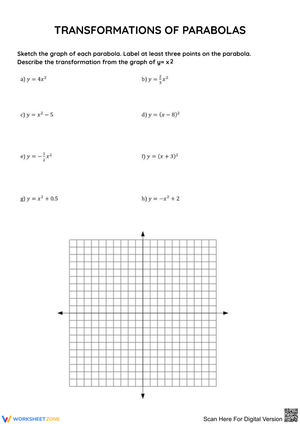
Transformation of Quadratic Functions Printable Worksheets for 10th Grade
These transformation of quadratic functions printable worksheets for 10th grade give algebra teachers a focused, print-ready set of exercises built around vertex form — the algebraic structure where every transformation parameter sits in plain view. Each worksheet targets a specific type of change: vertical shifts, horizontal shifts, stretches, compressions, or reflections, with later worksheets combining multiple parameters into single equations. Graphing tasks run throughout the set, requiring students to draw both the parent function and the transformed curve on the same grid, which surfaces errors that purely symbolic practice never reveals.
Core Skills Developed Across the Set
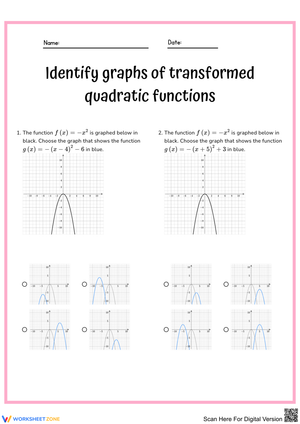
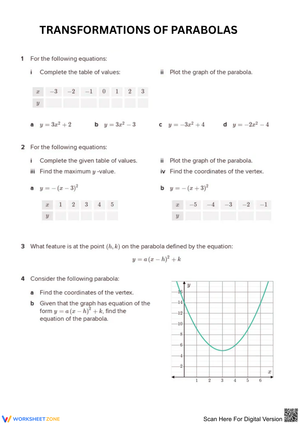
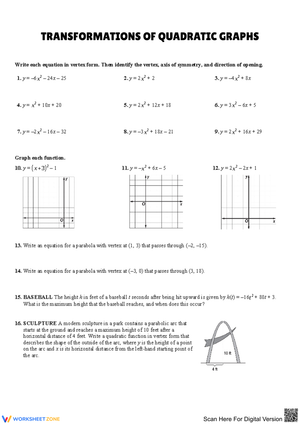
Students work with vertex form f(x) = a(x − h)² + k from the first worksheet through the last. The exercises move from problems where only one parameter changes at a time to problems where all three shift simultaneously. That progression is deliberate — it holds the cognitive demands at a manageable level while students build fluency with each parameter's effect before combining them.
Across the worksheets, students practice:
- Extracting the vertex (h, k) from a vertex form equation and plotting it without recalculation
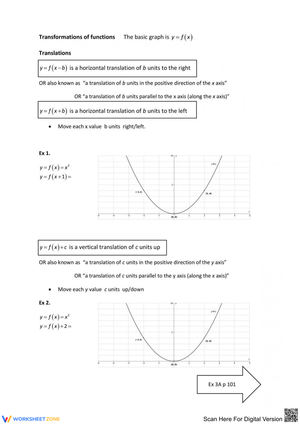
- Distinguishing vertical shifts (governed by k) from horizontal shifts (governed by h) and identifying the direction of each
- Determining whether the absolute value of a produces a narrower or wider parabola relative to y = x²
- Recognizing a reflection across the x-axis when a is negative and restating the function's range accordingly
- Writing vertex form equations that match a described or sketched transformation
- Moving between vertex form and standard form to confirm algebraic consistency
Why Vertex Form Is the Right Entry Point for This Topic
Standard form — ax² + bx + c — buries transformation information inside combined terms. Recovering the vertex coordinates requires completing the square or applying the axis-of-symmetry formula, both of which add procedural steps that redirect attention away from the geometric idea students are actually trying to grasp. Vertex form exposes each transformation parameter directly: the vertex sits at (h, k) and the scaling factor appears as a without any algebraic unwrapping. For 10th graders encountering function transformations for the first time, that transparency matters more than it might seem.
One specific classroom move worth trying: teach students that h is the x-value that zeroes out the squared term. When x = h, the expression (x − h) equals zero — which is precisely why the vertex falls at x = h regardless of what a or k are doing. Students who internalize that logic stop needing to memorize the "opposite sign" rule for horizontal shifts. They derive the direction from the equation's structure, and that kind of reasoning holds up under test-day pressure where mnemonic devices tend to collapse.
Frequent Sign Errors and Misconceptions Worth Anticipating
The horizontal shift produces the most persistent errors in student work. A student who correctly moves the vertex 4 units upward when k = 4 will still place the vertex of f(x) = (x − 5)² at (−5, 0), reading the minus sign as a negative x-coordinate rather than as part of the subtraction structure. The confusion is not carelessness — it reflects a genuine conflict between the visible sign on the page and the algebraic logic beneath it. Repeated practice with h values in both directions builds the pattern recognition that corrects the misread over time.
Stretches and compressions generate a second predictable error: students reverse the labels. They call |a| = 4 a compression and |a| = 1/4 a stretch because a larger coefficient intuitively feels like more spread. Asking students to plot one additional point beyond the vertex on each graphing worksheet resolves this quickly. When a student plots f(x) = 4x² at x = 2 and gets y = 16 instead of the parent function's y = 4, the direction of the narrowing becomes concrete rather than abstract.
Reflections produce a third reliable issue. The transformation of quadratic functions printable worksheets for 10th grade include a range statement prompt on every graphing problem for exactly this reason: students correctly flip the parabola but revert to writing y ≥ k for the range, borrowing the default phrasing from the upward-opening parabolas they studied earlier. The prompt forces students to write the range explicitly — and that is when the error surfaces rather than staying hidden in unmarked work.
Fitting These Worksheets Into a Quadratic Functions Unit
The most natural first use is the day after introducing vertex form notation, when students have seen the equation structure but haven't yet manipulated the parameters. A single worksheet isolating only k works well as a 15-minute guided practice: the teacher completes the first problem at the board, students finish independently, and the class debriefs the vertex placement. The following lesson, a horizontal-shift worksheet using the same format lets students apply parallel reasoning to h, and the contrast between k's intuitive behavior and h's counterintuitive behavior becomes the central discussion.
These transformation of quadratic functions printable worksheets for 10th grade also serve well as Friday warm-ups during a unit review week. One multi-transformation problem in the first six minutes of class — followed by a brief whole-group check — re-activates the vertex form logic before students encounter it in more complex modeling work. That spaced retrieval effect accumulates: students who revisit the notation in short, distributed bursts retain the parameter structure more accurately on unit assessments than students who encounter it only in long block sessions.
The equation-writing worksheets make strong exit tickets. Showing students a graph and asking them to produce the corresponding vertex form equation takes two to three minutes but requires every skill covered in the unit. A scan of 30 exit tickets before the next lesson tells you exactly which transformation is still causing confusion — and which students to pull for a targeted warm-up the following morning.
Standard Alignment
These worksheets address CCSS.MATH.CONTENT.HSF.BF.B.3, which requires students to identify the effect on the graph of replacing f(x) with f(x) + k, k·f(x), f(kx), and f(x + k) for specific values of k, and to determine k when given a graph. That standard sits within the Building Functions domain and is typically introduced in the second semester of a 10th-grade algebra course, after students have developed fluency with solving quadratic equations and have encountered parabolas through that lens. Placing transformation work after equation-solving is not accidental — students already understand what the vertex represents numerically, so transformations become a way to predict and manipulate graphs rather than to encounter parabolas for the first time.
Meeting Different Skill Levels With the Same Worksheets
For students who are not yet fluent with coordinate plane graphing, the practical adjustment is to provide a printed grid that already shows the parent function y = x² plotted in a second color. Removing the need to reconstruct the baseline from memory lets those students concentrate on applying the transformation itself, which is the actual learning target. Without this adjustment, weaker graphers often spend most of their working time recovering the parent curve and have little cognitive bandwidth left for the transformation task.
Students who move quickly through isolated-parameter worksheets benefit from vertex form equations that use non-integer parameter values — for example, f(x) = −(2/3)(x − 5/2)² + 7/4. These equations require identical conceptual reasoning but eliminate the quick visual shortcuts that tidy integer values invite. A useful extension beyond that: ask students to write two vertex form equations that share the same vertex but carry different a values, then explain in writing what changes and what stays constant between the two graphs. That task demands genuine parameter understanding rather than mechanical replication.
For students who need additional support, the most effective adjustment is to include a worked reference example at the top of each worksheet — one that labels each parameter explicitly, shows the equation alongside the annotated graph, and makes the connection between the algebraic value and the geometric shift visible. Keeping the reference on the same sheet matters more than it might seem during timed practice; flipping between pages breaks the working rhythm at exactly the moment when sustained attention is most important.
Frequently Asked Questions
Why does a positive h value produce a shift to the right rather than to the left?
In vertex form, the expression inside the parentheses is (x − h), which already contains a subtraction sign built into the notation. To find the x-value where the squared term equals zero — the x-coordinate of the vertex — you solve x − h = 0, which gives x = h. So if h = 3, the vertex falls at x = 3, three units to the right of the origin. Framing horizontal shift as "what value zeroes out the parentheses" is more durable than asking students to recall the sign convention, because it grounds the answer in algebra rather than in a rule that can reverse under pressure.
In what order should the four transformation types be introduced?
Vertical shifts first, then horizontal shifts, then stretches and compressions, then reflections, and finally problems that combine all three. Isolating each transformation with the other parameters held constant — particularly before layering h and k together — is critical. When students encounter both parameters changing simultaneously before they are secure with either one individually, they struggle to attribute specific graph features to specific parameters, which produces the kind of wholesale confusion that takes several lessons to untangle rather than a single targeted correction.
Can these worksheets serve as assessment tools, or are they better suited to practice?
Both uses are reasonable, but not interchangeably. Equation-writing worksheets — where students produce vertex form from a described or sketched parabola — work well as formative assessments because the task requires construction, not recognition. Graphing worksheets — where the equation is given and students draw the curve — work better as practice, because the visual output rewards process and allows self-correction against an answer key. Mixing both types within a single test creates an uneven assessment: one task type is considerably harder than the other under timed conditions.
What should students already know before starting this unit?
Two things are non-negotiable: accurate point-plotting on a four-quadrant coordinate grid, and a working familiarity with the shape of y = x². Without both in place, the transformation of quadratic functions printable worksheets for 10th grade become exercises in constructing the parent function rather than studying how it transforms. Running a short baseline graphing task — five or six points plotted for y = x² — at the start of the first lesson confirms readiness and gives the teacher a quick read on which students may need closer attention during the unit's opening days.
Clear All