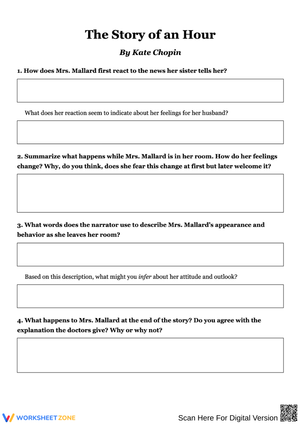
Irony worksheets for 10th grade give teachers a structured path through one of the most persistently misunderstood literary devices in secondary ELA — not labeling exercises that stop at identification, but analysis tasks that ask students to explain what a specific instance of irony actually accomplishes inside a text. The set covers verbal, situational, and dramatic irony through passage work drawn from short fiction, drama excerpts, and isolated dialogue, with written response prompts tied to each worksheet.
The Specific Skills Targeted
Each worksheet isolates one type of irony or one analytical move, keeping the cognitive load manageable before students encounter passages where multiple types operate simultaneously.
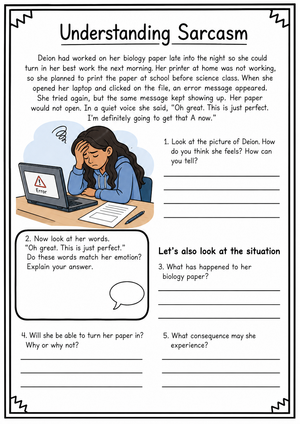
- Verbal irony: Students read a dialogue exchange, mark the literal meaning of what the speaker says, restate the intended meaning in their own words, and explain what the gap reveals about character or tone.
- Situational irony: Students identify the specific expectation a character holds, trace the mechanism that reverses it, and write a sentence connecting the reversal to the story's theme — not just "this was unexpected" but why the reversal carries thematic weight.
- Dramatic irony: Students annotate a scene by naming exactly what the reader knows that the character does not, then explain how that knowledge gap shapes the reader's emotional response — tension, dread, dark humor, or tragedy.
- Irony vs. coincidence: One worksheet addresses this distinction directly, using paired scenarios where students decide which constitutes situational irony and which is simple misfortune, supported by a written justification. This is the most direct intervention for the labeling error that persists longest at this grade level.
- Layered analysis: Later worksheets present a complete short story excerpt and ask students to identify multiple types of irony operating at once — the kind of close reading that RL.9-10.5 demands before students can write at the analytical level the standard requires.
Student Errors Worth Anticipating Before You Assign These
The most durable misconception at 10th grade is treating any surprising or unfortunate outcome as automatically ironic. Students reading Romeo and Juliet will write "it's ironic that Romeo dies" — not entirely wrong, but not the analysis the standard requires. They haven't named what makes it dramatic irony: the audience holds the information that Juliet is merely asleep while Romeo, acting on Friar Laurence's undelivered letter, makes a fatal decision based on false information. The dramatic irony worksheets address this by requiring students to specify the exact knowledge the audience holds that the character lacks, rather than describing the ending as simply tragic or unexpected.
A second persistent error is conflating verbal irony with deception. Students will mark a character who lies to another character as "using verbal irony," missing the audience-direction distinction. Verbal irony works because the reader sees the gap between stated and intended meaning — it is aimed at the audience, not at another character inside the story. When the reader is also deceived along with the character, the device is misdirection, not verbal irony. Students rarely sort this out through definition review; they sort it out by working through examples where the distinction becomes visible in practice.
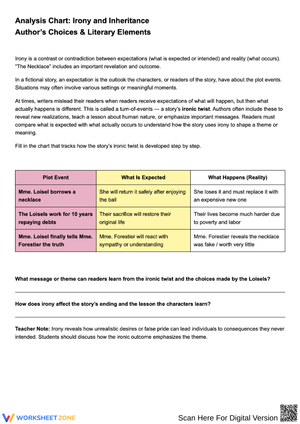
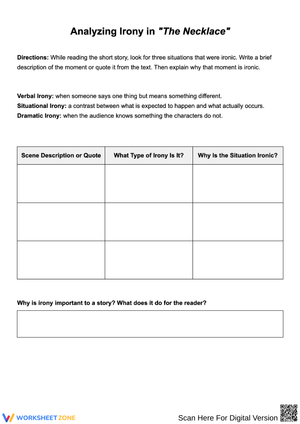
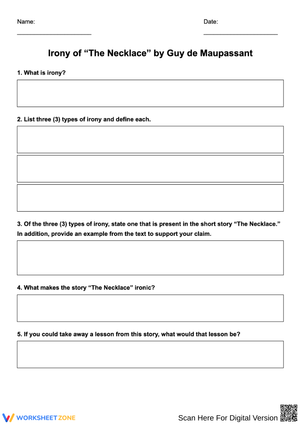
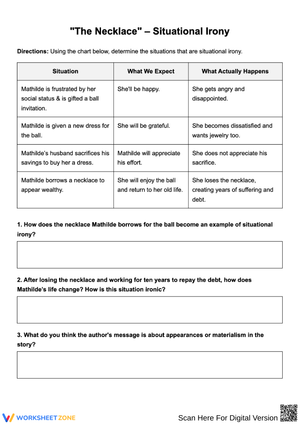
The situational irony worksheets target a third error: the "it's just weird" explanation. Students write that The Necklace is ironic "because she lost it," skipping the structural point — Mathilde spent ten years in poverty restoring monetary value to something that had none, and her very effort to protect social appearance destroyed the life she was trying to preserve. The worksheets prompt students with a two-part sentence frame that requires them to name both the specific expectation and the mechanism of its reversal, pushing the analysis from vague observation toward genuine precision.
How to Fit These Worksheets Into Your Weekly Planning
Teachers find that irony worksheets for 10th grade work at multiple points in the instructional sequence, so the question is less about when to introduce them and more about what work they need to do on a given day. The verbal irony worksheet that draws from everyday dialogue and pop-culture exchanges makes a reliable bell-ringer during the unit's first week — students who already use irony fluently in conversation are often surprised they can name it, and the five-minute opener surfaces prior knowledge before the analytical expectations increase. Later in the week, the situational irony worksheet pairs well with a first read of The Gift of the Magi or The Necklace: assign each worksheet after reading, have students compare their reversal-mechanism sentences in pairs, then debrief as a class before students draft a written response.
For the dramatic irony worksheets, a two-day sequence works well. On day one, students annotate the passage and complete the worksheet independently. On day two, before returning to the text, give students three minutes to recall — without looking — what the audience knows that the character does not. That brief retrieval exercise deepens retention more than rereading the passage does and primes the class for the kind of discussion where dramatic irony gets genuinely interesting. The irony-vs.-coincidence worksheet earns its place late in the unit — a Friday review slot after students have encountered all three types and need to make fine distinctions under some pressure.
Standard Alignment
These worksheets address two CCSS ELA-Literacy standards with real instructional precision. RL.9-10.4 asks students to determine figurative and connotative meanings and analyze the cumulative impact of specific word choices on meaning and tone — verbal irony sits squarely there, because analyzing a speaker's word choice requires recognizing that the literal meaning and the intended meaning diverge. RL.9-10.5 asks students to analyze how an author's choices concerning structure and literary devices create effects such as tension, mystery, or surprise — that is the standard situational and dramatic irony analysis maps onto most directly.
Most 10th-grade ELA departments place this unit in the fall semester, after students have encountered the irony vocabulary as definitions in 9th grade and before they enter longer works where types layer — Hamlet, Oedipus Rex, or The Great Gatsby later in the year. The worksheets are sized for that in-between instructional moment: students know the terminology but haven't yet made the consistent leap to explaining authorial effect, which is exactly what the written response prompts require.
Adjusting These Worksheets for Different Student Levels
For mixed-ability classrooms, irony worksheets for 10th grade tend to be accessible in the identification portions and harder in the written analysis — which means differentiation is mostly a matter of how much you constrain the response prompt. For students who write strong analytical sentences independently, the open-ended prompts stand as written. For students who freeze at "explain how this irony contributes to tone," offering a sentence frame — The author uses [type of irony] to create a sense of ___, which shows the reader that ___ — removes the blank-page problem without lowering the analytical expectation. The thinking is still the student's; the frame just provides a starting point.
For students who need more support distinguishing between types, the irony-vs.-coincidence worksheet can be used before the situational irony passage work rather than after. Running it earlier gives those students a sorting framework they can return to when a passage asks them to identify what kind of irony they're reading. Students who finish early are well-suited to the extension question on the layered analysis worksheets, which asks them to argue whether two competing interpretations of the same ironic moment are both defensible — a task that pushes toward the textual argumentation that appears on AP Literature and state assessments alike.
Frequently Asked Questions
Which texts work best alongside these worksheets?
The Gift of the Magi and The Necklace are the most reliable pairings for situational irony — the reversal in each story is central, unambiguous, and thematically rich enough to sustain real discussion. For dramatic irony, any scene from Romeo and Juliet where the audience knows Juliet's condition while Romeo acts on the friar's undelivered message works cleanly with those worksheets. The Cask of Amontillado is the strongest verbal irony text at this level: Montresor's gracious remarks to Fortunato are chilling precisely because the reader is in on what Fortunato is not.
How do I help students who keep labeling everything "ironic"?
The irony-vs.-coincidence worksheet is the most direct intervention, but the more durable habit is asking students to name the specific expectation before they make any call. If a student can't articulate what someone expected or intended, they usually can't explain the reversal — and that gap in the explanation tells you they've noticed something surprising without confirming it meets the structural definition. Running the question "what was expected, what actually happened, and why was that expectation reasonable?" as a class routine across several lessons does more than any single correction.
Can these be used as formative assessment?
Yes, and that's one of their most practical classroom uses. A short worksheet at the end of a period gives a fast read on whether students can move from labeling to explaining before a full analytical paragraph or unit test is assigned. The irony worksheets for 10th grade in this set include written response components that reveal whether a student understands the concept analytically or has simply memorized the definition — two different problems that call for two different responses from the teacher.
Do students need prior instruction before starting the first worksheet?
The first two worksheets in the set use everyday-language examples — a character calling a traffic jam "great timing," a sportswriter praising a team's "brilliant" fumble — before moving into literary excerpts. Students with no prior exposure to the terminology can enter through those examples. That said, the written analysis prompts are built for 10th-grade writers; students need to write in complete analytical sentences and engage with narrative text at that level to get full use out of each worksheet.












 Interactive Worksheet Maker
 Quiz Maker
 Word Search Maker
 Crossword Puzzle Maker
 Word Scramble Generator
 Sentence Scramble Generator
 Handwriting Worksheet Generator
 Name Tracing Generator
 Fill In The Blank Generator