10th Grade Irony in The Necklace printable worksheets
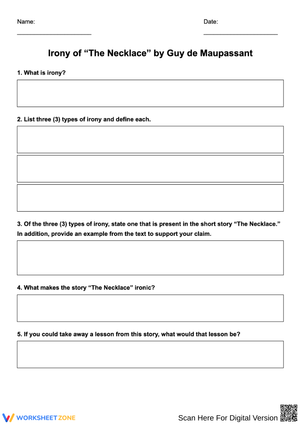
These 10th grade irony in the necklace printable worksheets give teachers the specific tools to move students past plot summary and into the kind of close reading Maupassant actually rewards. The story crams all three irony types into under ten pages, which is both its teaching strength and the source of real classroom confusion — students who can name situational, verbal, and dramatic irony in isolation often misapply the labels when all three appear in the same text. Each worksheet isolates a distinct skill before the set asks students to work across the story as a whole.
The Specific Skills These Worksheets Build
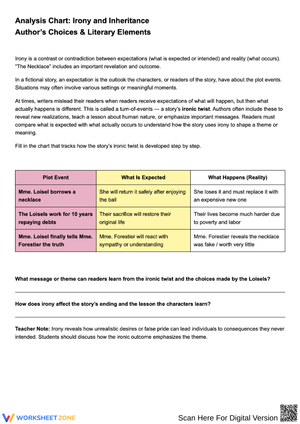
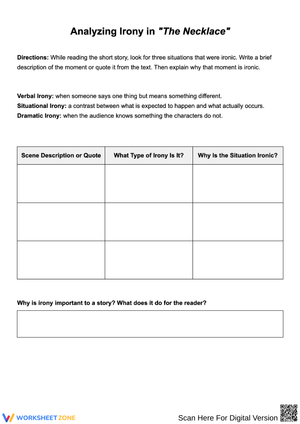
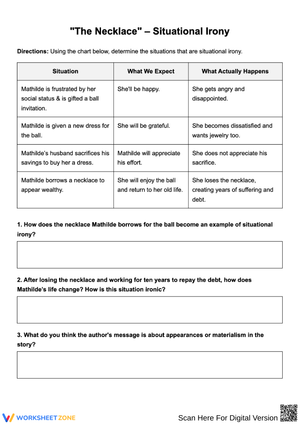
The core work is identification and evidence-based explanation — not just naming a type of irony but quoting the relevant passage and articulating what expectation the author sets up and how the text collapses it. One worksheet focuses on situational irony and asks students to map the gap between what Mathilde expects (a rise in social standing) and what she gets (ten years of hard labor to replace a worthless necklace). A second targets verbal irony through Mathilde's early narration — specifically her use of the word martyrdom to describe a life that includes a servant, a devoted husband, and a roof over her head. A third worksheet handles dramatic irony and asks students to track the information gap: what does the reader know during the Loisels' ten years of sacrifice that Madame Forestier does not? Students mark specific passages and annotate each with the dramatic question the reader holds but the characters cannot answer.
The set also includes a synthesis worksheet where students compare two irony types within the same scene. The ending — Madame Forestier's revelation — generates situational irony for Mathilde and a retrospective collapse of the dramatic irony that sustained the whole middle section. Getting students to articulate that distinction in writing is genuinely difficult, and the worksheet handles that task through a two-column graphic organizer rather than an open-ended prompt, which keeps students from writing their way around the distinction instead of through it.
Mistakes Students Make That These Worksheets Help You Catch
The most persistent error in student work on this story is misclassifying the twist ending as dramatic irony. Students hear that dramatic irony involves knowing something a character doesn't, and the ending feels like a revelation — so they assume it must be dramatic. But the twist surprises everyone, including the reader, which makes it situational. The actual dramatic irony lives in the middle section: the reader watches the Loisels age and suffer through grinding poverty to repay a debt for a real diamond necklace, while Madame Forestier, who owns the worthless original, has no idea any of this happened. Pointing students to the story's middle chapters — not its final paragraph — is where the dramatic irony worksheet does its most important work.
A second error worth anticipating is imprecision in verbal irony analysis. Students identify Mathilde's complaints as "ironic" in a vague, colloquial sense rather than explaining the structural contrast: she uses language associated with suffering and sacrifice at a point in the narrative where she has not actually suffered or sacrificed anything. The worksheet asks students to write out what martyrdom genuinely means, then describe Mathilde's actual circumstances at that moment, then explain the gap between the two. That sequence — definition, context, contrast — forces the specificity that clears up the loose use of "ironic" that shows up in almost every first draft on this story.
Building These Worksheets Into Your Lesson Sequence
The most natural placement is a three-day sequence immediately after the first full read. On day one, students complete the situational and verbal irony worksheets — those require the least prior analysis and work well as individual practice with a brief whole-class debrief at the end of the period. Day two handles dramatic irony, which benefits from a brief return to the middle section of the story — the ten-year labor sequence — before students annotate independently. Day three is the synthesis worksheet, which runs best as partner work followed by a Socratic discussion; the comparison task is hard enough that students benefit from talking through their reasoning before committing it to writing. 10th grade irony in the necklace printable worksheets also work well as the anchor for a Monday warm-up block when returning to the story before a unit assessment — assign one worksheet as a retrieval task and spend the first ten minutes comparing answers before moving into new instruction.
One honest limitation: the verbal irony worksheet assumes students have read the full story and know how Mathilde's life ends. If your reading schedule splits the text across multiple days, hold that worksheet until the class has finished. The irony of Mathilde's early complaints only fully registers once students know what real hardship looks like for her by the final pages — without that knowledge, students tend to write about her complaints as simple character flaws rather than ironic contrasts.
Appearance Versus Reality as the Thematic Anchor
The irony in this story is not decorative. Maupassant uses all three types to make a specific argument about social class: that the markers of wealth and status are often hollow, and that people who mistake symbols for substance pay for that confusion in ways they cannot anticipate. The fake necklace passes perfectly among the elite at the ball, which means the elite themselves cannot tell real wealth from imitation. That is not a minor plot detail — it is Maupassant's central claim. Worksheets that connect the irony analysis to the appearance-versus-reality theme ask students to write one sentence explaining what the necklace represents for Mathilde and one sentence explaining what Maupassant thinks it actually represents. Getting both sentences right requires a student to hold the irony in mind while articulating the theme — a harder cognitive move than simply labeling a passage, and the move that separates literary analysis from plot retelling.
Standard Alignment
CCSS.ELA-LITERACY.RL.9-10.4 asks students to analyze the cumulative impact of specific word choices on meaning and tone — directly applicable to Maupassant's use of language like martyrdom to signal verbal irony. CCSS.ELA-LITERACY.RL.9-10.5 targets analysis of how an author's structural choices create effects such as mystery, tension, or surprise, which is exactly what the dramatic and situational irony worksheets address. In most 10th grade ELA sequences, "The Necklace" appears in a short fiction unit or a thematic unit on social class; either placement maps to the literary analysis skills these two standards require. The synthesis worksheet, which asks students to compare irony types within the same scene, also touches on CCSS.ELA-LITERACY.W.9-10.1 when used as a written response task — students must make a claim about how the irony functions and support it with textual evidence, which is the core demand of the argument writing standard at this grade level.
Adjusting the Set for a Range of Learners
For students who struggle to distinguish the three irony types in application, a useful first step is to provide each worksheet with the irony type already labeled and ask students only to find the textual evidence and explain the contrast. That keeps the cognitive demand on analysis rather than recall of definitions. Once students can consistently explain what the gap is — between expectation and outcome, between what is said and what is meant, or between what the reader knows and what the character knows — pull back the label and ask them to classify on their own. That progression moves from supported identification to independent application without simply re-teaching terms from scratch.
10th grade irony in the necklace printable worksheets can also push advanced readers who have already demonstrated solid irony identification. Assign those students a comparative task alongside the standard worksheet: identify a parallel use of situational irony in O. Henry's "The Gift of the Magi" and write a paragraph explaining what each author's use of the device reveals about their respective themes. Maupassant's ending is cynical and withering; O. Henry's is tender and affirming. Same structural device, opposite tonal effect. That comparison surfaces something more sophisticated than any single-text analysis can reach on its own.
Frequently Asked Questions
Do students need to finish the story before starting these worksheets?
Yes — at minimum for the dramatic irony and synthesis worksheets. The verbal irony worksheet can begin after students have read the story's opening section, but the full weight of Mathilde's early complaints only becomes ironic once students know how the decade of labor ends. Running any of these worksheets mid-story risks producing surface-level responses that miss the cumulative effect Maupassant spends the entire narrative building.
How long does each worksheet typically take during a class period?
The situational and verbal irony worksheets run about 20 to 25 minutes for most 10th graders — enough for individual work plus a brief pair-share before whole-class discussion. The dramatic irony worksheet, which requires students to return to the middle section and annotate specific passages, runs closer to 30 to 35 minutes. Budget a full period for the synthesis worksheet if you want time for the discussion that follows, because the comparative thinking the worksheet generates is too valuable to cut short.
How do I handle students who argue the twist ending is "just a surprise," not irony?
That is a productive misconception to surface rather than correct quickly. Push students to define what distinguishes irony from mere surprise: irony requires a structural gap between expectation and outcome, not simply an unexpected event. Then ask them what expectation Maupassant spent most of the story constructing and how the final revelation collapses it. Students who work through that question in writing usually arrive at a more durable understanding of situational irony than students who accepted the label without questioning it in the first place.
Can these worksheets substitute for a Socratic seminar on the story?
No — and they should not try to. Written irony analysis identifies and explains; a Socratic seminar generates the interpretive friction that moves students toward evaluative and comparative thinking. The most effective classroom sequence treats the 10th grade irony in the necklace printable worksheets as preparation for discussion rather than a replacement for it. Students who have already worked through the three irony types in writing come to a seminar with sharper claims and better textual evidence than students who enter the discussion with only their reading notes.
Clear All