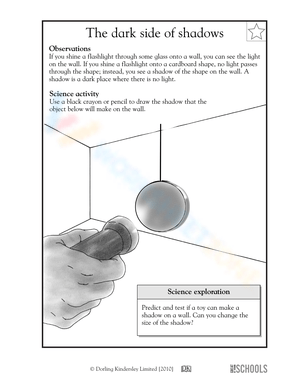
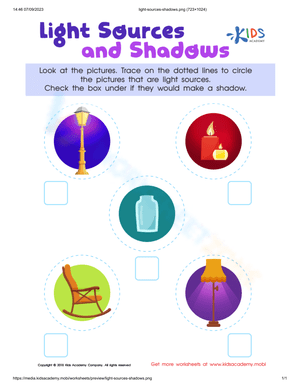
These 1st grade shadow work printable worksheets give teachers a ready-to-use set of activities for the light and shadows unit — the unit where students are already asking questions before instruction begins because they have been watching their shadows stretch across the playground all year. Each worksheet isolates a specific skill rather than bundling multiple concepts into a single task, so teachers can pull one for direct instruction, assign another during station rotation, and save a third as an informal end-of-unit check. The set spans shadow matching, material sorting, outdoor observation recording, diagram labeling, and shadow prediction tasks.
What Each Worksheet Targets
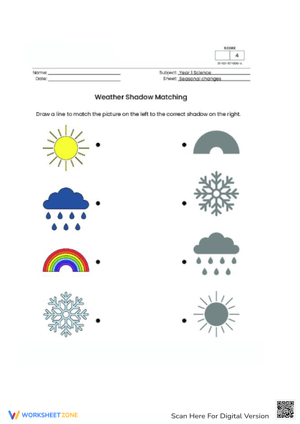
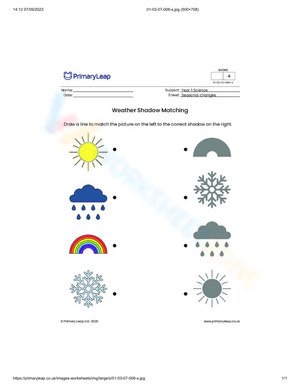
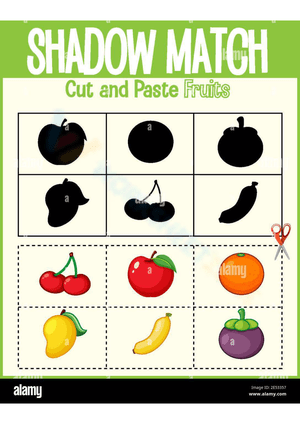
The matching worksheets ask students to draw lines between a row of familiar objects — a pencil, a cup, a hand shape — and the corresponding shadow silhouettes arranged in a separate column. The task looks simple until students discover they must hold the object's precise shape in mind and account for orientation. Selecting the right silhouette requires spatial reasoning, not just shape recognition, which gives the exercise more cognitive weight than it first appears.
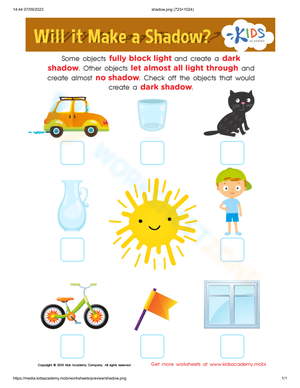
Sorting worksheets present photographs of common materials and ask students to place each one under opaque, translucent, or transparent columns. Grade 1 students rarely retain all three vocabulary terms after a single lesson, but repeated sorting builds reliable recognition. By the third time a student places wax paper in the "lets some light through" column, the concept is consolidating even when the word translucent hasn't fully landed yet.
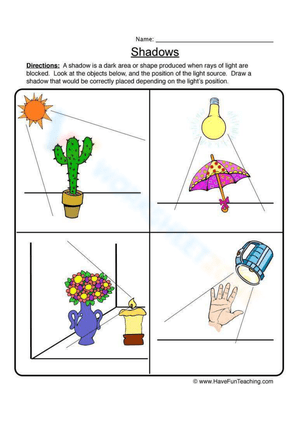
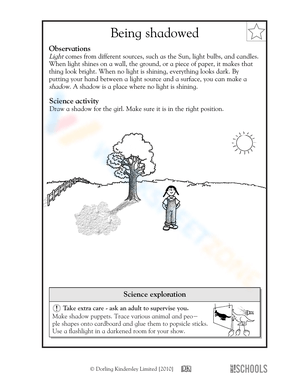
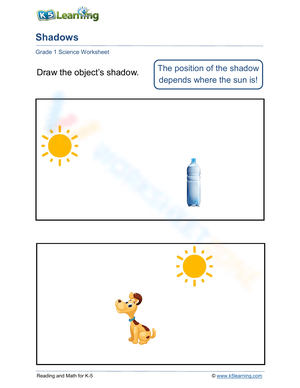
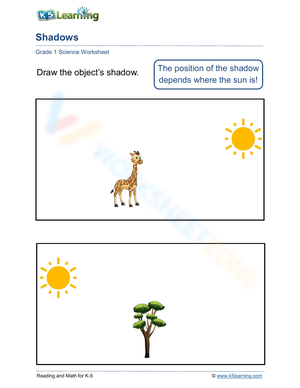
The shadow journal worksheet provides three framed boxes — Morning, Noon, Late Afternoon — where students sketch and briefly annotate a shadow they observed outside. It functions as an observational recording task and as an early writing integration point simultaneously. The predict-and-draw worksheet operates at a higher level: students are given an object and a directional arrow representing a light source, then draw where the shadow falls. This is the set's most demanding task and works best placed at the close of the unit.
The diagram-labeling worksheet shows a light source, a solid object, and a cast shadow, with blank labels for each part. Filling in those labels reinforces the cause-and-effect logic — light travels until an object blocks it, and the blocked region becomes the shadow — which is the conceptual core of the entire unit.
Frequent Student Errors Worth Watching For
The most consistent error in shadow matching tasks: students flip silhouettes incorrectly. A child who correctly identifies that a mug has a handle will still select the wrong silhouette because they don't account for the direction the handle faces when the shadow is cast. They match shape category rather than precise orientation. A quick whole-group demonstration — hold the mug under a flashlight, cast its shadow on the board, ask students what changed — resolves this faster than written corrections on a returned worksheet.
On the sorting worksheets, aluminum foil causes persistent confusion. Students see it as shiny rather than opaque and frequently place it alongside transparent or translucent materials. A brief pre-sorting moment with actual foil under a flashlight settles the question immediately. Frosted glass in photographs presents a similar problem: students assume all glass is transparent because windows are, but the image of a frosted bottle challenges that assumption in ways that produce genuinely productive conversation.
On the journal page, students regularly draw their shadow on the same side as the sun rather than opposite it. A first grader who sketches the Morning box with the shadow facing east when the sun is also in the east is revealing the core conceptual gap the unit is trying to close. Seeing that error on a worksheet is diagnostic — it tells the teacher exactly what to revisit before moving the class to the predict-and-draw task.
Building These Worksheets Into Your Lesson Sequence
Sequence matters here more than in most Grade 1 science units. Start with two days of purely physical investigation: flashlights, classroom objects, a darkened room, and no worksheets at all. Students who discover on their own that a lower angle of light produces a longer shadow bring a working mental model to every worksheet they complete afterward. Distributing the matching worksheet on Day 1, before any hands-on exploration, tends to produce guessing rather than reasoning.
The most productive classroom move with 1st grade shadow work printable worksheets is pairing an outdoor shadow walk with the journal worksheet on the same day. Send students outside at 9 a.m. with chalk — have them trace a partner's shadow on the blacktop, mark it with the time, and return at noon and again at 2 p.m. to trace the same shadow. Back inside, students fill in their three journal boxes from memory that is still fresh. This produces noticeably richer drawings and more specific student language than sending them out to observe one afternoon and asking them to fill in the sheet the following morning. The observational details are still live.
After the outdoor session, use the sorting and matching worksheets across the next two days during independent station work. These tasks reward distributed exposure over time — students internalize the material categories more reliably if they sort on two separate occasions rather than once for a longer stretch. The predict-and-draw worksheet belongs at the end, functioning as a low-stakes formative check before any summative discussion about what the class learned.
Why This Format Works for This Skill at This Grade
First graders reason far more reliably about things they have physically handled and observed than about abstractions. Shadow science fits this developmental window well because the phenomena are visible, immediate, and personally relevant — students watch their own shadows change size across a single school day. These worksheets work because they extend a physical experience rather than substitute for it. A matching task completed after a flashlight demonstration carries different cognitive weight than the identical task assigned before any hands-on exploration.
The predict-and-draw format represents a deliberate shift in cognitive demand. Observation tasks ask students to record what happened. Prediction tasks ask students to apply a pattern they've constructed internally to a new situation they haven't seen before. That move from observation to application is the core of NGSS science practice, and having a worksheet format that specifically asks for prediction — rather than description of something already witnessed — gives teachers a clear window into who has built a generative understanding and who is still working from surface pattern recall.
Adjusting the Worksheets for a Range of Learners
For students who struggle with fine motor demands, the matching worksheets work well with sticky dots rather than drawn lines — students place a colored dot on the object and a matching dot on its silhouette. This removes the coordination barrier without altering the conceptual task at all. On the diagram-labeling worksheet, offer a word bank on a separate sticky note attached to the page rather than embedding it directly on the worksheet; students who need the support use it, and students who don't set it aside.
For students who move through the standard tasks quickly, extend the predict-and-draw worksheet by asking them to predict shadow placement from two different light source positions rather than one. A student who can correctly draw a shadow from a light source directly overhead and from a light source angled low to the left has demonstrated real understanding of the relationship — not pattern recall. The journal page can be extended with a sentence requiring causal reasoning: not just what the shadow looked like, but why it was longer at one time than another.
When English is a developing language in the classroom, the sorting and matching worksheets transfer well because they rely on visual discrimination rather than language production. The diagram-labeling task works with picture-supported vocabulary cards placed next to the worksheet, allowing students to match terms to positions without first needing to retrieve the English word from memory independently.
Standard Alignment
These worksheets address NGSS performance expectation 1-PS4-3 (Waves and Their Applications in Technologies for Information Transfer), which asks Grade 1 students to plan and conduct investigations to determine the effect of placing objects made of different materials in the path of a beam of light. In classroom terms, this standard sits at the intersection of physical science content and investigative practice — students aren't only learning that opaque objects block light; they are developing the habit of observing systematically, recording what they notice, and using that evidence to make predictions. The sorting tasks build content knowledge about how different materials interact with light; the journal page develops observational recording skills; the predict-and-draw worksheet addresses evidence-based reasoning. The 1st grade shadow work printable worksheets in this set align most directly with this standard's emphasis on structured observation and prediction rather than passive content delivery.
Frequently Asked Questions
Do students need hands-on experience before using these worksheets, or can the worksheets introduce the concept?
Students get substantially more from every worksheet in this set after they have explored shadow formation with actual objects and a light source. The matching and prediction tasks require a mental model of how shadows form — a model that comes from handling a flashlight and an object, not from reading a printed definition. A two-minute flashlight demonstration before the first worksheet measurably improves the accuracy and specificity of student responses.
What vocabulary should be in place before students begin the sorting and labeling worksheets?
Students should have working familiarity with light source, shadow, and opaque before attempting the sorting or labeling worksheets. The terms translucent and transparent can be introduced alongside the sorting worksheet rather than before it — the act of sorting cements the vocabulary more effectively than pre-teaching alone. A word wall with simple illustrations posted where students can see it during independent work removes the vocabulary retrieval burden and keeps attention on the conceptual task.
How does the predict-and-draw worksheet function as assessment?
It works as a formative check rather than a summative grade. A student who draws the shadow on the correct side and adjusts its length plausibly based on the light source angle has applied the unit's core concept to an unfamiliar situation — that is the evidence teachers are looking for. Students who place the shadow on the same side as the light source are showing the same directional error that appears on the journal page, which tells the teacher the concept needs another hands-on reinforcement before moving on.
Are these worksheets usable with students who are not yet writing independently?
Most tasks in the set require drawing, line-drawing, or cut-and-paste rather than sentence writing. The journal page is the only worksheet with a writing component, and it works well as a dictation-to-teacher activity or with a sentence frame posted on the board. The 1st grade shadow work printable worksheets set overall is accessible across a wide range of writing readiness levels because the majority of tasks are grounded in visual discrimination and sketching rather than independent sentence production.












 Interactive Worksheet Maker
 Quiz Maker
 Word Search Maker
 Crossword Puzzle Maker
 Word Scramble Generator
 Sentence Scramble Generator
 Handwriting Worksheet Generator
 Name Tracing Generator
 Fill In The Blank Generator




 BACK TOSCHOOL