


























Views
Downloads
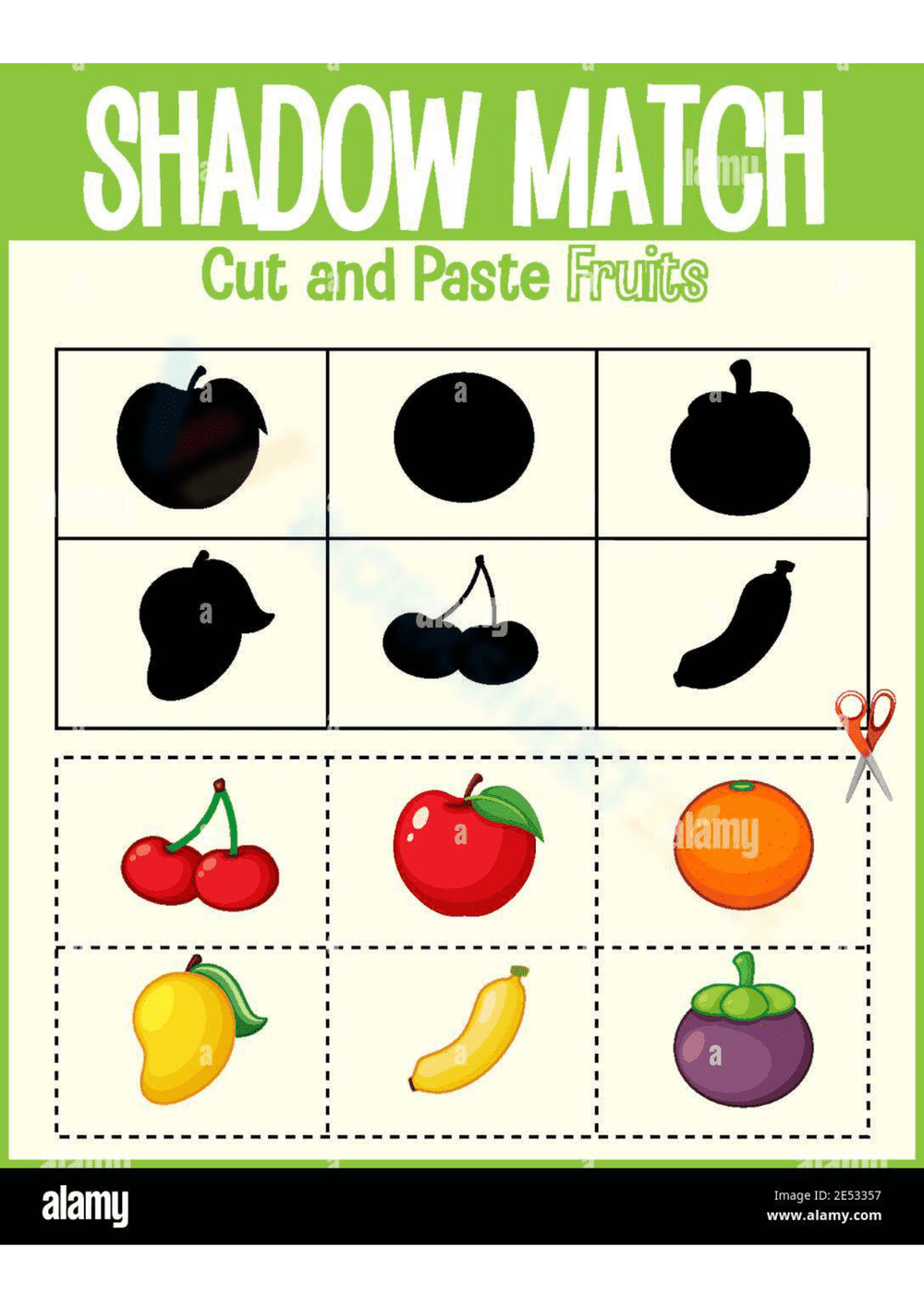

Grade K Fruit Shadow Match — Printable No-Prep Worksheet
Paste this activity's link or code into your existing LMS (Google Classroom, Canvas, Teams, Schoology, Moodle, etc.).
Students can open and work on the activity right away, with no student login required.
You'll still be able to track student progress and results from your teacher account.
This engaging fruit shadow matching worksheet helps Kindergarten students develop essential visual discrimination and fine motor skills. By identifying the correct silhouette for each colorful fruit, early learners practice shape recognition and spatial awareness. The cut-and-paste format keeps young hands active while reinforcing foundational observation techniques.
At a Glance
- Grade: K · Subject: Science
- Standard:
CCSS.MATH.CONTENT.K.G.A.2— Identify and match shapes regardless of orientation- Skill Focus: Visual discrimination and fine motor skills
- Format: 1 page · 6 problems · Answer key included · PDF
- Best For: Independent practice and centers
- Time: 10–15 minutes
This single-page resource features a straightforward layout for early childhood education. The top section displays six black-and-white fruit silhouettes, including an apple, cherry, banana, and mango. The bottom section provides corresponding full-color fruit illustrations with dashed cut-lines. Students use scissors to cut out the six fruits and paste them over their matching shadows. The self-correcting visual match means no separate answer key is required.
This activity requires zero teacher preparation.
- Print (1 minute): Print the single-page PDF. The high-contrast shadows render beautifully on standard printers.
- Distribute (1 minute): Hand out the page along with child-safe scissors and glue sticks. The visual instructions are intuitive for non-readers.
- Review (1 minute): Quickly scan the completed pages to verify that all six fruits are pasted correctly.
Total teacher prep time is under two minutes, making this an excellent, reliable option for emergency sub plans or spontaneous center rotations.
This activity aligns with early learning geometry and observation standards, specifically CCSS.MATH.CONTENT.K.G.A.2: "Correctly name shapes regardless of their orientations or overall size." Matching a complex 2D shape to its silhouette directly supports this standard. Students analyze the contour and overall proportion to make a successful match. Both standard codes can be copied directly into lesson plans, IEP goals, or district curriculum mapping tools.
This worksheet serves as excellent morning work to settle students while activating visual processing skills. It functions perfectly as an independent center station during guided reading blocks. Teachers can use this as a quick formative assessment to observe scissor grip, cutting accuracy, and spatial reasoning. Expect students to complete the matching and pasting process within a 10 to 15-minute timeframe.
This resource is primarily designed for Kindergarten and first-grade students developing their fine motor control and visual discrimination abilities. It is highly beneficial for occupational therapy sessions or special education classrooms where students need targeted practice with scissor skills and shape matching. For a complete lesson, pair this worksheet with a read-aloud book about healthy eating or a hands-on science observation activity using real classroom fruits.
Developing strong visual discrimination through engaging activities like shadow matching is a critical precursor to letter recognition and early reading success in young learners. When students practice identifying and matching shapes regardless of orientation, directly aligned with CCSS.MATH.CONTENT.K.G.A.2, they actively train their brains to notice subtle differences in form, contour, and line. According to EdReports 2024, integrating fine motor tasks like cutting and pasting with cognitive matching exercises significantly improves both spatial awareness and hand-eye coordination in early childhood classrooms. This highly effective dual-focus approach ensures that young learners simultaneously build the physical dexterity required for future handwriting success and the visual processing skills absolutely necessary for decoding complex text. By successfully completing these six targeted matching tasks, students consistently reinforce the foundational observation habits that support long-term academic achievement across both foundational literacy and early STEM disciplines.


