




























Views
Downloads


Playing with Shadows Worksheet | Essential Grade 1 Science

Paste this activity's link or code into your existing LMS (Google Classroom, Canvas, Teams, Schoology, Moodle, etc.).
Students can open and work on the activity right away, with no student login required.
You'll still be able to track student progress and results from your teacher account.
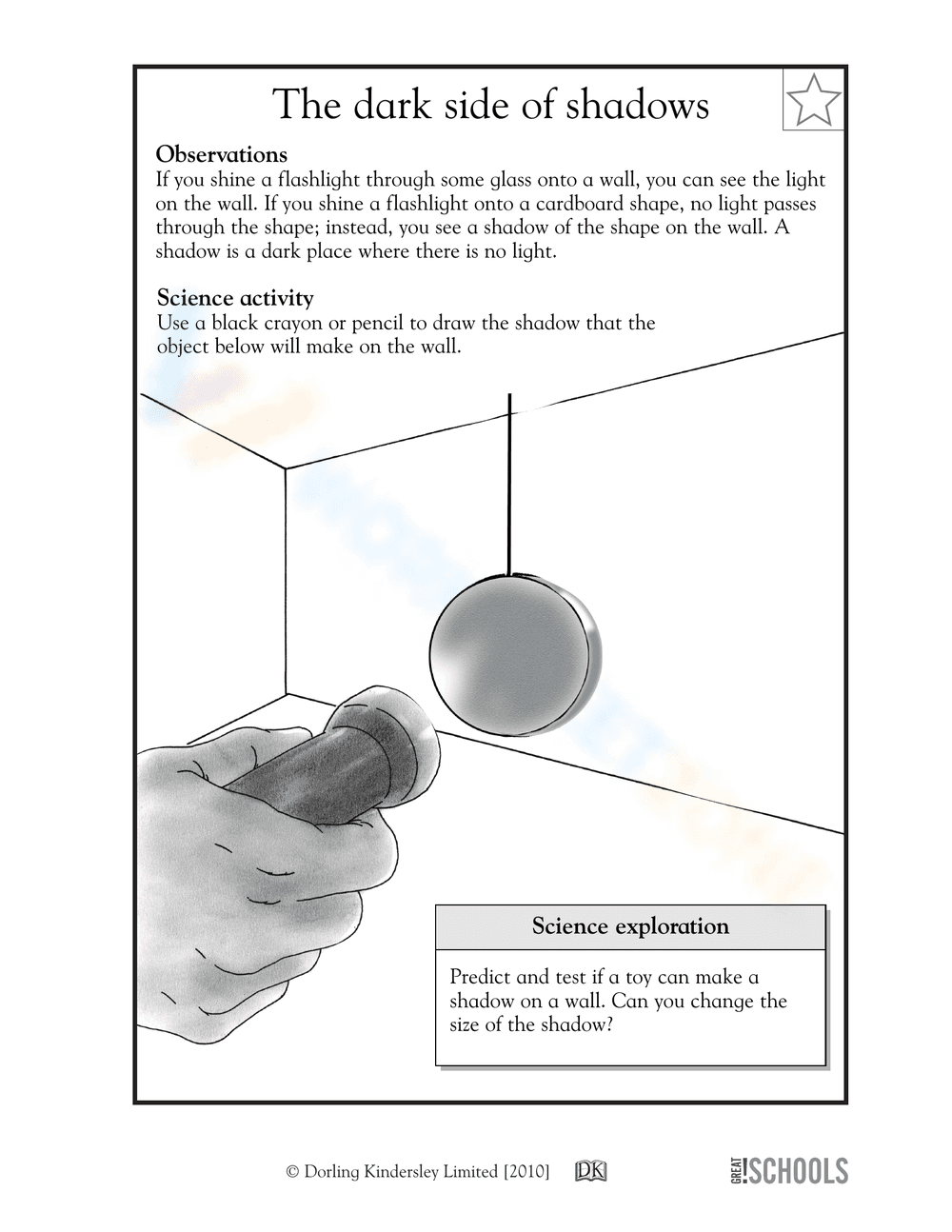
This Grade 1 science worksheet helps students understand the physical properties of light and shadow. By observing how solid objects block light beams, learners develop a foundational grasp of cause and effect in the physical world. Students will identify that shadows are dark places where light is absent, reinforcing core scientific vocabulary through hands-on illustration.
At a Glance
- Grade: 1 · Subject: Science
- Standard:
1-PS4-3— Plan and conduct investigations to determine how objects block light beams- Skill Focus: Shadow formation and light blocking
- Format: 1 page · 1 task · Answer key included · PDF
- Best For: Introductory physical science lessons
- Time: 15–20 minutes
The resource features a clear observation block that explains the difference between transparent glass and opaque cardboard. It includes a central science activity where students use a black crayon to draw a shadow based on a provided light source and object. A science exploration box at the bottom provides an extension prompt for testing real-world objects with flashlights. A full-color answer key is provided for quick grading and self-correction.
Zero-Prep Workflow
- Print: Select the single-page PDF and print enough copies for your class in under 30 seconds.
- Distribute: Hand out the sheets along with black crayons or pencils; no complex lab setup is required for the initial drawing task.
- Review: Use the included answer key to check for student understanding of shadow placement relative to the light source in less than 1 minute.
This workflow is ideal for emergency sub plans or quick morning work where teacher preparation time must be kept under 2 minutes.
This worksheet is aligned with 1-PS4-3, which requires students to plan and conduct investigations to determine the effect of placing objects made with different materials in the path of a beam of light. It specifically addresses the concept of opacity and the resulting shadow. Both standard codes can be copied directly into lesson plans, IEP goals, or district curriculum mapping tools.
Use this worksheet during the "Explore" phase of a 5E lesson cycle. After a brief demonstration with a flashlight and a ball, assign the drawing task to check for individual comprehension. As a formative assessment, observe whether students place the shadow directly opposite the light source. Completion typically takes 15 to 20 minutes, making it a perfect transition activity.
This resource is designed for first-grade students but is also appropriate for second and third graders needing a refresher on light properties. The heavy use of visual cues makes it an excellent support tool for English Language Learners (ELLs) and students with IEPs who benefit from reduced text density. Pair this with a classroom anchor chart about light sources and shadows.
The 1-PS4-3 standard emphasizes the importance of early scientific inquiry through observable phenomena. According to Fisher & Frey (2014), the gradual release of responsibility is most effective when students move from guided observations to independent application. This worksheet facilitates that transition by providing a clear conceptual model of light blocking before asking students to predict and draw the resulting shadow. By engaging with the physical relationship between a light source, an opaque object, and a surface, students build the mental frameworks necessary for more complex optics in later grades. Research from the NAEP highlights that early exposure to physical science concepts like light behavior significantly correlates with long-term proficiency in STEM subjects. This resource provides the structured practice needed to solidify these foundational concepts in a classroom-ready format.


