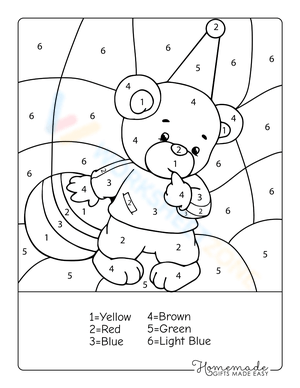
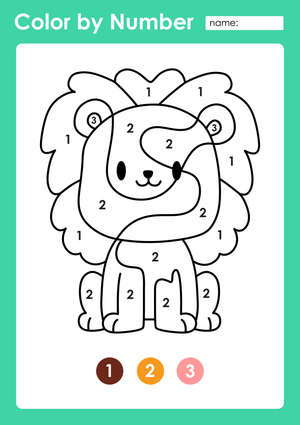
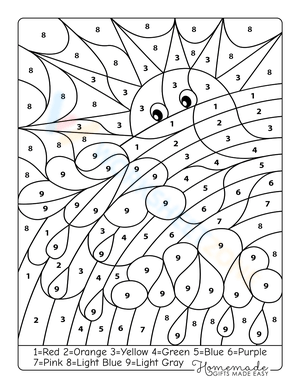
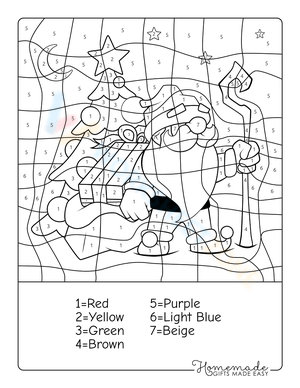
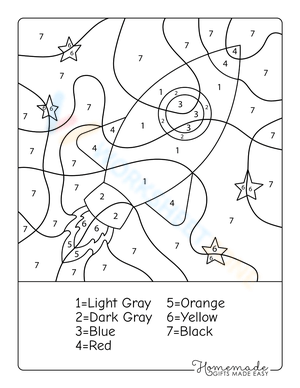
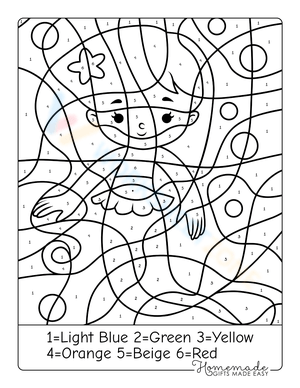
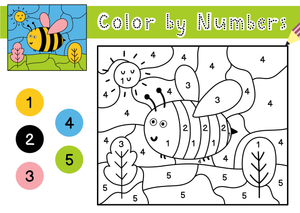
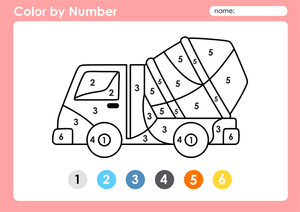
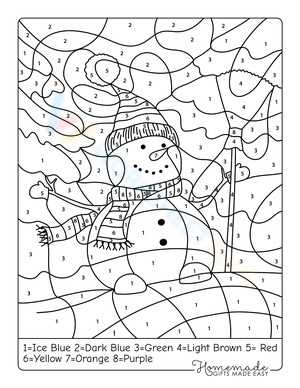
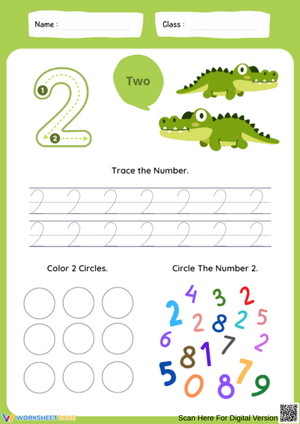
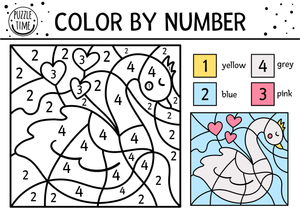
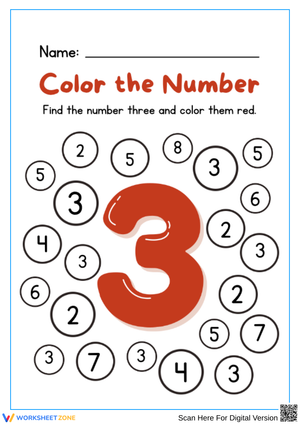
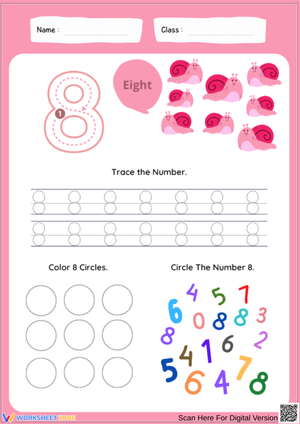
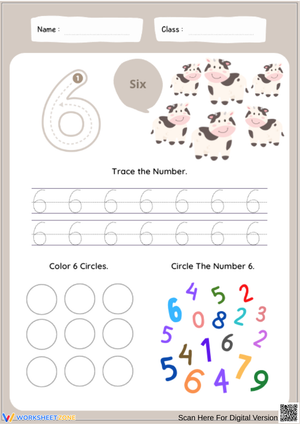
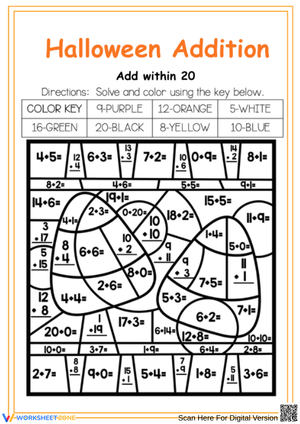
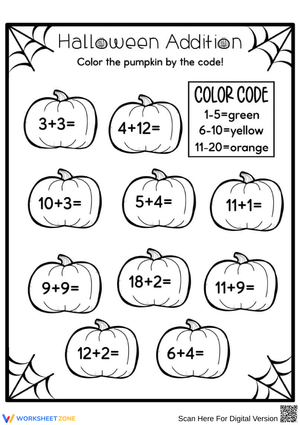
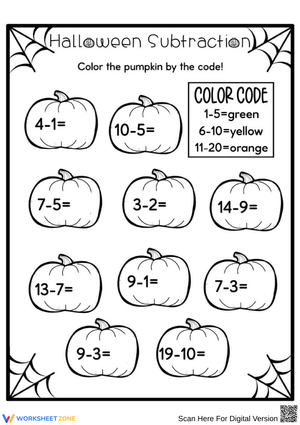
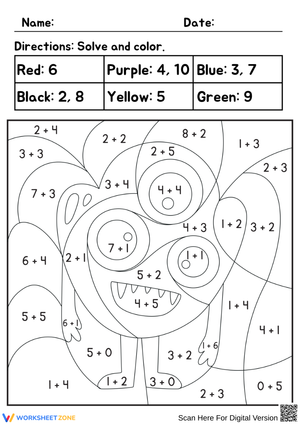
1st grade color by number pdf worksheets accomplish something most independent activities don't: they put numeral recognition, color-word sight reading, and fine motor practice into a single task students can run without ongoing teacher direction. The finished image does the feedback work — when a student grabs orange instead of brown and the tree trunk looks wrong, they catch it before anyone says anything.
The Specific Skills These Worksheets Build
The format behind 1st grade color by number pdf worksheets sends students through a tight cognitive loop: spot a numbered region, carry that numeral to the key, read the color word beside it, find the right crayon, apply the color, return to the image, and repeat. For a six-year-old, that sequence demands genuine focused effort, and the short-cycle repetition builds fluency without overwhelming working memory the way longer multi-step tasks can. At age six and seven, students are consolidating two separate symbol systems at once — numerals and printed words — and this is one of the few activity formats that exercises both in rapid alternation.
Science-themed versions extend the task into content vocabulary. When a worksheet depicts a labeled cross-section of a plant, an animal habitat, or a weather diagram, students slow down enough to examine what they're coloring, which carries over into stronger recall during class discussion. The set targets:
- Numeral identification in the 1–20 range most first-grade classrooms are actively working with
- Reading high-frequency color words, including less common ones like violet, tan, and scarlet that appear in more complex keys
- Two-step reference work: locate the number, then find and read its corresponding word in the key
- Controlled coloring within defined boundaries, which directly supports the pencil control needed for letter formation
- Science vocabulary connected to the image theme — animal characteristics, plant structures, seasonal change, Earth and sky patterns
Error Patterns Teachers See When Students Meet This Format
The most predictable first-session mistake is skipping the key entirely. Students who associate coloring with creative work assume the numbers are decorative and color by personal preference. A thirty-second explicit introduction handles it: "The number is an instruction, not a decoration — it tells you exactly which color to use." Once that expectation is established, students start monitoring each other without prompting.
Numeral confusion between 6 and 9 is the second pattern worth watching. Students who haven't fully automatized those two symbols will pull the wrong key entry and commit an incorrect color across several regions before stopping to check. When you see a sky colored brown or grass colored blue, compare those shades against where 6 and 9 appear in the key — that's almost always the source. A quick numeral-identification warmup before distributing the worksheet prevents most of these errors after the fact.
There's also a color-crayon mismatch that doesn't reflect any reading problem. A student reads brown correctly but reaches for orange because the two crayons sit next to each other in the box. This surfaces most often with violet/purple pairs and gray/black pairs. Asking students to hold up their chosen crayon before coloring — a five-second check — catches the majority of these before they become something to erase.
Building These Worksheets Into Your Week Without Disrupting Flow
The best placement for 1st grade color by number pdf worksheets is in the transition gaps that accumulate throughout a first-grade day — the eight minutes between morning meeting and the first instruction block, the stretch when early finishers wait while others complete a math task, the tail end of Friday afternoon when launching anything new would be wasted. Because students direct themselves through the task after the format introduction, teachers don't need to monitor closely. The activity runs quietly and independently, which is its main logistical advantage.
For science integration, timing matters more than teachers usually plan for. A habitat or life-cycle worksheet placed at an independent station immediately after whole-group instruction reinforces vocabulary while it's still accessible. Some teachers use the completed worksheet as a brief oral debrief at the end of science block — "tell me one thing you colored and why it looks that way in nature" — which turns the activity into science discourse without requiring a separate discussion task.
Placement options that work consistently across classroom settings:
- Morning arrival work — on desks before the bell, requiring no verbal explanation, accessible to students arriving over a 15-minute window
- Science center rotation — as a quieter follow-up after a hands-on observation, processing the same content through a different mode
- Emergency substitute plans — the format is familiar enough that a substitute can explain it in one sentence and the class runs independently
- Pre-unit preview — distribute a thematically matched worksheet before introducing a science topic to surface what students already notice in the visual
Differentiating the Set Across a Range of Student Readiness Levels
1st grade color by number pdf worksheets work across ability levels without requiring entirely different materials, but a few targeted modifications increase access meaningfully. For students who haven't yet consolidated color-word reading, print a small solid-color rectangle beside each word in the key before copying. Students still encounter the printed word each time they return to the key; the swatch removes the decoding barrier so the numeral-matching practice can continue. Remove that support structure once sight-word recognition becomes consistent.
For students ready for more, the completed image becomes a writing prompt. Two or three sentences describing what they colored — what the animal eats, how the plant grows, why the sky looks different at night — keep the task productive for the full work period. Students who finish both the coloring and the writing early can add detail to the image using colors outside the key, then write a sentence justifying each choice. This keeps them engaged with the science content rather than waiting for a separate extension.
For English language learners, the color key functions as a natural vocabulary anchor. Color words are among the earliest content categories acquired in a second language, and the visual image gives concrete meaning to each English term. Cross-referencing a home-language word list during key reading doesn't undermine the English practice — it speeds it up by giving students a conceptual bridge rather than asking them to hold an unknown word in isolation.
Standard Alignment
CCSS.ELA-LITERACY.RF.1.3.G asks students to recognize and read grade-appropriate irregularly spelled words. Color words — orange, purple, white, brown — appear on both Dolch and Fry high-frequency lists, and the repetitive key-referencing process delivers more purposeful exposures to those words in a single sitting than most reading activities provide. CCSS.MATH.CONTENT.1.NBT.A.1 covers reading and writing numerals in the 1–120 range; these worksheets practice the numeral-recognition component of that standard at low cognitive stakes, which matters because many students entering first grade haven't fully automatized all numerals from 1 to 20.
Science-themed worksheets align with NGSS standards across the K–2 band, particularly 1-LS1-1 (structures and functions of plants and animals), 1-ESS1-1 (observable patterns of the sun, moon, and stars), and 1-ESS1-2 (seasonal patterns). All three standards ask students to describe and compare observable features — and a carefully labeled image gives students a visual reference point they can return to during the oral discussions where that descriptive language develops.
Frequently Asked Questions
What number range is right for first graders?
Keys running 1–15 work for most first-grade classrooms. Students who entered first grade with solid number skills manage keys up to 20 without slowing down significantly. Keys that extend into two-digit territory above 20 shift the cognitive demand from numeral recognition to number identification — a distinct skill — which changes what the worksheet is actually practicing. Keep the range within what students have already consolidated unless the specific lesson goal is extending numeral fluency.
How do I introduce the format to a class that hasn't used color by number before?
One demonstration at the document camera is enough. Find a numbered region in the sample worksheet, walk to the key, read the color word aloud, pick up the crayon, color the space. Then invite one student to repeat the process with an adjacent region while the class watches. That takes under three minutes, and most students are ready to work independently. The only thing that requires reinforcement is the expectation that students check the key on every single region — not just the first few.
Can these worksheets serve as a formative check on science content?
They can, with one caveat: the coloring task itself reveals whether students can match numerals to color words, not whether they understand the science. The formative information comes from the brief conversation afterward. A student who looks at a completed food-web worksheet and explains one relationship — "the hawk eats the mouse" — is showing content knowledge. A student who only describes what colors they used has completed the task but hasn't demonstrated science comprehension. The image creates the prompt; the coloring gets students to look at it carefully enough to answer it.












 Interactive Worksheet Maker
 Quiz Maker
 Word Search Maker
 Crossword Puzzle Maker
 Word Scramble Generator
 Sentence Scramble Generator
 Handwriting Worksheet Generator
 Name Tracing Generator
 Fill In The Blank Generator




 BACK TOSCHOOL