


























Views
Downloads
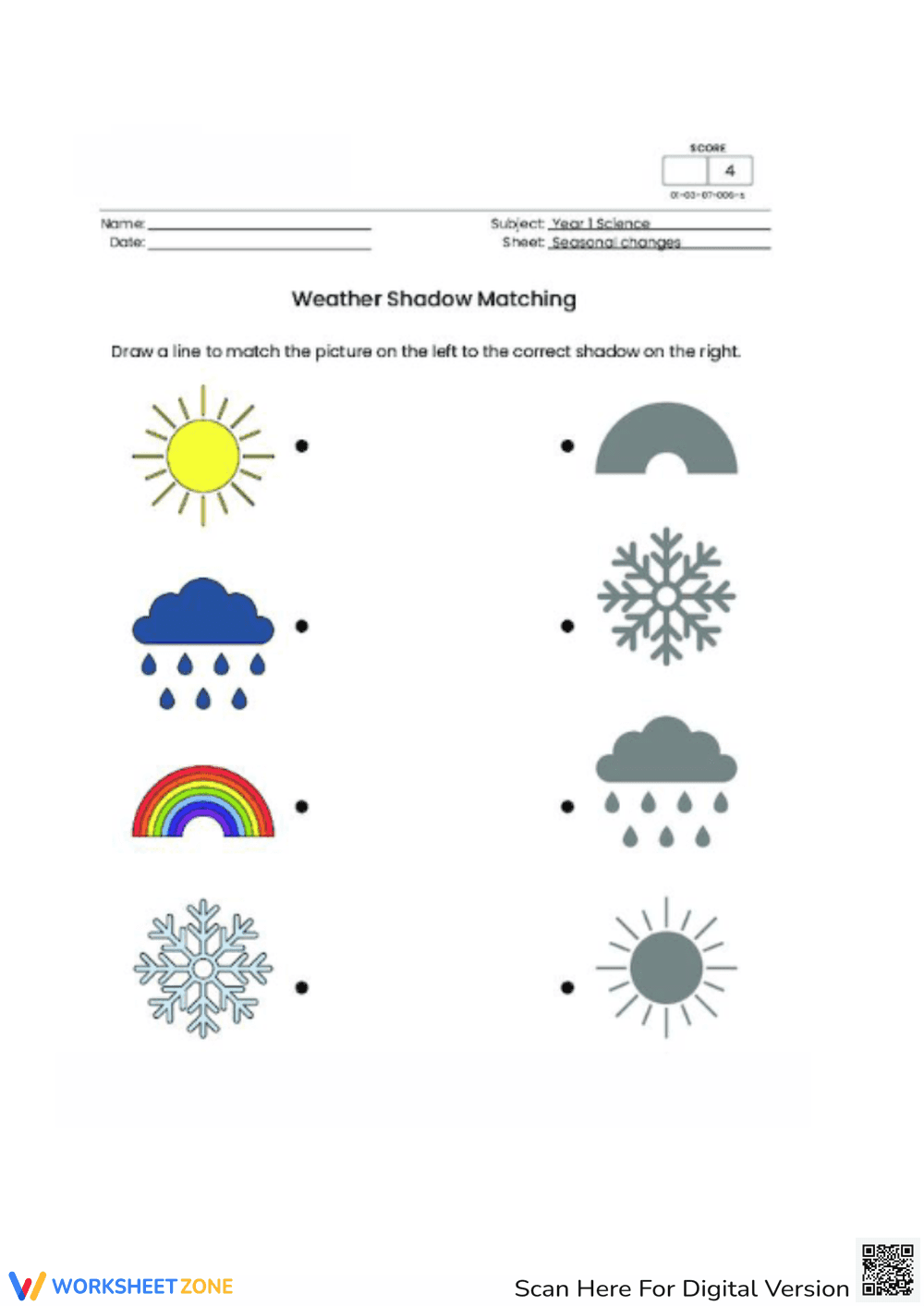

Weather Shadow Matching Printable | Grade 1 Science
Paste this activity's link or code into your existing LMS (Google Classroom, Canvas, Teams, Schoology, Moodle, etc.).
Students can open and work on the activity right away, with no student login required.
You'll still be able to track student progress and results from your teacher account.
This Grade 1 science worksheet helps students build visual discrimination skills by matching common weather symbols to their corresponding silhouettes. By connecting vibrant illustrations of the sun, rain, rainbows, and snow to their shadows, young learners reinforce their understanding of seasonal changes and weather patterns in an engaging, accessible format.
At a Glance
- Grade: 1 · Subject: Science
- Standard:
K-ESS2-1— Observe and describe local weather patterns over time- Skill Focus: Visual discrimination and weather symbols
- Format: 1 page · 4 problems · PDF
- Best For: Morning work or science centers
- Time: 5–10 minutes
Inside this single-page resource, educators will find a straightforward matching activity featuring four distinct weather conditions: sunny, rainy, rainbow, and snowy. The left column presents full-color, easily recognizable weather icons, while the right column displays their solid gray shadows in a mixed order. Students simply draw a line connecting the matching pairs. The clear layout minimizes distractions, making it highly effective for early childhood visual processing tasks.
Zero-Prep Workflow
Designed for immediate classroom implementation with no teacher setup.
- Print (1 minute): Simply download the PDF and print the required number of copies. Shadows print clearly in grayscale.
- Distribute (1 minute): Hand out the worksheets along with pencils or crayons. Visual instructions are intuitive for pre-readers.
- Review (3 minutes): Quickly check student work as a whole class or collect for a rapid visual assessment of their matching accuracy.
With a total prep time of under two minutes, this activity is an excellent addition to emergency sub plans or spontaneous transition periods.
Standards Alignment
This activity aligns with foundational science skills, specifically supporting K-ESS2-1: Use and share observations of local weather conditions to describe patterns over time. Recognizing standard weather symbols is the first step in recording and charting daily weather data. Both standard codes can be copied directly into lesson plans, IEP goals, or district curriculum mapping tools.
How to Use It
Use this worksheet as a warm-up before direct instruction on seasonal changes. Teachers can also place it in an independent science center for students to complete during guided reading rotations. As a formative assessment tip, observe how quickly students identify the asymmetrical shapes, like the rain cloud versus the symmetrical sun, which indicates developing spatial awareness. Expected completion time is a brief five to ten minutes.
Who It's For
This resource is primarily designed for Grade 1 students, though it is equally appropriate for Kindergarten learners or Grade 2 students needing foundational review. The heavy reliance on visual cues makes it highly accessible for English Language Learners (ELLs) and students requiring modified assignments for fine motor practice. It pairs perfectly with a daily classroom calendar routine or a read-aloud book about the four seasons.
Visual discrimination through shadow matching is a precursor to scientific observation. According to a ScienceDirect TpT Analysis, early childhood science resources that integrate basic cognitive tasks with thematic content significantly improve conceptual understanding. By practicing with this worksheet, students build the foundational skills necessary to master K-ESS2-1, allowing them to accurately observe and describe local weather patterns over time. Identifying weather symbols equips learners for daily weather graphing. This simple yet effective matching format reduces cognitive load, ensuring that students can focus on the relationship between the visual representation and the real-world meteorological phenomenon it represents, ultimately fostering a stronger early interest in earth sciences.


