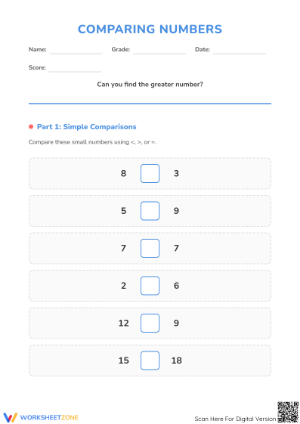
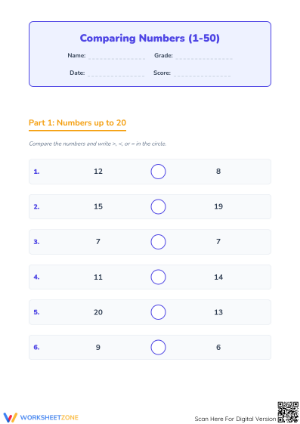
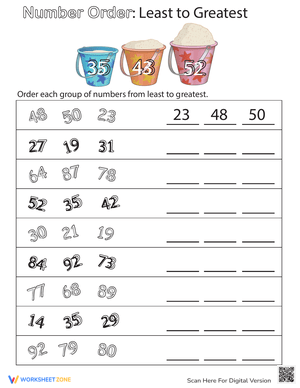
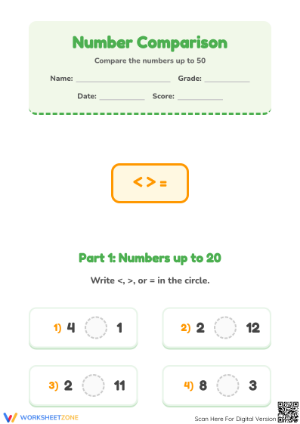
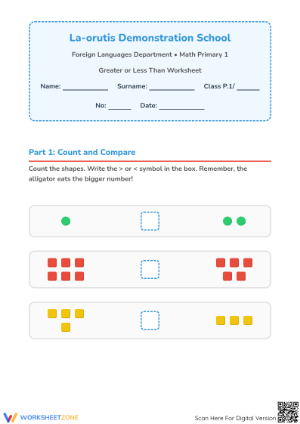
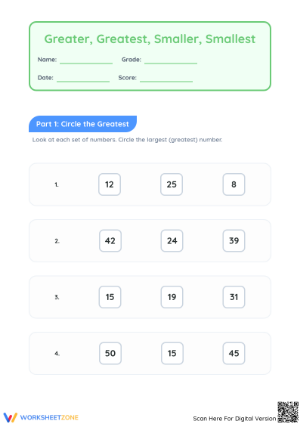
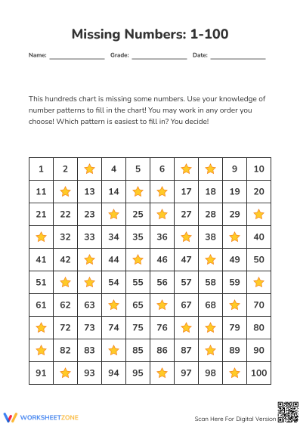
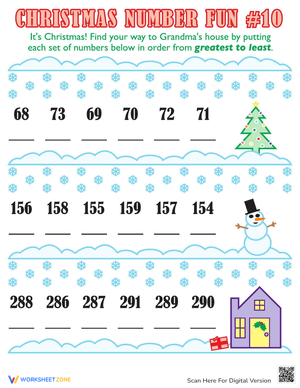
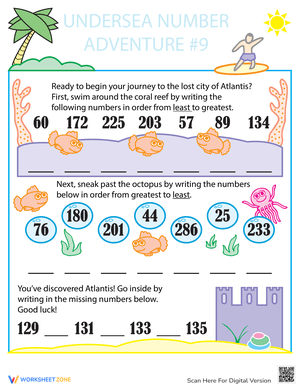
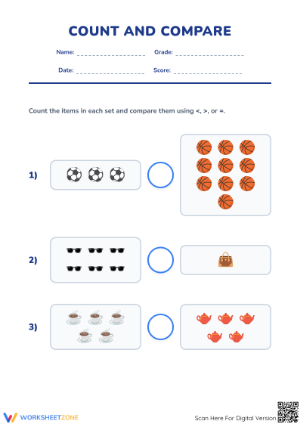
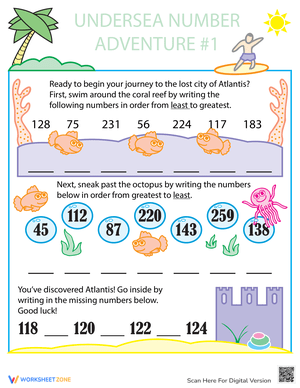
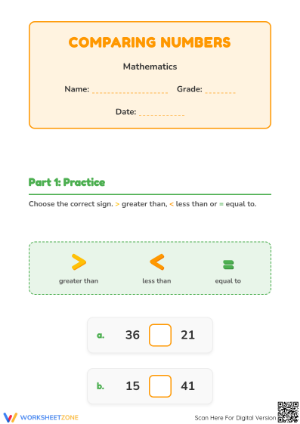
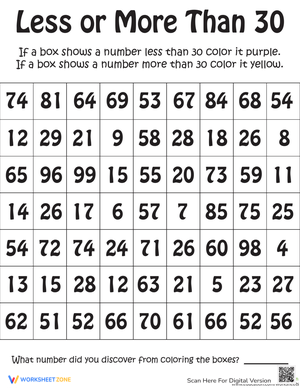
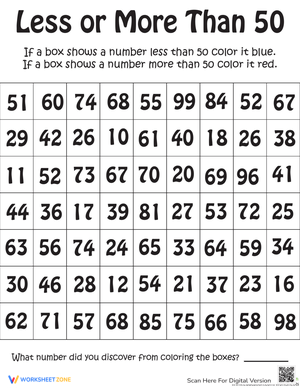
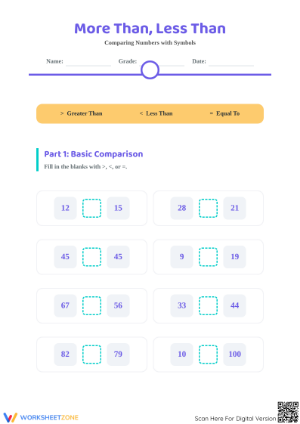
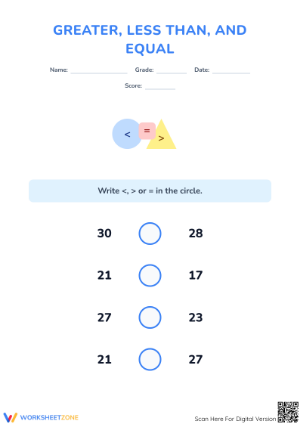
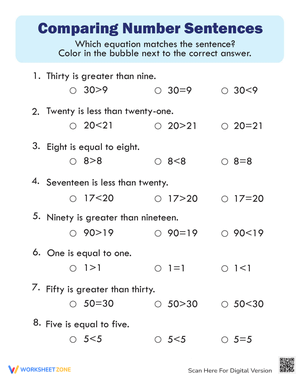
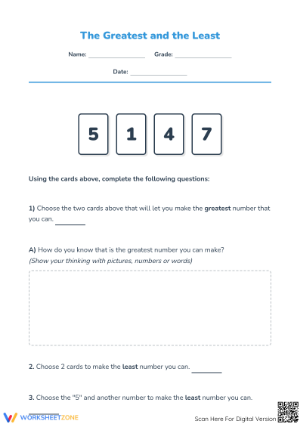
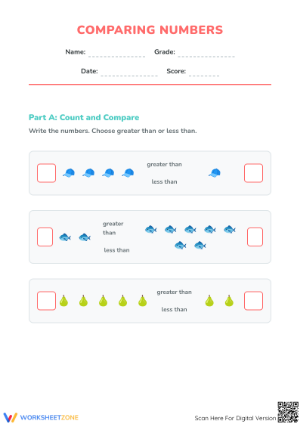
These comparing two digit numbers printable worksheets for 1st grade give teachers a focused set of practice materials built around one of the most conceptually demanding skills in the Grade 1 math sequence. The set addresses both the place value reasoning that makes comparison possible and the symbolic notation — >, <, = — that records the outcome. Teachers will find multiple activity formats across the set, from base-ten block illustrations to bare numeral problems to brief real-world scenarios, so the same underlying skill reaches students through more than one approach.
Why the Tens Place Has to Come First
Students who can count to one hundred fluently will still look at 29 and 31, choose 29 as the larger number, and be entirely confident about it — because nine is bigger than one, and that logic feels sound to a six-year-old. This is the central cognitive trap in two-digit comparison, and it is not a careless error. It reflects genuine uncertainty about how positional value operates. The worksheets address it by building in a step where students record the tens digit and the ones digit separately before writing any comparison symbol. That structural requirement interrupts the impulse to process full numerals as single visual objects and redirects attention to the digit that actually determines magnitude.
The activity sequence moves from illustrated base-ten blocks, to numerals alongside a place value chart, to bare numeral comparisons with no visual support. A student who works fluently through the first format and stalls at the third is showing you exactly where genuine conceptual understanding ends and visual pattern-matching began — which is precisely the diagnostic information a teacher needs before deciding what to reteach.
Mistakes Students Make That These Worksheets Help You Catch
Symbol reversal gets the most instructional attention, but the more persistent error is directional confusion after correct place value analysis. A student identifies that 47 has more tens than 36 — correctly — then draws the symbol pointing the wrong direction. The reasoning and the written symbol have come apart. That specific breakdown is visible in the completed worksheet precisely because the format separates the two steps: identify the greater number, then record the symbol. When a teacher sees accurate circling of the larger number paired with a reversed symbol, the instructional fix is very different from when the comparison itself is wrong.
A more instructive pattern appears in same-tens problems: 54 vs. 57, 83 vs. 88. Students who relied on a rough magnitude read for mixed-tens problems stall here because both numbers look similarly large. The worksheets include a concentrated group of same-tens items in the later portion of the set. When a student works easily through early mixed-tens comparisons but slows down and makes errors on the same-tens group, the worksheet has already done its diagnostic work before the teacher collects a single paper.
Standard Alignment
The comparing two digit numbers printable worksheets for 1st grade align to CCSS Math 1.NBT.B.3, which requires first graders to compare two two-digit numbers based on the meanings of the tens and ones digits, recording results with the symbols >, =, and <. In classroom terms, this standard belongs in the second half of the year — after students have built counting fluency to 120 (1.NBT.A.1) and have worked through composing and decomposing tens (1.NBT.B.2). Introducing comparison practice before those prerequisites are solid tends to produce the place value inversion error described above — students who see 29 > 31 as reasonable because the ones digit is larger. These worksheets function best as follow-up practice after explicit place value instruction, not as a first introduction to the concept.
How to Work These Worksheets Into Your Weekly Lesson Plans
The most direct application is as the independent practice segment of a gradual release lesson — after a whole-class introduction using physical base-ten blocks on the projector, students work the worksheet while the teacher circulates and notes who second-guesses their tens reading. The base-ten block worksheets suit morning warm-up during the week following initial instruction. The bare numeral worksheets hold up better as end-of-unit review, once students no longer need the visual support to reason accurately.
Small-group instruction benefits from the same-tens worksheet in particular. Seat four or five students, distribute the worksheet, and ask each student to state their tens and ones analysis aloud before writing the symbol. An eight-minute session built around that one worksheet usually surfaces exactly where the comparison logic breaks down — and tells you whether the next instructional move is more place value work or targeted symbol practice.
A completed worksheet also functions as a quick formative read. Consistent symbol reversal paired with correct identification of the larger number points toward a symbol-writing problem, not a place value problem. Random errors across both the comparison and the symbol suggest the place value foundation is still unstable. Those are two different instructional responses, and the worksheet makes the distinction visible without a separate assessment event.
Activity Formats Across the Set
The comparing two digit numbers printable worksheets for 1st grade include five distinct activity formats. Base-ten block comparison worksheets present illustrated tens rods and ones cubes side by side; students count each group and write the correct symbol between them. Place value chart worksheets give students a tens column and an ones column to fill in before writing the comparison — that recording step is what makes these different from simple fill-in exercises, because it forces students to articulate the decomposition rather than guess from the full numeral. A cut-and-paste sorting worksheet has students place number cards into greater-than and less-than categories by hand, incorporating fine motor work that many first graders still need. Number line comparisons ask students to locate both numbers on a 0–100 line and identify which sits further to the right, reinforcing the idea that magnitude has a direction. The final format uses brief word problems — enough context to ground the comparison in a situation, but short enough that the task stays about numbers, not reading.
Adjusting the Set for a Range of Learners
For students still building place value foundations, pair each worksheet with physical base-ten blocks at the desk. Rather than reading 47 as a numeral, they build it — four rods and seven cubes — before making any comparison. That process makes the tens-first rule feel necessary rather than arbitrary, because the rods are visibly taller than the cubes and the quantity difference is concrete before it is symbolic.
Students who move quickly through the visual formats benefit from a deliberate constraint: cover the ones digits of both numbers with a small piece of paper and ask them to predict the comparison using only the tens. That step surfaces whether the student genuinely understands place value hierarchy or has been arriving at correct answers through careful counting without understanding why the tens column governs.
The comparing two digit numbers printable worksheets for 1st grade also support a writing extension for students who need a higher-level challenge. After completing the comparison symbol, those students write one sentence explaining the result: "47 is greater than 36 because 4 tens is more than 3 tens." A sentence like that demonstrates conceptual understanding in a way the symbol alone cannot, and it gives teachers something more diagnostic to read than a correctly placed > sign.
Frequently Asked Questions
The greater than and less than symbols look nearly identical to my students. How do I help them past that?
The alligator mnemonic helps with initial exposure, but muscle memory matters more for retention. On the first few worksheets, have students trace the symbol three times in the air — saying its name out loud — before writing it on paper. Students who reverse symbols but correctly identify the larger number are a different instructional case from students who are uncertain about both. The trace-and-say routine resolves the first group within a few practice sessions and keeps the second group visible for further place value instruction.
My students understand which number is greater but consistently place the symbol incorrectly when they write it down. What helps?
Build a verification step into the end of each problem: students read the completed statement aloud as a sentence — "47 is greater than 36" — and then check that the symbol opens toward the larger number. Reading the written statement out loud catches reversals that the eye skips when reviewing silently, and it adds roughly four seconds per problem. Students who do this consistently stop reversing symbols within a week of regular practice.
When should I move a student from the illustrated worksheets to bare numeral comparisons?
When a student completes a base-ten block worksheet with zero errors and can explain which number is greater without pointing at the illustration, the visual support has served its purpose. Moving to bare numerals too early produces correct answers for the wrong reasons — students count drawn cubes rather than read digits. The place value chart format is a useful intermediate step: it preserves the decomposition structure without providing a countable image to fall back on.













 Interactive Worksheet Maker
 Quiz Maker
 Word Search Maker
 Crossword Puzzle Maker
 Word Scramble Generator
 Sentence Scramble Generator
 Handwriting Worksheet Generator
 Name Tracing Generator
 Fill In The Blank Generator