


























Views
Downloads

Grade 1 Comparing Numbers — Printable No-Prep Worksheet
Paste this activity's link or code into your existing LMS (Google Classroom, Canvas, Teams, Schoology, Moodle, etc.).
Students can open and work on the activity right away, with no student login required.
You'll still be able to track student progress and results from your teacher account.
Printable Worksheet for Comparing Numbers
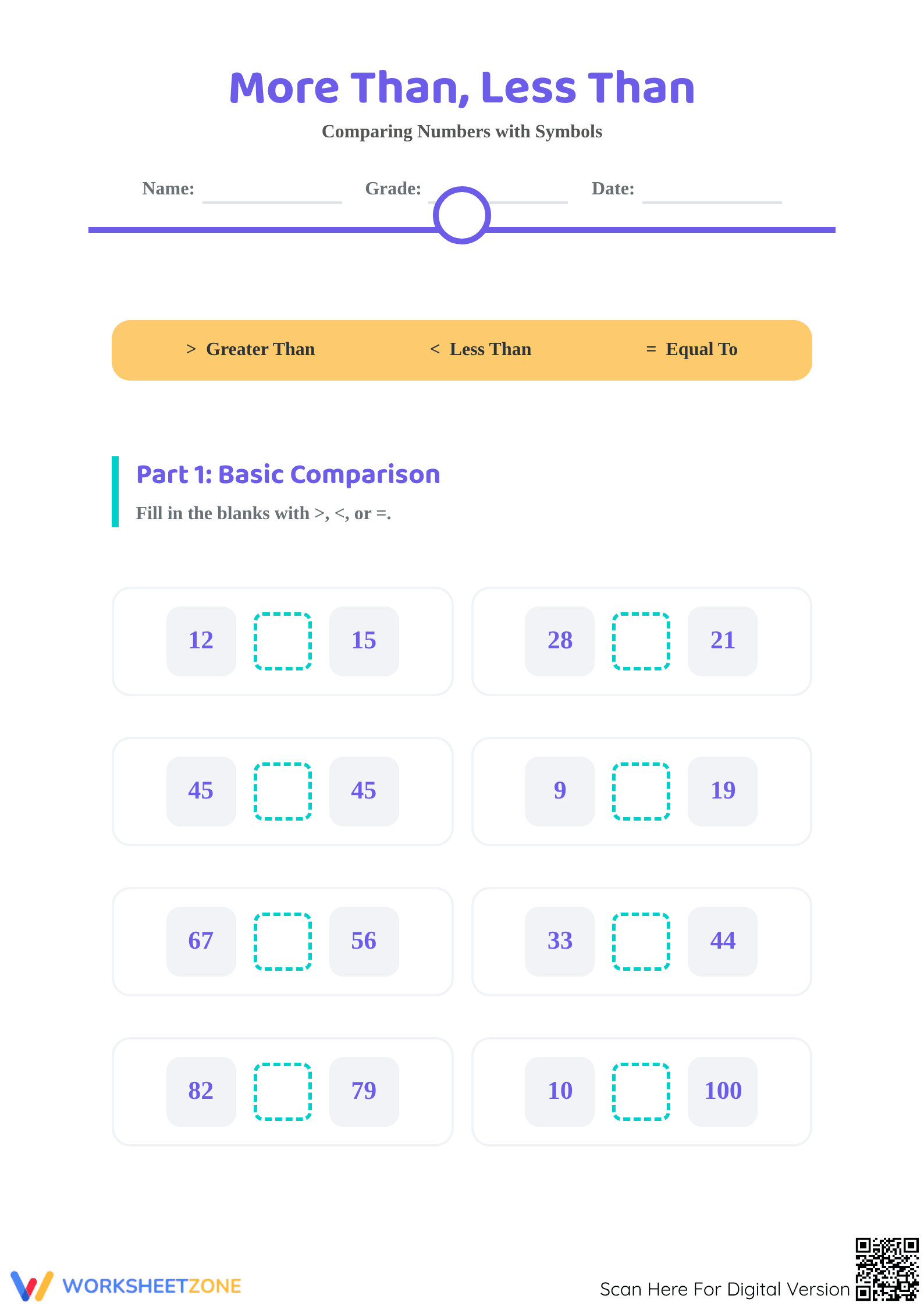
This worksheet provides targeted practice for first-grade students learning to compare two-digit numbers. Through a series of clear and focused exercises, students will build fluency in using the greater than (>), less than (<), and equal to (=) symbols to record comparisons, a foundational skill for number sense and future mathematical understanding.
At a Glance
- Grade: 1 · Subject: Math
- Standard:
CCSS.MATH.CONTENT.1.NBT.B.3— Compare two-digit numbers using >, =, and < symbols.- Skill Focus: Comparing Numbers (<, >, =)
- Format: 3 pages · 22 problems · Answer key included · PDF
- Best For: Independent practice, math centers, or homework.
- Time: 10–15 minutes
What's Inside
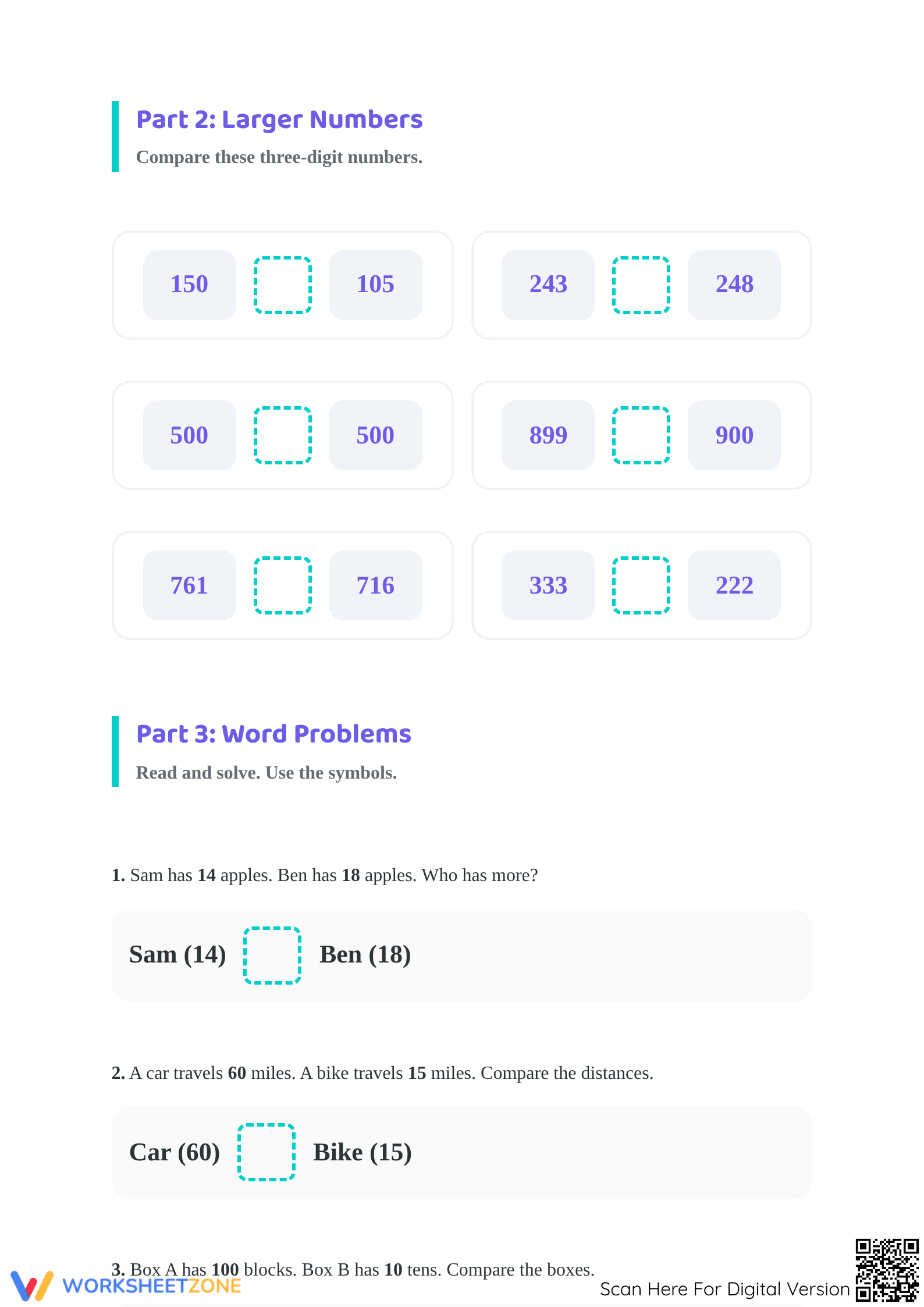
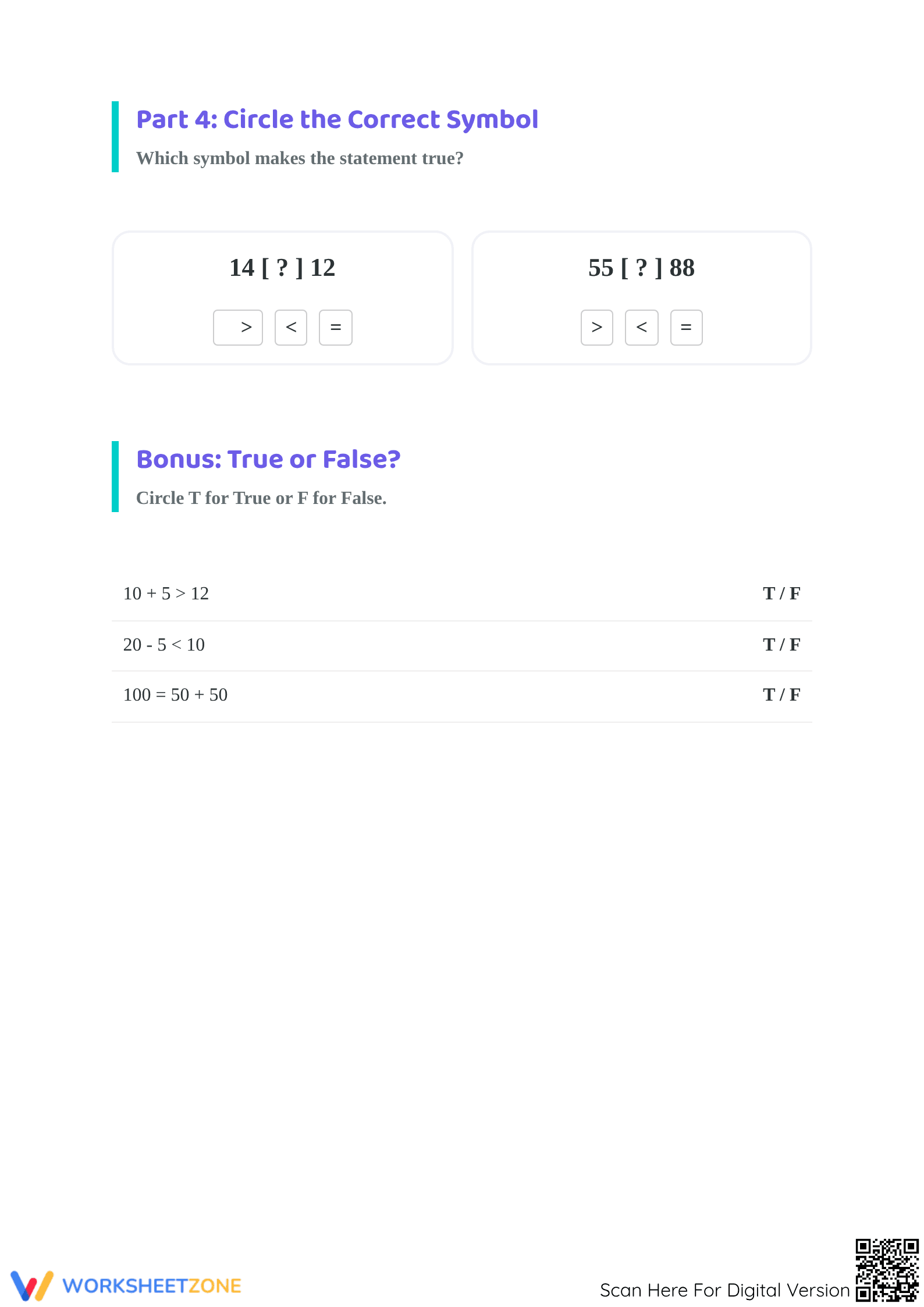
This 3-page PDF contains a cover, a single worksheet with 22 comparison problems, and a full answer key. The worksheet features two distinct sections to reinforce student understanding of the <, >, and = symbols, ensuring they can both recognize and apply the concepts.
A Zero-Prep Workflow for Busy Teachers
This resource is designed for maximum classroom efficiency. The workflow is simple: print the single worksheet page for each student (less than one minute), distribute for independent work (one minute), and use the provided answer key for quick grading or student self-correction. Because the total teacher prep time is under three minutes, this worksheet is an ideal resource for substitute plans, supplemental practice, or a quick formative assessment.
Standards Alignment for Lesson Planning
This worksheet directly aligns with Common Core standard CCSS.MATH.CONTENT.1.NBT.B.3. It requires students to compare two-digit numbers using the symbols >, =, and <. The 22 problems give students focused practice on this core skill. This standard code can be copied directly into lesson plans, IEP goals, or district curriculum mapping tools, making documentation simple and clear.
How to Use It in Your Classroom
Use this worksheet as independent practice after a lesson on number comparison. For a quick formative assessment, observe students as they work, noting any confusion with the symbols. It also functions well as a homework assignment or math center activity. Most first-graders will complete the tasks in 10 to 15 minutes, making it a perfect short, focused activity.
Who It's For
Primarily for first-grade students, this worksheet is also an effective review tool for second graders at the beginning of the school year. Its clear layout is accessible to most learners. For extra support, pair this activity with a hands-on tool like base-ten blocks, allowing students to build and compare the numbers before writing the corresponding symbol.
Foundational number sense, including the ability to compare numerical quantities, is a critical predictor of later mathematical achievement. This worksheet directly supports standard CCSS.MATH.CONTENT.1.NBT.B.3, where students learn to record number comparisons with the formal symbols >, <, and =. Research from the RAND Corporation highlights the importance of fluency in basic number concepts for building a robust mathematical foundation (RAND AIRS 2024). The 22 targeted problems in this resource give students the repeated, focused practice necessary to internalize these symbols and their meanings. By moving from a concrete understanding to the abstract representation of comparison, students develop the fluency required for more complex operations and algebraic thinking in later grades. This worksheet provides a practical tool for building that essential fluency.


