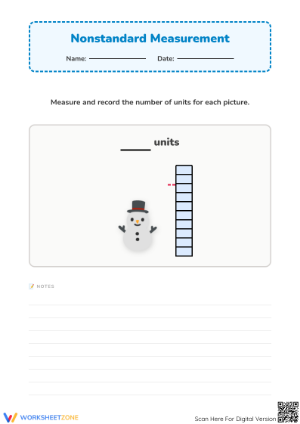
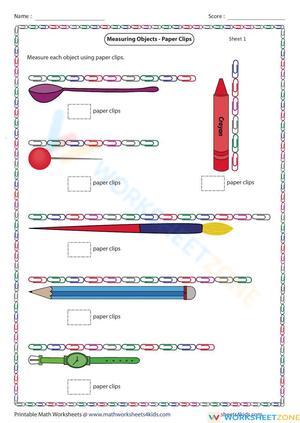
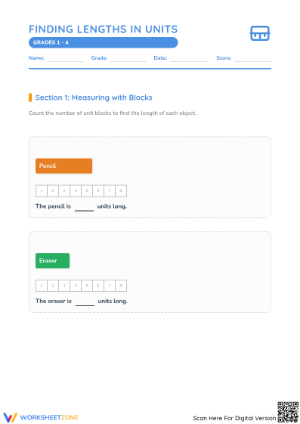
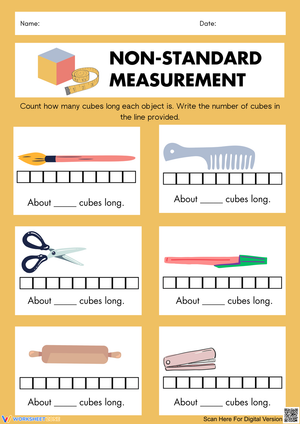
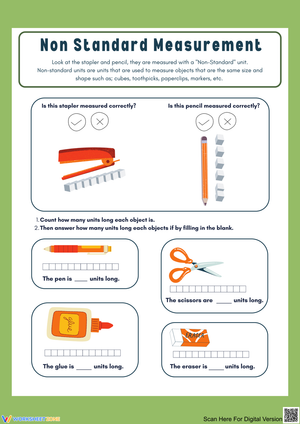
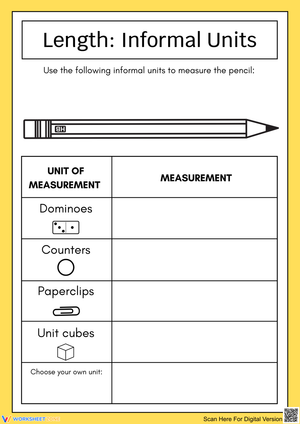
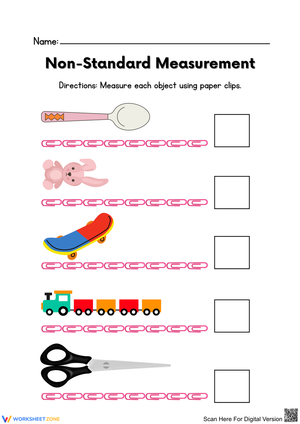
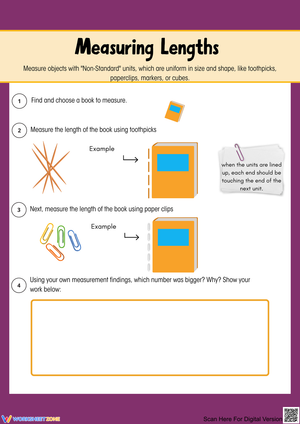
These measuring with nonstandard units worksheets for 1st grade give teachers a structured sequence for building the concept of unit iteration — the foundational skill that makes standard measurement meaningful later. Each worksheet targets a specific piece of that understanding, from counting illustrated paper clips next to a drawn crayon to recording measurements of actual classroom objects on a data line.
The Specific Skills Targeted
Across the set, students practice four connected competencies: counting length units accurately, ordering objects from shortest to longest, comparing two measured objects using relational vocabulary, and recording measurements as whole numbers. The worksheets use paper clips, linking cubes, square tiles, and craft sticks as measuring units — objects that appear in most 1st grade classrooms and can be paired with physical manipulatives during instruction.
Several worksheets include sentence frames ("The crayon is ___ cubes long. The marker is ___ cubes long. The ___ is longer.") that require students to produce measurement language, not just count. This matters because the verbal and written articulation of comparison — "more units," "fewer units," "about the same" — is where first graders reveal gaps in conceptual understanding that a simple fill-in number won't expose.
Standard Alignment
These worksheets address two 1st grade Common Core standards in the Measurement and Data domain. Standard 1.MD.A.1 requires students to order three objects by length and compare lengths indirectly or using a third object — the cut-and-paste ordering activity and the comparison worksheets both address this directly. Standard 1.MD.A.2 requires students to express the length of an object as a whole number of length units by iterating a shorter object end to end — this is the core skill practiced across every worksheet in the set. In classroom terms, 1.MD.A.2 is the conceptual entry point that makes rulers readable in 2nd grade; students who arrive in 2nd grade without it tend to count ruler lines rather than spaces, a persistent error that traces back to missing unit iteration understanding in 1st grade.
Common Student Mistakes Teachers Should Anticipate and Address
Four error patterns appear consistently in first-grade measurement work, and they are worth watching for because they look superficially correct — students are placing units and writing a number — until you check the placement closely.
The first is gaps. Students leave small spaces between units because they are treating the cubes like discrete counting objects rather than segments of a continuous line. The resulting count is low, and students often can't tell why their answer differs from a neighbor's.
The second is overlap. Students push units together so the ends cross, producing a count that is also inaccurate — but in this case inflated. Both gap and overlap errors become visible when students compare answers and get different numbers for the same object, which is itself a teachable moment.
The third is start-point misalignment. Students begin with the first cube set slightly in from the edge of the object rather than flush with the end. This is especially common on the measure-the-picture worksheets, where the drawn object starts mid-row and students aren't sure where the "edge" really is. Marking the starting endpoint with a small arrow or dot during whole-group modeling helps.
The fourth is unit mixing. A student reaches into a shared basket and picks up two sizes of paper clips — the standard and jumbo varieties. Their measurement is meaningless, but they have no intuitive sense of why. The concept that the unit must stay consistent is not obvious to a 6-year-old. Pulling two different-sized clips out during a class discussion and measuring the same object both ways, then comparing the numbers, makes the rule concrete rather than arbitrary.
How to Build These Worksheets Into Your Lesson Plans
The most effective sequencing runs the measure-the-picture worksheets first as whole-group or guided work, then moves to the real-classroom-object recording pages as center or partner work once students can count units accurately on paper. Trying to send students around the room with recording sheets before they have internalized the start-align-count sequence creates chaos and inaccurate data.
For math centers, pre-bag a measurement kit — roughly 20 linking cubes, 15 paper clips, and 10 craft sticks per student or pair — so students aren't sorting mixed supplies mid-rotation. This single logistical choice reduces the most common unit-mixing error and cuts transition noise significantly. Partner work on the comparison worksheets, where one student places units and the other checks for gaps, builds in a natural error-correction loop that whole-class instruction can't replicate efficiently.
The sentence-frame worksheets travel home well because they don't require a ruler or any specific tool — a handful of pennies or small blocks from home works. If you are using these as Monday warm-ups after morning meeting, the illustrated worksheets (no manipulatives needed) are the practical choice for that 8-minute window before the formal math block opens.
Adjusting the Worksheets for a Range of Learners
Students who are still building one-to-one correspondence benefit from worksheets where the units are pre-drawn and spaced clearly — their task is counting, not placing. For students who have that counting piece and are ready for more, the real-object recording pages add a layer of physical judgment: they have to decide where the object ends, place units without a printed guide, and manage the start-point alignment on their own.
For students who move through the core tasks quickly, the comparison worksheets can be extended by asking them to measure three objects, order them, and write a number sentence showing the difference ("The book was 2 cubes longer than the eraser"). That extension connects measurement to early subtraction in a context that feels purposeful rather than computational. Students who struggle with the fine motor demands of aligning small paper clips can use larger linking cubes or square tiles, which are easier to place flush and less prone to shifting.
Frequently Asked Questions
Why teach nonstandard measurement before introducing rulers?
A ruler combines unit iteration with a printed scale, numeral reading, and often fractional markings — all at once. Nonstandard measurement strips the task down to one concept: a length can be described by how many equal units fit along it. Once that idea is secure, the ruler becomes a tool for expressing the same idea more efficiently rather than a source of confusion.
Do students need physical manipulatives to use these worksheets?
For the illustrated measure-the-picture worksheets, no — the units are drawn on the page and students count them. For the real-object recording worksheets, physical manipulatives are the point; linking cubes or paper clips need to be on hand. As a practical matter, the illustrated worksheets work for homework or morning warm-ups, while the recording worksheets belong in a center where materials are already staged.
How many worksheets are in the set, and how are they sequenced?
The set includes worksheets across five activity types: measure-the-picture, cut-and-paste ordering, real-object recording, two-object comparison, and sentence-frame completion. They are designed to be used in roughly that order — from purely visual tasks toward tasks requiring physical placement and written explanation — though teachers can pull individual worksheets to match where a particular group of students is in their instruction.
What do I do if students are getting different numbers for the same object?
Different counts for the same object almost always point to gaps, overlaps, or start-point misalignment — the three placement errors described above. Rather than correcting individually, pausing the class, having two students measure the same drawn pencil in front of the group using different techniques, and asking "why are the numbers different?" turns the error into the lesson. First graders who watch that comparison tend to self-correct their placement more reliably than those who receive a verbal reminder.













 Interactive Worksheet Maker
 Quiz Maker
 Word Search Maker
 Crossword Puzzle Maker
 Word Scramble Generator
 Sentence Scramble Generator
 Handwriting Worksheet Generator
 Name Tracing Generator
 Fill In The Blank Generator