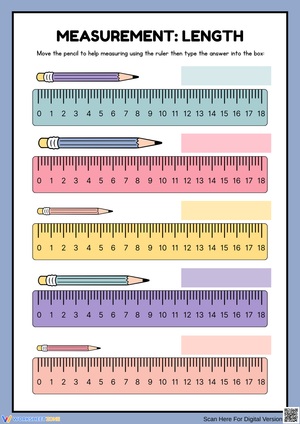
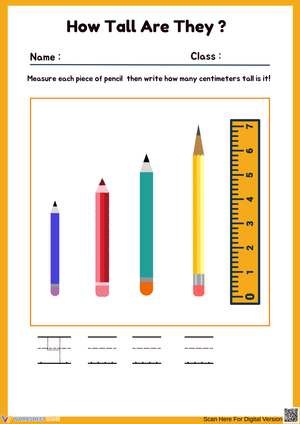
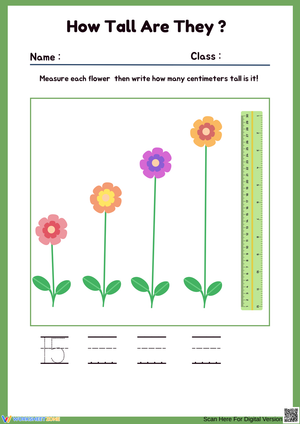
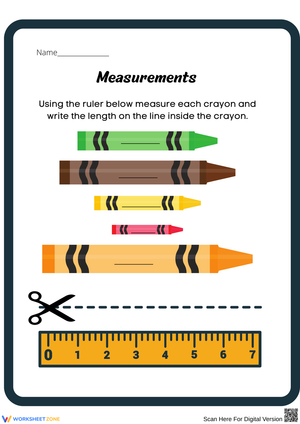
1st grade measurement tools and strategies pdf worksheets give teachers a ready path through the four skill areas that matter most at this grade level: tool identification, non-standard unit measurement, ordering by length, and error analysis. At Grade 1, measurement is where abstract math notation meets physical comparison — students must learn not just to record a number, but to defend why their count is accurate, and each worksheet in this set is built around that reasoning requirement.
What's Inside the Set
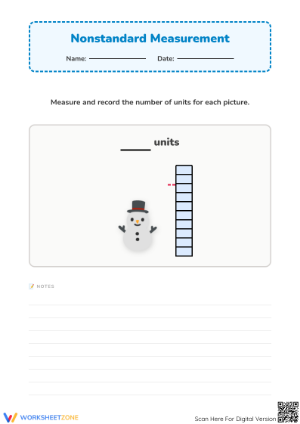
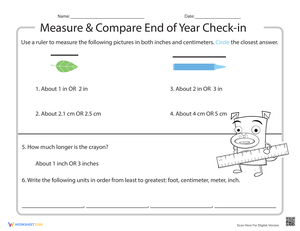
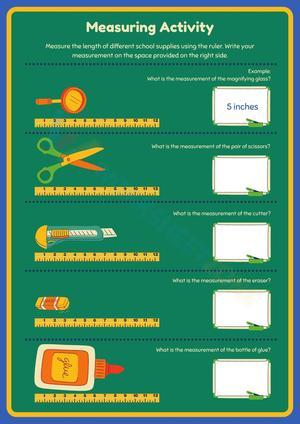
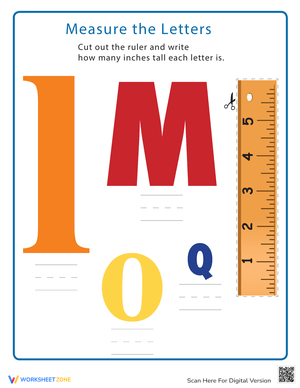
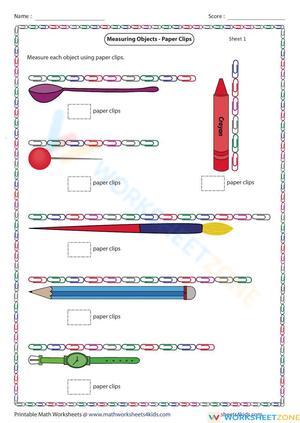
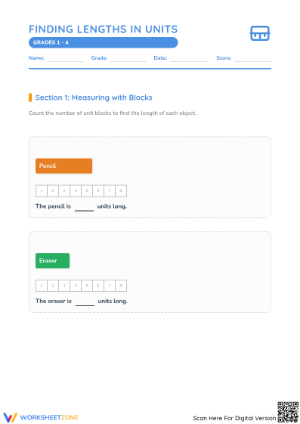
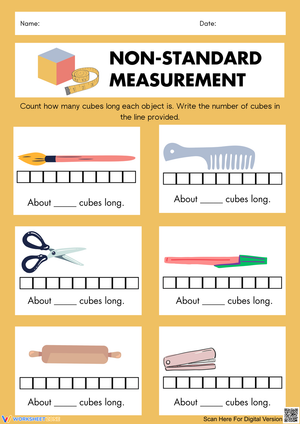
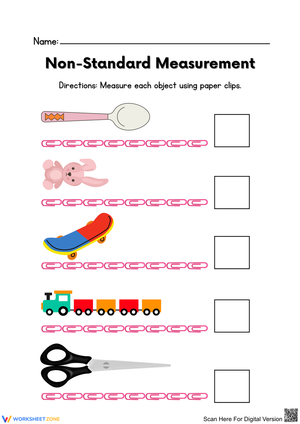
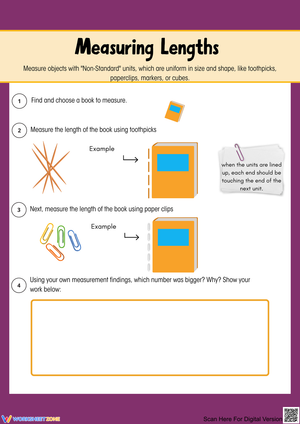
Tool identification worksheets ask students to match rulers, balance scales, measuring tapes, and thermometers to the attributes they measure — length, weight, and temperature. These are not passive matching exercises; students also annotate drawings to identify which feature of a tool does the measuring work (the numbered markings on a ruler, the two pans on a balance scale). Non-standard unit worksheets present drawn objects and ask students to mark and count units placed end to end, then record the whole-number length. These 1st grade measurement tools and strategies pdf worksheets also include ordering tasks where students rank three objects from shortest to longest using a third object as an indirect reference, which is exactly the comparison skill CCSS 1.MD.A.1 targets.
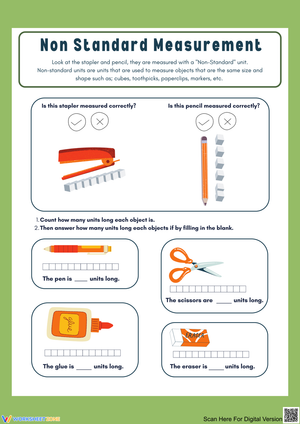
Error-analysis worksheets round out the set. Students examine a printed measurement scenario — units with gaps between them, or an object measured starting from the wrong end — then explain what went wrong and redraw the correct version. This format produces more durable understanding than a standard fill-in sheet because students have to name the rule, not just apply it. The difference shows up in follow-up work: students who complete error-analysis tasks repeat the annotated mistakes far less often on subsequent assessments.
Where Student Errors Cluster in Grade 1 Measurement
Two errors appear so consistently in Grade 1 measurement work that they deserve explicit pre-teaching rather than correction after the fact. The first is gap-leaving between non-standard units. A student places six cubes to measure a pencil but leaves small spaces between them, counts six, and records six — not realizing the gaps have made the object appear shorter than it actually is. The second is starting a ruler at "1" rather than "0." When a student measures from 1 to 7 and writes 7 inches instead of 6, the error is invisible until you ask them to point to where they started. Both mistakes are targeted directly by the error-analysis worksheets in this set, but naming them before students begin — rather than waiting for them to surface — prevents the errors from calcifying into habit.
A subtler misconception involves tool matching. Many first graders associate a ruler with weight because it looks like a stick that could rest on a scale. The visual logic makes sense at this age. Cut-and-paste tool identification tasks expose this confusion immediately, at the moment when a single clarifying sentence closes it before it goes underground.
Where These Worksheets Land in a Real Lesson Plan
The most reliable sequence runs physical before printed. Before handing out a non-standard unit worksheet, spend five minutes having students measure a marker or whiteboard eraser with actual cubes at their seats. Students who skip that tactile step tend to draw floating units on the worksheet — units that hover above the object rather than resting against it. After independent work time, pull two or three completed worksheets and display them on a document camera for a two-minute whole-class comparison. Ask students to explain their reasoning out loud rather than simply confirm a right answer. That brief discussion generates better retention than an additional round of solitary practice.
These 1st grade measurement tools and strategies pdf worksheets fit naturally into morning warm-up blocks, small-group rotations, or as the independent practice component after a whole-class lesson introduction. For rotations, pair a worksheet station with a hands-on measuring station (physical objects and cubes) and a card-sort activity; ten-minute rotations give students three exposures to the same concept in different formats. Building in a predict-then-measure step — students write an estimate before recording an actual count — adds formative data without any extra assessment materials.
Standard Alignment
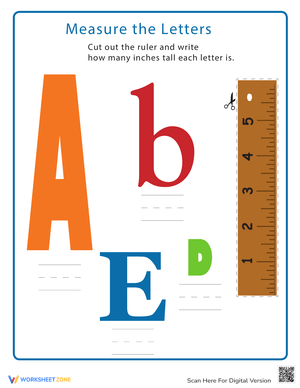
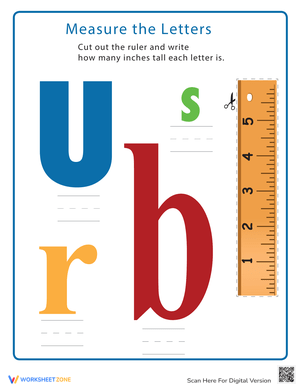
The worksheets map directly to the Measurement and Data domain in the Grade 1 Common Core State Standards. CCSS 1.MD.A.1 asks students to order three objects by length and compare two objects indirectly using a third — addressed by the ordering and comparing worksheets in the set. CCSS 1.MD.A.2 asks students to express object length as a whole number of length units by laying copies of a shorter object end to end with no gaps or overlaps — the core skill in the non-standard unit worksheets. Both standards sit at the foundation of the measurement progression that continues into Grade 2, where students begin reading a standard ruler to the nearest whole inch. Grade 1 is the conceptual stage: students learn what measurement means before they're asked to measure precisely.
Using These Worksheets at Different Readiness Levels
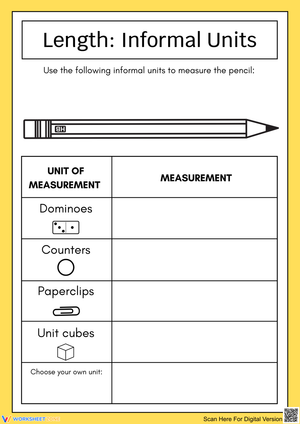
For students who need additional support, keep physical manipulatives at the desk alongside each worksheet — actual cubes or tiles they can overlay on the drawn object before counting. Placing a concrete unit on top of the printed image reduces working memory demand and keeps attention on the measurement concept rather than on decoding an abstract diagram. Students working above grade level benefit from a second-layer challenge added to the same worksheet: measure the same drawn object twice using two different non-standard units, then write a sentence explaining why the two counts differ. That question — why does the pencil measure 4 tiles but 7 paper clips? — is where proportional reasoning begins to emerge in young learners, and it requires no additional materials.
These 1st grade measurement tools and strategies pdf worksheets also work well with ELL students because the tool identification and cut-and-paste formats are largely visual. Language demand stays low, and the physical tools can sit on the table alongside each worksheet as vocabulary anchors without changing the task structure at all.
Frequently Asked Questions
Do these worksheets cover both standard and non-standard units?
Non-standard unit tasks form the core of the set because CCSS 1.MD.A.2 focuses on the iteration concept — repeating a unit end to end with no gaps or overlaps — before students move to ruler increments. Tool identification worksheets introduce standard measurement tools at the recognition level, which is the appropriate depth for Grade 1. Reading a ruler to the nearest inch is a Grade 2 expectation in the Common Core progression.
What task formats appear across the worksheets?
The set includes mark-and-count tasks, cut-and-paste tool matching, length-ordering sequences, and error-analysis scenarios. Each format asks students to do something different with measurement concepts — record a count, physically sort images, rank objects by size, or diagnose what went wrong in a worked example. The variety prevents the task fatigue that builds when students complete the same format repeatedly across a unit.
Can these worksheets support whole-class lessons as well as small groups?
Yes. Tool identification and ordering tasks work well for whole-class introduction because they offer clear visual entry points that most students can access without prior explanation. Error-analysis and non-standard unit worksheets tend to produce richer discussion in small groups, where students can compare their annotations and disagree about what went wrong without the social pressure of a whole-class share. The set moves comfortably between both structures across the same week.













 Interactive Worksheet Maker
 Quiz Maker
 Word Search Maker
 Crossword Puzzle Maker
 Word Scramble Generator
 Sentence Scramble Generator
 Handwriting Worksheet Generator
 Name Tracing Generator
 Fill In The Blank Generator