


























Views
Downloads

Essential Finding Lengths in Units Worksheet | Grade 1 Math
Paste this activity's link or code into your existing LMS (Google Classroom, Canvas, Teams, Schoology, Moodle, etc.).
Students can open and work on the activity right away, with no student login required.
You'll still be able to track student progress and results from your teacher account.
This Grade 1 measurement worksheet introduces students to quantifying physical space using non-standard unit blocks. Students will measure various classroom objects, compare their lengths, and solve measurement word problems. This resource helps develop a concrete understanding of unit iteration and comparison, ensuring learners can express length as a whole number of same-size units with precision.
At a Glance
- Grade: 1 · Subject: Math
- Standard:
CCSS.MATH.CONTENT.1.MD.A.2— Express length as a whole number of units by laying copies end to end- Skill Focus: Measuring with non-standard unit blocks
- Format: 4 pages · 12 problems · Answer key included · PDF
- Best For: Intro to measurement and comparing lengths
- Time: 25–35 minutes
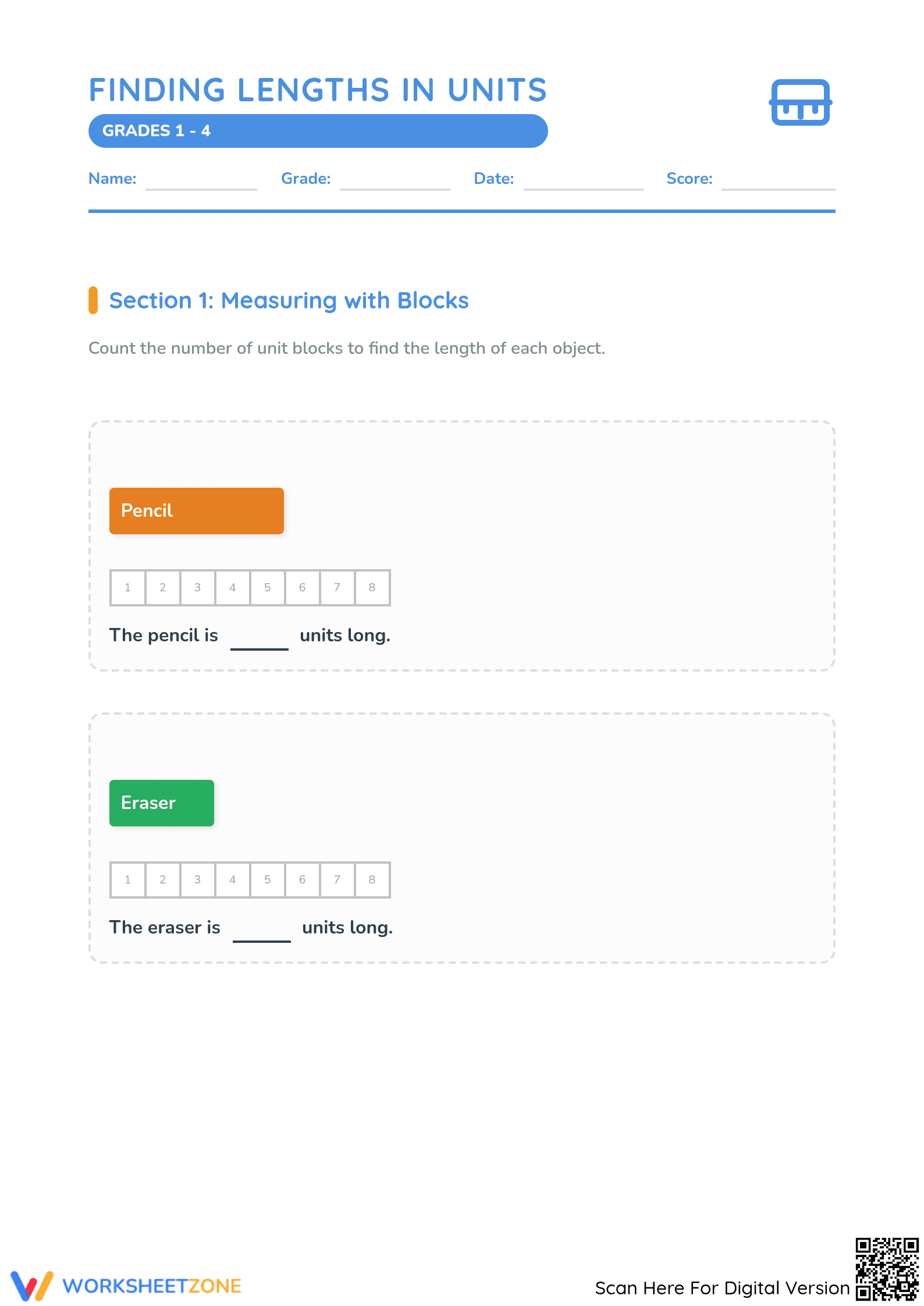
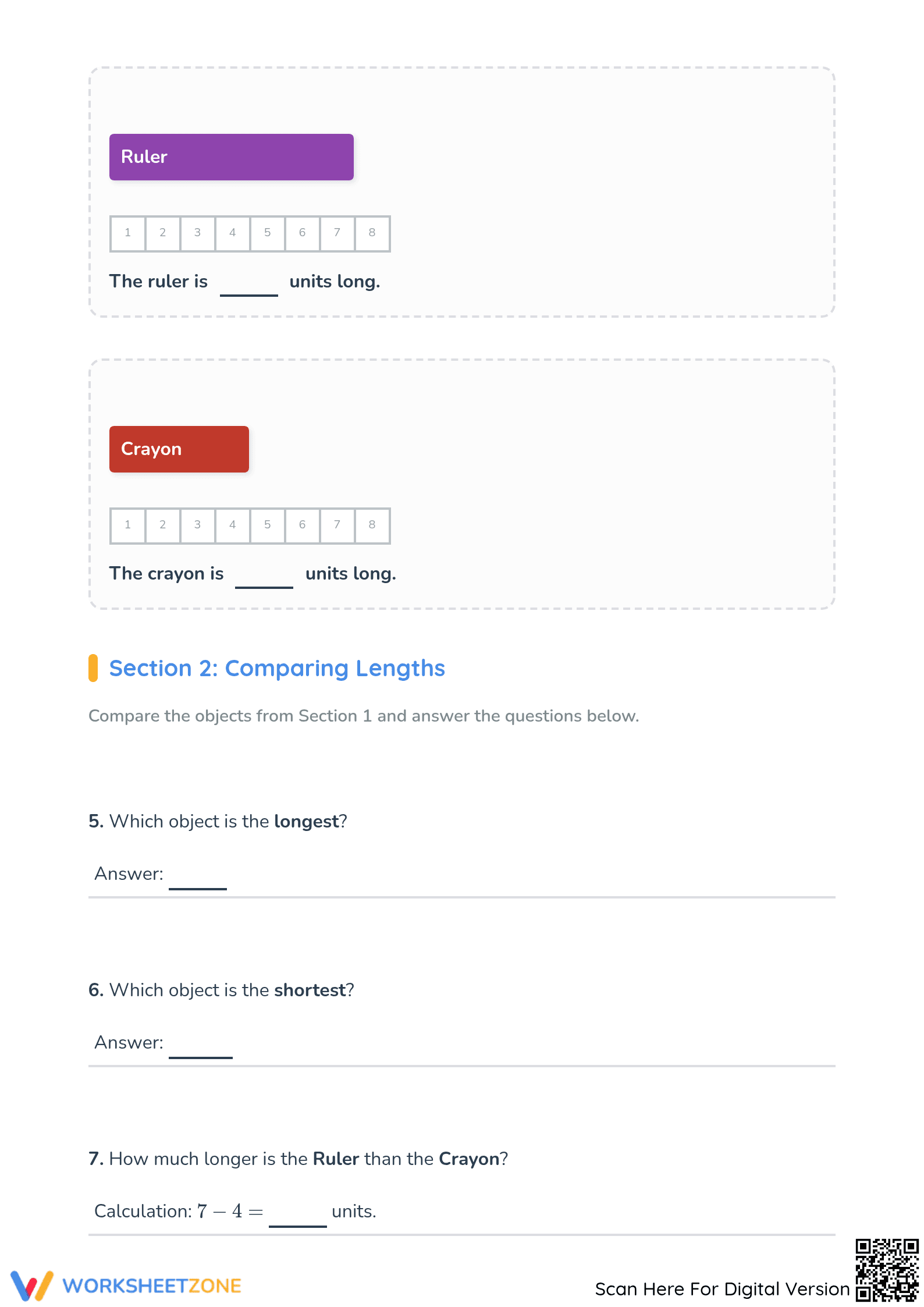
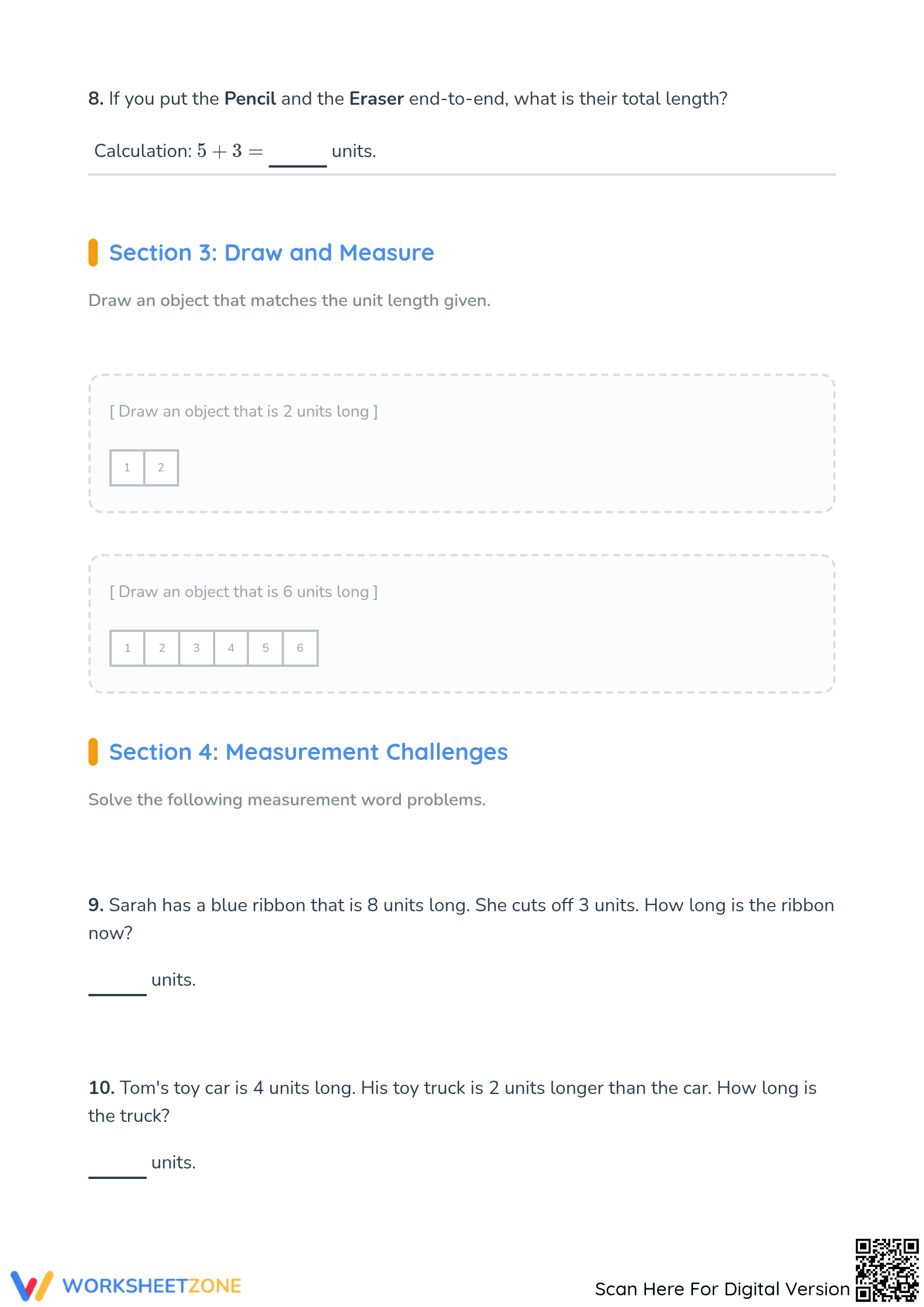
Inside this four-page resource, students encounter twelve distinct tasks designed to build measurement fluency. The worksheet features clear illustrations of objects like pencils, erasers, and crayons aligned with numbered unit blocks. It includes sections for direct measurement, comparative analysis (longest versus shortest), scale drawing, and multi-step word problems. A full answer key is provided to facilitate quick grading or student self-check sessions.
Skill Progression
- Guided Practice: The first four problems offer a visual scaffold where objects are pre-aligned with numbered unit blocks. Students simply count the blocks to determine the whole number length of items.
- Supported Practice: Sections 2 and 3 transition students into comparing measurements. Learners calculate differences in length and determine total lengths, reinforcing addition and subtraction skills.
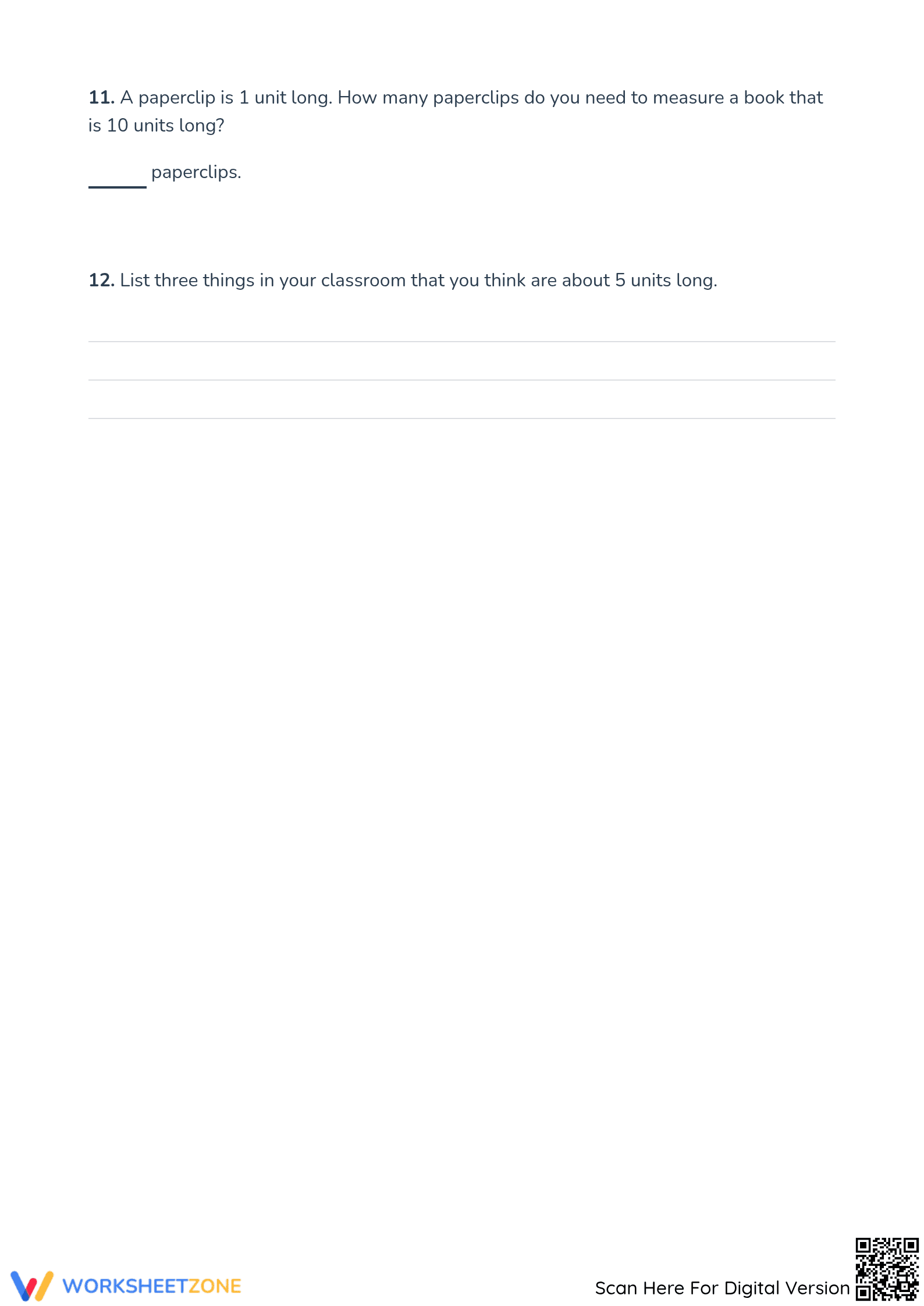
- Independent Practice: The final section challenges students with measurement word problems and open-ended tasks, such as listing classroom objects of a specific unit length. This encourages the application of measurement concepts to real-world scenarios.
This structure follows the gradual release of responsibility model, ensuring students master the mechanics of counting units before applying them to abstract problem-solving.
Standards Alignment
The primary focus of this worksheet is CCSS.MATH.CONTENT.1.MD.A.2, which requires students to express the length of an object as a whole number of length units by laying multiple copies of a shorter object end to end. Using non-standard unit blocks helps students develop the foundational concept that measurement is the iteration of a unit without gaps or overlaps. Both standard codes can be copied directly into lesson plans or curriculum mapping tools.
How to Use It
This worksheet is ideal for the "We Do" or "You Do" phase of a measurement lesson. Use the first page for direct instruction to model how to align the start of an object with the first unit block. For a formative assessment, observe students during Section 3 where they must draw objects to a specific length; this reveals understanding of unit size and iteration. Expect students to take approximately 30 minutes to complete the full four-page set.
Who It's For
While designed for first-grade students, this resource is excellent for second-grade review or for students needing intervention in spatial reasoning. It pairs perfectly with hands-on activities using physical manipulatives like Unifix cubes or base-ten blocks. Teachers can use it as a standalone assessment or as a targeted practice packet during math centers.
Measurement using non-standard units is a foundational precursor to formal metric and imperial systems, establishing conceptual understanding of iteration and unit size. According to Fisher & Frey (2014), concrete visual scaffolds like the unit blocks in this worksheet help Grade 1 students transition from qualitative comparisons to quantitative data. By expressing lengths as a whole number of units without gaps or overlaps, learners fulfill the core requirements of CCSS.MATH.CONTENT.1.MD.A.2. This resource provides twelve specific tasks that move from simple counting to complex word problems involving subtraction and addition of lengths. Educational research indicates that early exposure to these measurement concepts predicts later success in geometry and algebraic thinking. This printable assessment is verified for pedagogical accuracy and provides a clear path for students to build measurement fluency in various classroom settings.


