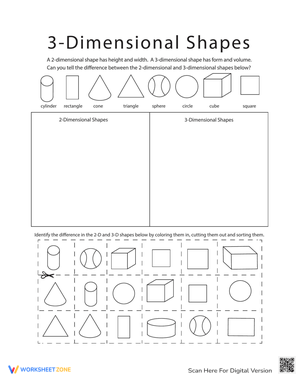
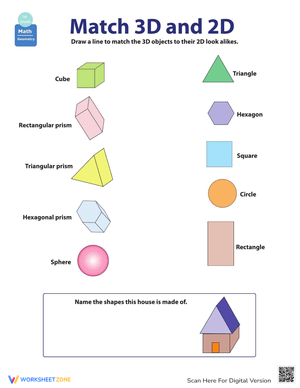
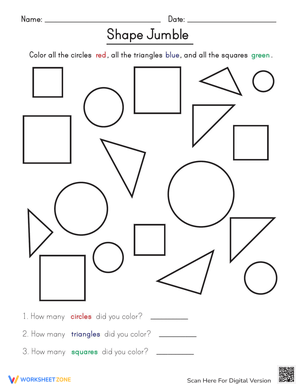
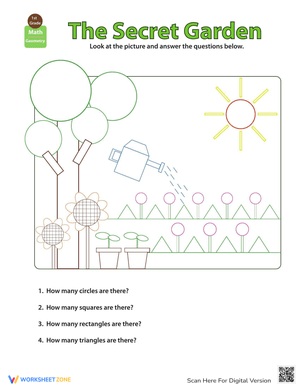
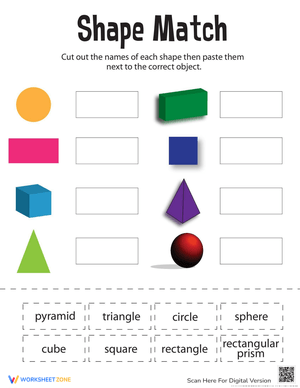
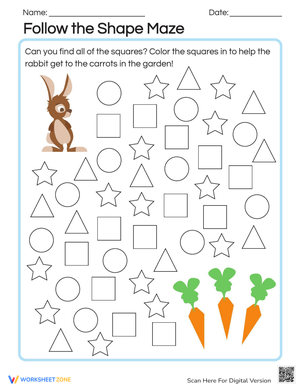
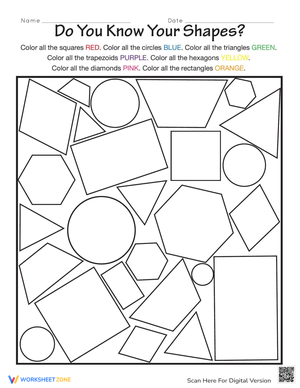
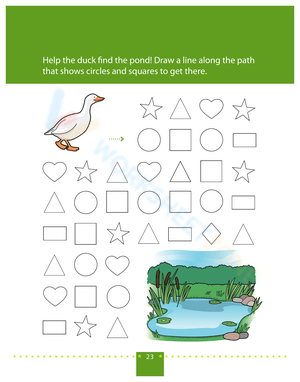
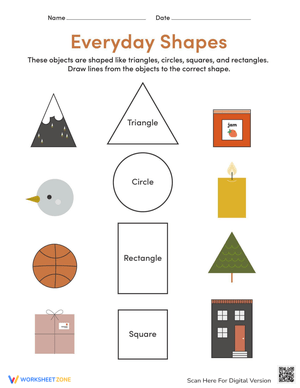
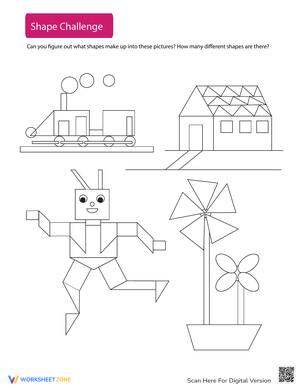
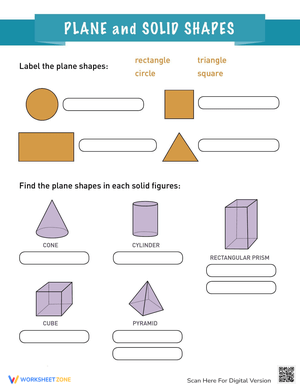
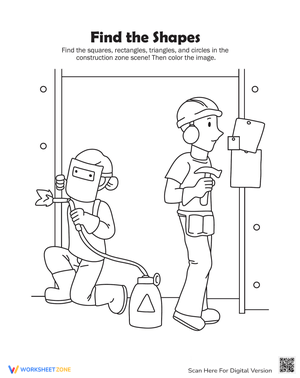
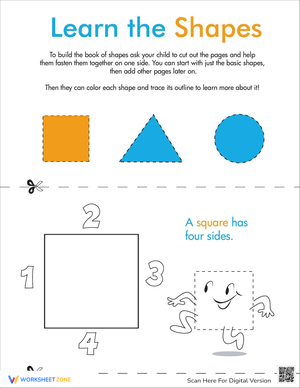
These 1st grade squares printable worksheets give teachers a set of focused practice activities built around one of the most deceptively simple early geometry lessons: what makes a square a square, and why a tilted one is still a square. Each worksheet targets a specific skill — tracing, identifying, comparing, or labeling — so teachers can slot individual activities into the spots in the week where they fit rather than working through a fixed sequence.
What's Inside the Set
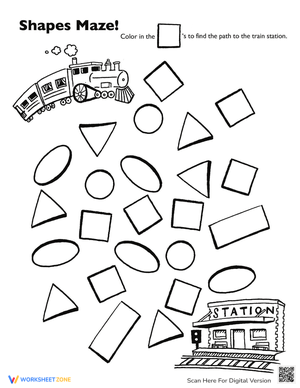
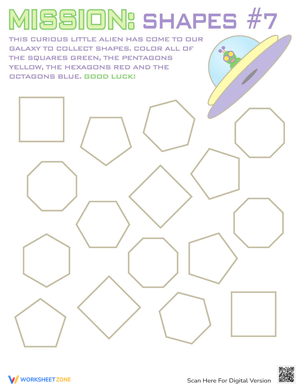
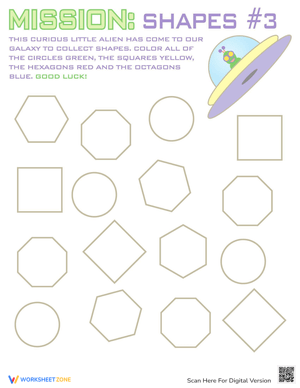
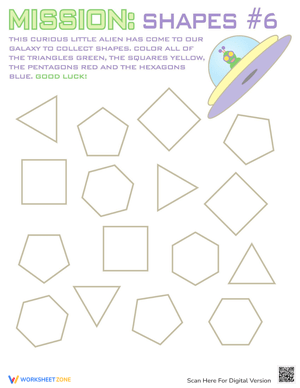
Each worksheet in this 1st grade squares printable worksheets set zeroes in on a distinct aspect of square geometry rather than covering multiple concepts at once. Some worksheets have students trace squares of varying sizes and then reproduce them freehand — a pairing that matters because many first graders can follow a dotted line but freeze when the guide disappears. Others present a mixed array of quadrilaterals and ask students to circle only the squares, which requires them to apply a rule rather than recognize a familiar image. A third type embeds squares in simple scene illustrations: windows, floor tiles, picture frames. Students mark every square they find and write how they know each one qualifies. That labeling step — writing "4 equal sides" or "4 corners" in their own words — surfaces vocabulary gaps that a multiple-choice format would hide entirely.
Error Patterns That Surface Early in Square Work
The most predictable mistake in first-grade square work is orientation blindness. A student who correctly names an upright square will call the same shape rotated 45 degrees a "diamond." This is not carelessness — it reflects how young children build categories, by prototype image rather than by rule. A worksheet that places a rotated square beside an upright one and asks students to compare them directly forces the rule-checking that moves students past visual matching. The second error worth anticipating is the square-rectangle confusion. First graders understand that both shapes have four sides and four corners, but they have not yet locked in the constraint that a square's four sides must all be equal. Asking students to compare side lengths concretely — by folding a paper strip along each side or counting units on a grid — makes that distinction physical rather than purely verbal.
Standard Alignment
These worksheets address CCSS.MATH.CONTENT.1.G.A.1, which requires first graders to distinguish defining attributes from non-defining attributes when working with two-dimensional shapes. For a square, defining attributes are four equal sides and four right-angle vertices; non-defining attributes include size, color, and orientation. First grade is the designated placement for this standard because children at this developmental stage are ready to move from whole-image recognition — a shape "looks like" a square — toward property-based classification: a shape qualifies as a square because it meets specific, checkable criteria. The activities in this set that present squares in non-standard orientations and alongside other quadrilaterals build exactly that reasoning, not just familiarity with the shape's appearance.
Where These Worksheets Fit Best in the Week
The most productive slot for these activities is the ten to fifteen minutes immediately after direct instruction, when students need to rehearse a just-taught concept before moving to something new. Introduce defining attributes whole-group, then send students to their seats with one worksheet while you pull a small group for corrective feedback. Because each worksheet addresses a single skill, you can also use individual activities as Monday warm-ups that revisit geometry during non-geometry units — three to five minutes of side-counting or shape-sorting keeps the concept active across the year without borrowing time from current units.
Math center rotations are another natural home for this 1st grade squares printable worksheets. Pair a tracing or identification worksheet with a set of attribute blocks, and students can check their paper reasoning against a physical model. Moving between the abstract — a drawn square on paper — and the concrete — a block with clear, measurable edges — accelerates internalization of the four-equal-sides rule faster than paper practice alone.
Adapting the Work for Different Starting Points
Students still developing fine motor control benefit most from the larger tracing models, where thick dotted lines give the pencil clear guidance. For these students, shift the assessment focus to identification and labeling — whether they can name the attributes correctly matters more at this stage than whether they can reproduce the shape freehand. Motor production and conceptual understanding are separate skills in early elementary, and conflating them causes teachers to underestimate what students actually know about geometry. This 1st grade squares printable worksheets set includes comparison tasks that naturally extend the work for students who have already internalized the defining-attribute rule. Asking these students to write a plain-language explanation — "This is a square because it has 4 sides that are all the same length and 4 square corners" — reveals any remaining gap between what they can do and what they can articulate.
Building Geometry Vocabulary Alongside the Activities
The terms side, vertex, vertices, equal, and attribute should move from teacher speech into student speech as the unit progresses. The progression worth aiming for is concrete: by the end of the geometry unit, students say "It has four vertices" instead of "It has four pointy parts," and "The sides are equal" instead of "They all look the same." The labeling exercises in the identification worksheets push this shift directly, because students must write their reasoning rather than just circle an answer. One small move that speeds vocabulary uptake: post those terms on an anchor chart within eyeline of wherever students complete their seat work, so they can reference the words independently without raising a hand.
Frequently Asked Questions
How do I explain to a first grader why a rotated square is still a square and not a diamond?
Tell students that shape names come from sides and corners — not from the direction a shape is facing. Count the sides together: four. Are they equal? Yes. Check the corners: four, and they match the corner of a book or a door. Does that fit the square rule? It does. The word "diamond" describes how something looks at a glance, not a rule about sides and corners. Running the count-and-check sequence across several rotated examples builds the habit of reasoning rather than guessing, and students usually get there quickly once they trust the rule over their first impression.
Can I use these worksheets as a formative assessment?
The identification and labeling worksheets work well as quick formative checks at the end of a lesson or unit. A student who correctly circles all the squares in a mixed-quadrilateral array shows attribute-based recognition. A student who labels each selected shape with its defining attributes shows the next level — they can articulate the rule, not just apply it implicitly. The tracing and freehand drawing worksheets reveal fine motor development more than geometric understanding, so weight them accordingly when drawing instructional conclusions about concept mastery.
What vocabulary should students know before starting these worksheets?
Students need side, corner, and equal before the worksheets make sense. The word attribute is worth introducing at the start of the unit, but students do not need to have mastered it — they pick it up quickly once they see it used consistently to mean "a feature we check." Save right angle for students who are ready; most first graders work effectively with "square corner" as a working synonym until the formal term settles into place.













 Interactive Worksheet Maker
 Quiz Maker
 Word Search Maker
 Crossword Puzzle Maker
 Word Scramble Generator
 Sentence Scramble Generator
 Handwriting Worksheet Generator
 Name Tracing Generator
 Fill In The Blank Generator