1st Grade Oval printable worksheets for Math Classrooms
These 1st grade oval printable worksheets resources give teachers six standalone practice sheets covering oval tracing, identification, shape sorting, and real-world object connections — the specific work that turns a vague familiarity with curved shapes into confident, attribute-based recognition. The set sits at the intersection of geometry and fine motor development, which matters at this age because the two skills reinforce each other. Teachers who have watched students identify a circle without hesitation and then freeze when an oval appears will find the built-in comparison work especially useful.
What Each Worksheet Builds
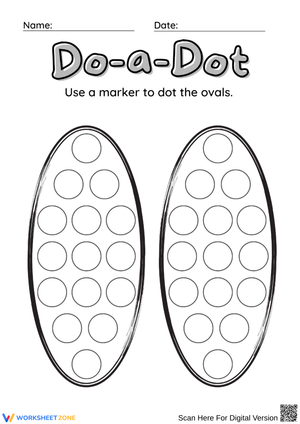
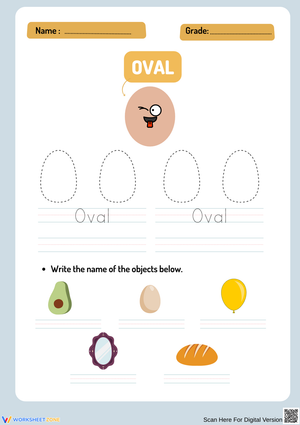
The worksheets move through a deliberate sequence of tasks, each isolating a different demand so students aren't asked to trace, identify, and sort simultaneously before they are ready. Tracing worksheets open with large, heavily dashed ovals and progress to smaller, lighter guides before ending with a blank field and a single starting dot — a step-by-step format that builds pencil control before asking for independent production. Identification worksheets present mixed arrays of shapes and ask students to mark only the ovals, reinforcing that orientation and size don't change what a shape is. The sorting worksheet uses a cut-and-paste format where students place shapes into "curved sides" and "straight sides" columns, connecting attribute-based thinking to the geometric vocabulary they're actively building.
- Progressive tracing from large dashed guides to freehand drawing
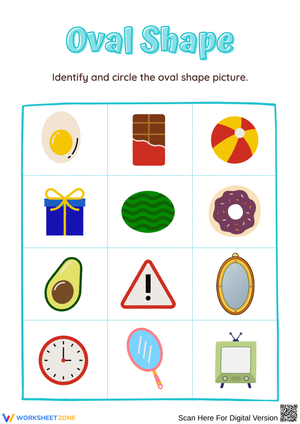
- Mixed-shape identification arrays across multiple orientations
- Cut-and-paste sorting by defining attributes — curved vs. straight sides
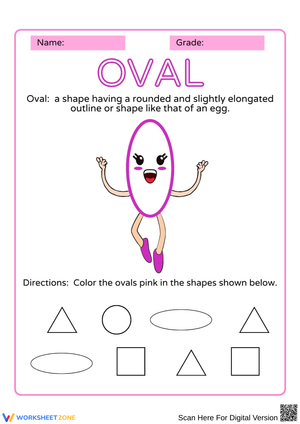
- Side-by-side oval and circle comparison with direct marking tasks
- Real-world object matching — eggs, mirrors, footballs, and related examples
- Attribute recording: students write zero sides, zero vertices
The Confusion Students Carry Into the Lesson
The oval-circle distinction is the predictable sticking point in first-grade geometry, and it trips students up in a specific way. Both shapes are closed curves with no straight sides and no vertices — so when a student is asked what makes an oval different from a circle, the answer is often silence or a shrug. The confusion runs deeper than carelessness: first graders are still developing the spatial perception needed to distinguish degree of curvature from regularity of curvature. A student who correctly marks a wide, horizontal oval will often call a narrow, upright oval a "weird circle" — because the taller orientation triggers the circle schema already in place.
A second error pattern shows up during drawing. Students told that an oval is "a stretched circle" frequently produce a rectangle with rounded corners — the mental model of "stretched" translates into a flat middle section rather than a continuous smooth curve. Worksheets that place the oval directly next to a circle for comparison, and that ask students to trace before they draw, address both patterns by giving a concrete visual reference rather than an abstract definition to memorize.
Fitting These Worksheets Into Your Geometry Block
The tracing worksheets work best as an opening activity during the first two or three days of a geometry unit, before students are expected to reproduce the shape independently. Five minutes of guided tracing at the start of math block — before direct instruction shifts to identification — builds the muscle memory that later sorting and recognition tasks can anchor to. For the identification and sorting worksheets, independent center work is the stronger setting: students who have already heard "oval" and "closed curve" in a whole-group lesson produce noticeably more accurate work than students attempting those tasks cold.
These 1st grade oval printable worksheets resources also serve well as a quick formative check at the close of a shape unit. A glance at whether a student is marking circles alongside ovals in the identification array tells you immediately whether the distinction has landed — without the overhead of a formal assessment. Placing the worksheets in dry-erase sleeves extends their life considerably; a student can trace, erase, and trace again across multiple sessions in a week, which builds the spaced retrieval that makes shape recognition durable rather than lesson-specific. The rainbow tracing technique is particularly effective here: students trace the same large oval in three different crayon colors before moving on to smaller versions, reinforcing the elongated curve through repetition while keeping the task visually engaging.
The Reason Tracing Comes Before Drawing
In early elementary geometry, the sequence of guided tracing, copying, and freehand drawing follows a principle well-documented in occupational therapy and fine motor development: students cannot consistently reproduce a shape they haven't fully encoded through guided movement. An oval is harder to internalize than a circle because it requires two distinct arc types — a wider, flatter arc across the top and bottom, and a tighter arc at each end — rather than the single continuous curve of a circle. Tracing the large dashed version three times before attempting a freehand oval gives students both the directional memory and the pressure changes the shape demands.
The effect shows up clearly in first-grade student work. Children who skip directly to freehand drawing typically produce one of two errors: an egg-drop shape with one end pointed, or a form that closes too early and resembles a deflated circle. A single guided tracing pass on a large model corrects both before either becomes a habitual production error.
Standard Alignment
These worksheets align to CCSS.MATH.CONTENT.1.G.A.1, which requires first graders to distinguish defining attributes — number of sides, vertices, type of line — from non-defining attributes like color, size, and orientation. The standard's specific instructional demand is that students be able to articulate why a shape belongs to a category, not simply recognize it by appearance. The attribute-recording activities address that directly: asking students to write "0 sides, 0 vertices" forces them to use the language of defining attributes rather than gesturing at the shape. The sorting worksheet — placing shapes into curved-line and straight-side columns — builds the categorical reasoning this standard expects before students encounter more complex polygons in later grades.
Meeting Learners Across the Room
For students still building pencil control, the large dashed tracing worksheets carry most of the directional load, which allows success without frustration. These students benefit from a finger-trace pass first: running a fingertip along the dashes before picking up a pencil gives a proprioceptive preview that the subsequent pencil work confirms and deepens. Teachers working with mixed-ability classes find that the 1st grade oval printable worksheets set's range of formats lets them assign different worksheets simultaneously without signaling who is behind — the tracing sheet and the identification sheet are similar enough in appearance that students at different levels can work at the same time without comparison becoming a distraction.
Students who have mastered tracing and identification move productively into the open-ended extension on the drawing worksheet, where they produce three ovals of different sizes without any guide — a task that requires internalizing the shape's proportions rather than following a template. A further stretch is the real-world connection activity: eggs and footballs are obvious choices, but a student who identifies the pupil of an eye, a racetrack oval, or a certain leaf shape is applying geometric thinking well beyond the standard. One honest limitation worth noting: the cut-and-paste sorting worksheet combines fine motor control with multi-step sequencing, and it consistently frustrates students who understand the geometry but lose track of procedural steps. For those students, replacing the cutting with a color-code version — color ovals red, circles blue, all polygons green — preserves the attribute-sorting demand without the procedural complexity.
Frequently Asked Questions
How do I explain the oval-circle difference to a first grader without causing more confusion?
The most reliable approach is direct visual comparison rather than definition. Place a circle and an oval side by side and ask students to describe what they notice — most will say "one is rounder" or "one is longer." Confirm that observation: a circle is the same width and height, while an oval is longer in one direction than the other. Avoid the phrase "a stretched circle" until students have already grasped the visual distinction; used too early, it often produces the rounded-rectangle drawing error described above. A worksheet that asks students to color circles one color and ovals another, using the same mixed array, gives immediate feedback on whether the distinction is landing.
Does an oval have sides or vertices?
No — an oval has zero straight sides and zero vertices. This is one of the defining attributes students record on the attribute-counting worksheet, and writing it out matters more than it might seem. First graders who can say "zero sides, zero vertices" for an oval are building the exact language CCSS.MATH.CONTENT.1.G.A.1 calls for: attribute-based identification rather than visual guessing. When students later encounter the hexagon or trapezoid, the habit of counting and recording attributes transfers directly.
What hands-on activities pair well with these worksheets?
Pairing a worksheet from this 1st grade oval printable worksheets set with a playdough or pipe-cleaner activity on the same day creates a strong concrete-to-abstract connection. Students who roll playdough into an oval shape and then trace that physical form onto paper are building the same spatial encoding that the dashed tracing worksheets target. A classroom scavenger hunt — students collect drawings or photographs of oval objects from around the room — works especially well before the real-world matching worksheet, because students arrive with their own examples already in mind rather than encountering the concept cold on the page.
Clear All