


























0
Views
0
Downloads

0.0
0
Save
0 Likes
Share
Matching Shapes Worksheet Activity
0 Views
0 Downloads
Paste this activity's link or code into your existing LMS (Google Classroom, Canvas, Teams, Schoology, Moodle, etc.).
Students can open and work on the activity right away, with no student login required.
You'll still be able to track student progress and results from your teacher account.
Information
Description
What It Is:
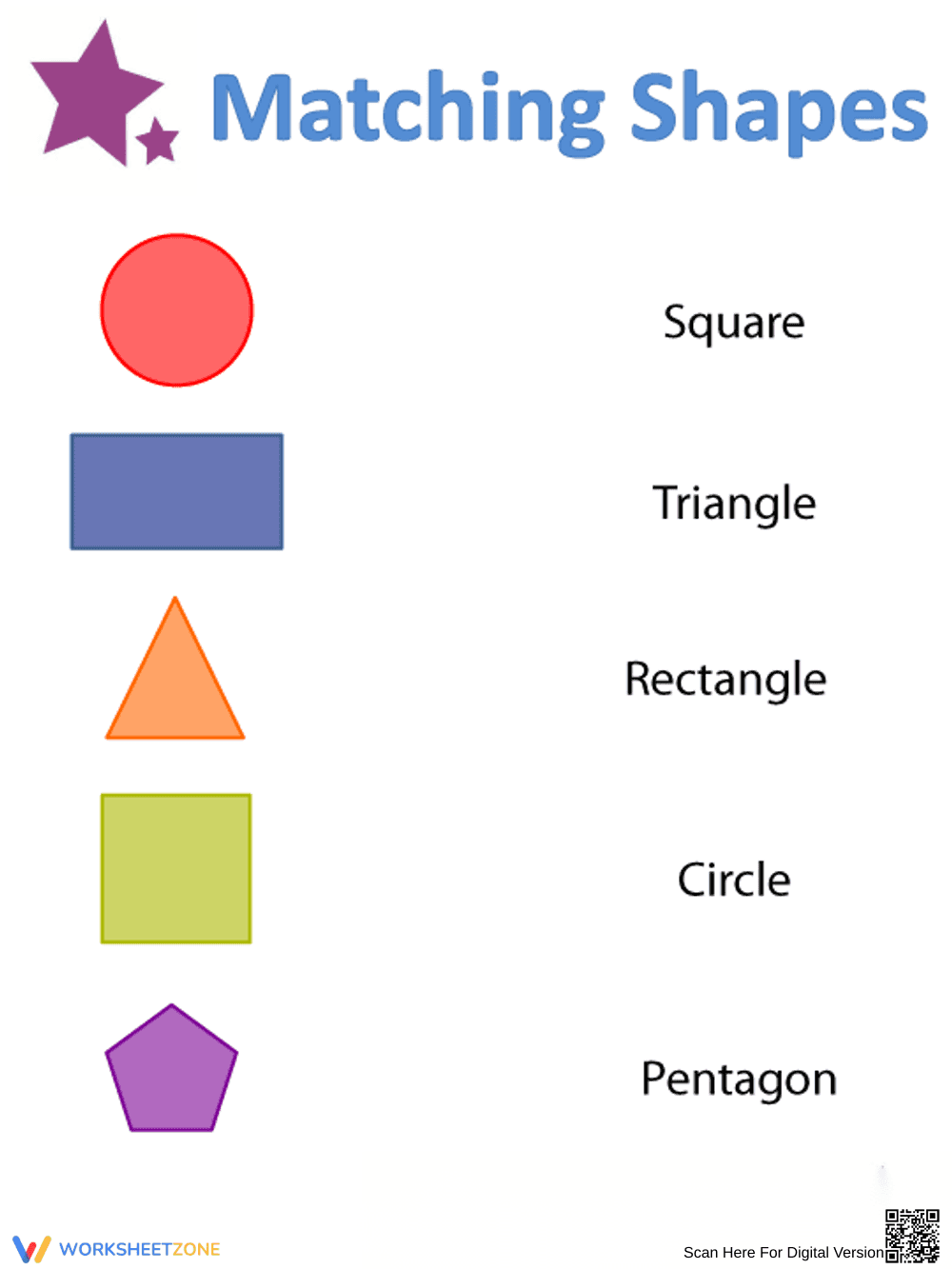
This is a worksheet titled 'Matching Shapes'. It features a column of five different colored shapes: a red circle, a blue rectangle, an orange triangle, a green square, and a purple pentagon. Next to the shapes is a column listing the names of the shapes in a different order: Square, Triangle, Rectangle, Circle, Pentagon. The activity involves matching each shape to its correct name.
Grade Level Suitability:
This worksheet is suitable for Preschool and Kindergarten (ages 3-5). The activity focuses on basic shape recognition, which is a fundamental skill taught at these grade levels.
Why Use It:
This worksheet helps children develop shape recognition skills and improves their vocabulary related to geometric shapes. It also enhances visual discrimination skills and reinforces the connection between visual representations and their corresponding names.
How to Use It:
Instruct the child to draw a line connecting each shape on the left to its correct name on the right. Alternatively, children can color code the shapes and their corresponding names using the same colors.
Target Users:
The target users are preschool and kindergarten children learning about basic shapes. It's also beneficial for children who need extra practice in shape recognition and matching skills.
This is a worksheet titled 'Matching Shapes'. It features a column of five different colored shapes: a red circle, a blue rectangle, an orange triangle, a green square, and a purple pentagon. Next to the shapes is a column listing the names of the shapes in a different order: Square, Triangle, Rectangle, Circle, Pentagon. The activity involves matching each shape to its correct name.
Grade Level Suitability:
This worksheet is suitable for Preschool and Kindergarten (ages 3-5). The activity focuses on basic shape recognition, which is a fundamental skill taught at these grade levels.
Why Use It:
This worksheet helps children develop shape recognition skills and improves their vocabulary related to geometric shapes. It also enhances visual discrimination skills and reinforces the connection between visual representations and their corresponding names.
How to Use It:
Instruct the child to draw a line connecting each shape on the left to its correct name on the right. Alternatively, children can color code the shapes and their corresponding names using the same colors.
Target Users:
The target users are preschool and kindergarten children learning about basic shapes. It's also beneficial for children who need extra practice in shape recognition and matching skills.


