Addition to 20 worksheets for 1st Grade: Building Math Fluency
These addition to 20 worksheets for 1st grade give teachers print-ready practice that moves students through the strategies they actually need — counting on, making ten, using doubles — rather than drilling isolated facts without context. The set covers sums up to 20 across several formats: open equations, missing addends, number line problems, and double ten-frame tasks. Each worksheet targets one strategy deliberately, so teachers can assign them with purpose rather than guesswork.
The Strategies Each Worksheet Targets
First graders working toward addition fluency need more than repeated exposure to 7 + 8 = 15. They need mental frameworks their brains can trust. Each worksheet in this set builds one of the major pathways students use to handle sums to 20:
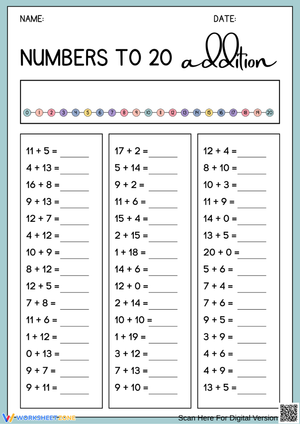
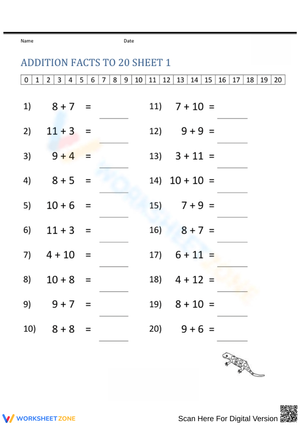
- Counting on from the larger addend — students identify the bigger number and track forward, supported by number lines printed directly on the worksheet
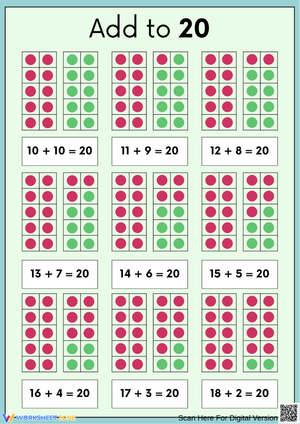
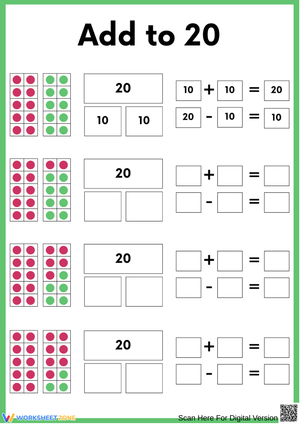
- Making ten — students decompose one addend to bridge to ten, then add the remainder; double ten-frame images guide this process visually
- Doubles and near-doubles — students anchor on a known fact like 6 + 6 = 12 and shift by one to solve 6 + 7
- Missing addend problems — students work equations like 9 + __ = 16 by applying the making-ten structure in reverse or using the relationship between addition and subtraction
Each worksheet stays inside one strategy per session. Mixing every strategy on the same task increases cognitive load without helping students internalize any single approach — a common problem with generic fact-drill sheets that try to cover everything at once.
Ten Frames, Number Lines, and Why Both Matter
The visual tools printed on each worksheet are not decorative. Double ten frames give students a concrete image of how a number like 9 relates to 10 — that one empty cell is the visual anchor for the entire making-ten strategy. When a student adds 9 + 4, they can see that filling the frame requires exactly one counter from the second group, leaving three behind. That image tends to stick in a way that a bare equation does not.
Number lines serve a different purpose. They make the counting-on process visible and give students a physical path to trace with a pencil. A first grader who keeps losing count at "8, 9, 10, 11..." because they are holding too much in working memory can offload that tracking onto the line. Once the sequence becomes stable, students stop reaching for the line without being told to — the support fades naturally as fluency builds.
Student Mistakes Worth Anticipating Before You Hand These Out
The most common error on making-ten worksheets is incomplete decomposition. A student working on 8 + 5 will correctly split the 5 into 2 and 3, add the 2 to 8 to reach 10 — and then write 13 because they added 3 again instead of just carrying over the remainder. They followed the procedure but lost track of what they had already used. This is not confusion about addition; it is a working-memory slip that clears up quickly once students circle or cross out the portion they have already applied on the worksheet itself. Watch for it in the first week students encounter this strategy.
A second error surfaces on counting-on problems: students start counting from the smaller addend rather than the larger one. Given 3 + 9, they begin at 3 and count up nine more, which is slow and produces more errors. The fix is simple — circle the larger number before beginning — but students need a teacher to name that habit explicitly, and then they need several worksheets of practice before it becomes automatic. Circling is not a crutch; it is the strategy made visible.
Smart Ways to Build These Worksheets Into Your Lesson Plans
The addition to 20 worksheets for 1st grade in this set fit most naturally at three points in the week: as a brief warm-up to activate a strategy before guided math begins, as the independent component during a rotations block, and as a short exit check at the close of a strategy lesson. The number-line formats work well during activation, when students are transitioning into math thinking and need something concrete in front of them. The missing-addend worksheets belong in rotations, when the teacher is with a small group and students need a format they can work through without stopping to ask questions.
One classroom routine that pays off consistently: three minutes at the end of independent time in which one student narrates their decomposition steps aloud while pointing to their work. "I had 8 + 6. I took 2 from the 6 to make 10, and I still had 4 left, so 14." That thirty-second explanation turns a silent worksheet into a visible-thinking moment — and it gives the teacher real-time information about which strategy students actually used versus which one they performed on paper without understanding.
Standard Alignment
CCSS.MATH.CONTENT.1.OA.C.6 requires first graders to add and subtract within 20 and demonstrate fluency within 10 by applying specific strategies: counting on, making ten, decomposing a number leading to a ten, and using the relationship between addition and subtraction. In classroom terms, this standard sits at the center of the first-grade math year — not a unit that passes but a skill that builds across most of the fall and winter. The worksheets in this set sequence from counting-on support to making-ten practice to missing-addend work, which mirrors how most districts pace instruction toward this standard through the first and second quarters.
Differentiating These Worksheets Across Student Levels
Students who are not yet secure with sums to 10 will struggle on tasks that assume that foundation. For these students, limit the problem range to addends of 5 or less and use only the worksheets that include ten-frame images — the visual structure does the work of manipulatives without requiring the teacher to be present at every moment. Pairing a less-confident student with one ten-frame worksheet and five physical counters gives them two representations simultaneously, which reduces frustration without removing the cognitive work they need to do.
Students who have already moved past counting-on strategies benefit most from the missing-addend worksheets and from a simple prompt written at the bottom: "Can you solve it a different way?" Some of these students will begin to generalize without any formal instruction — noticing that 8 + 5 and 5 + 8 always land at 13 — and that informal discovery is worth more than naming the commutative property before they have felt it.
The addition to 20 worksheets for 1st grade in this set offer enough variety in format and difficulty that one worksheet can serve as meaningful review for an advanced student while a different one in the same session functions as supported first practice for a student still developing fluency — without either group recognizing they are doing something different from their peers.
Frequently Asked Questions
What is the difference between using these worksheets for formative assessment versus independent practice?
In independent practice mode, students work through the problems and the teacher reviews completed work afterward. In formative assessment mode, the teacher circulates during the worksheet, watching for students who cross out and rewrite answers, who stall on specific problem types, or who finish quickly but get every making-ten problem wrong. The worksheet is the same — the teacher's attention is what changes. Collecting a handful of worksheets at the end of a strategy lesson and scanning specifically for the decomposition error described above gives a cleaner picture of understanding than any quick quiz can provide.
How many problems per sitting is realistic for first graders?
Eight to twelve problems in a focused session is the practical range for most first graders working independently. Beyond that, accuracy tends to drop — not because students do not know the math, but because sustained attention is genuinely hard at this age. Short, frequent practice builds fluency more reliably than long sessions completed once a week.
Should teachers use these worksheets before or after hands-on work with manipulatives?
After — always after, at least at the start of a new strategy. The addition to 20 worksheets for 1st grade in this set work best as the consolidation step following a concrete experience, not as the introduction to it. Students who have first built tens on a physical ten-frame understand what the printed image on the worksheet represents. Students who encounter the image cold often treat it as a visual decoration rather than a problem-solving tool. Teachers who introduce a strategy with manipulatives on day one and assign the corresponding worksheet on day two see faster consolidation with fewer procedural errors.
Clear All