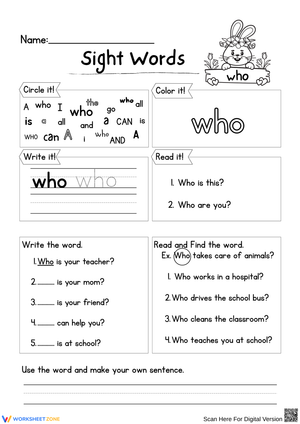
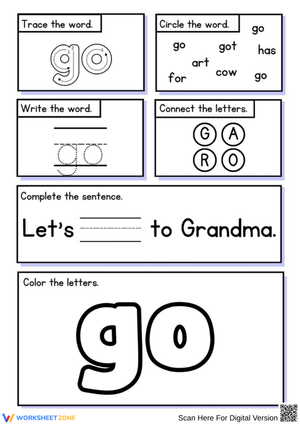
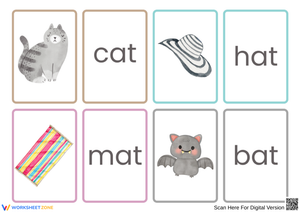
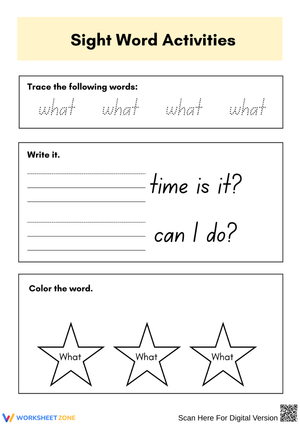
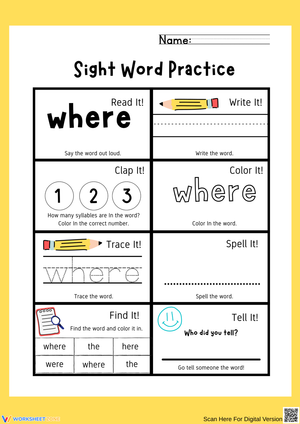
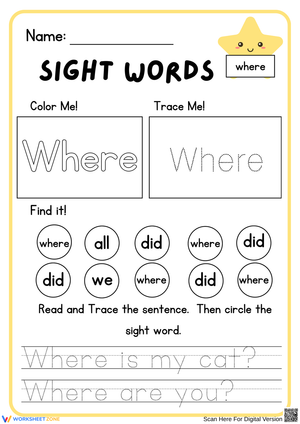
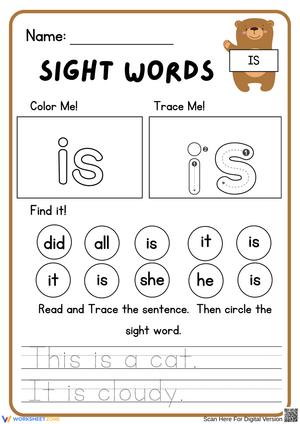
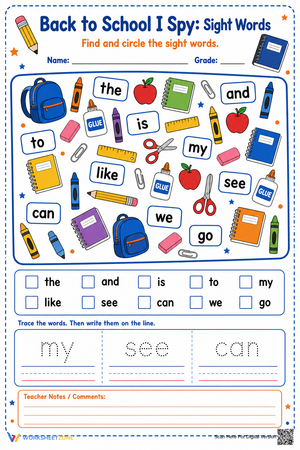
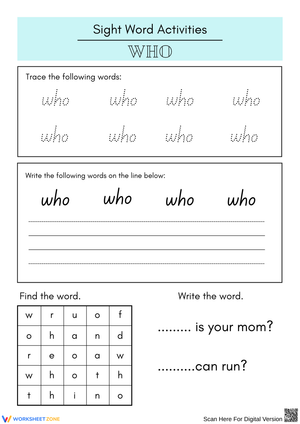
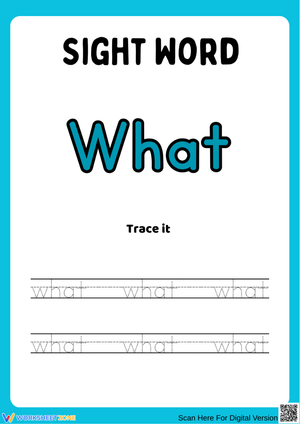
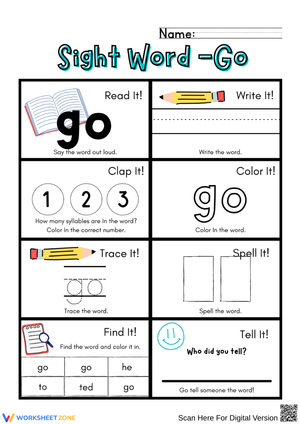
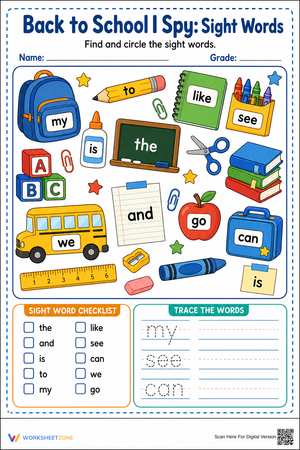
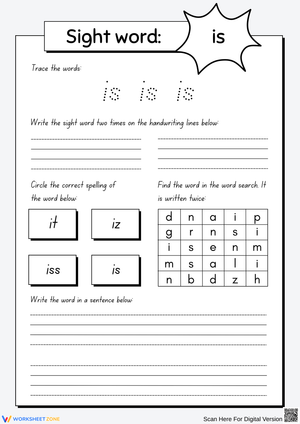
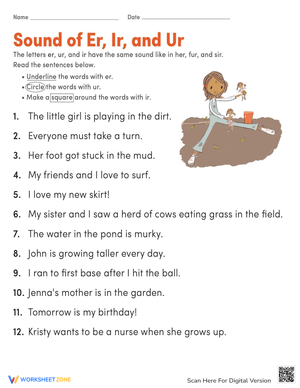
These 1st grade sight words worksheets resources give first-grade teachers deliberate, low-prep practice with the words that appear most often in early text. Each worksheet targets a manageable group — usually five to eight words — across several task types: reading, tracing, writing from memory, and using words in sentences. The format fits morning work, literacy centers, small-group time, and take-home practice without extra setup.
The Specific Skills Each Worksheet Builds
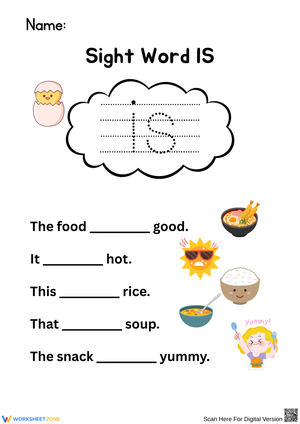
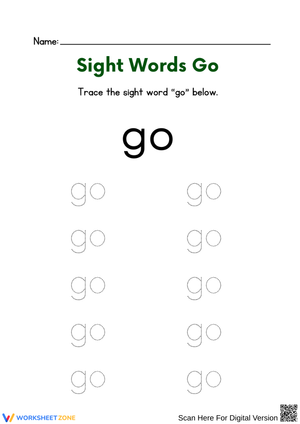
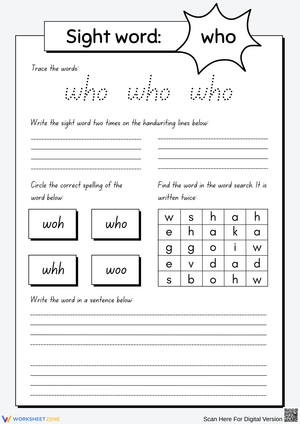
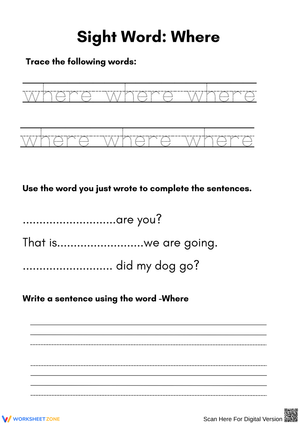
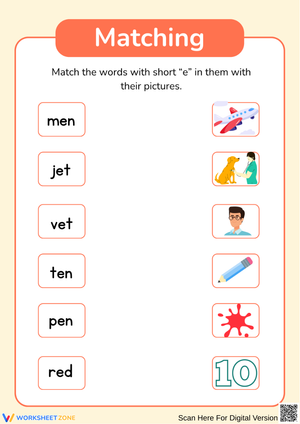
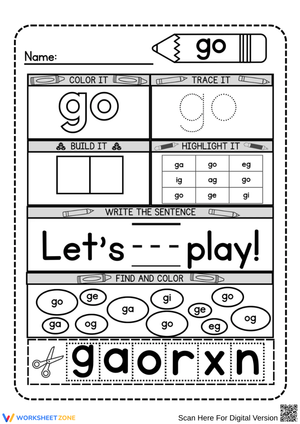
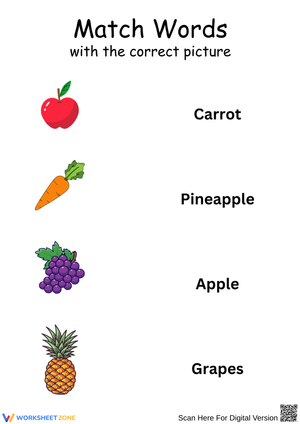
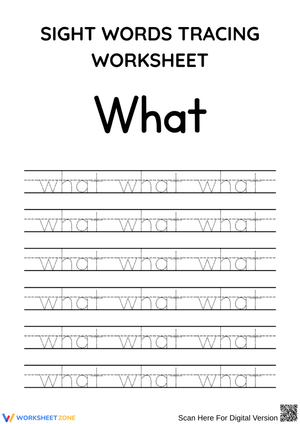
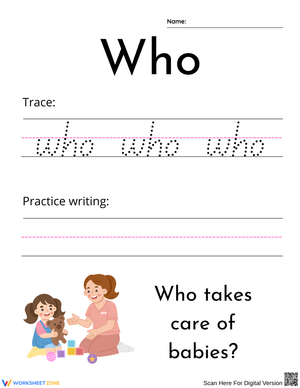
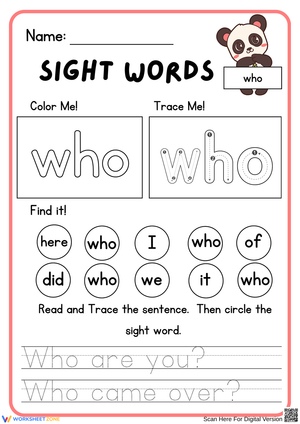
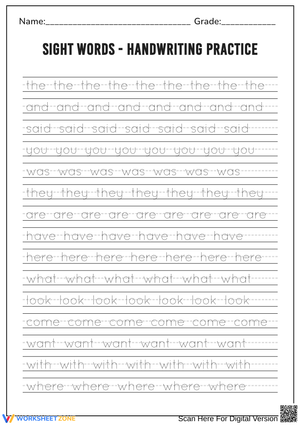
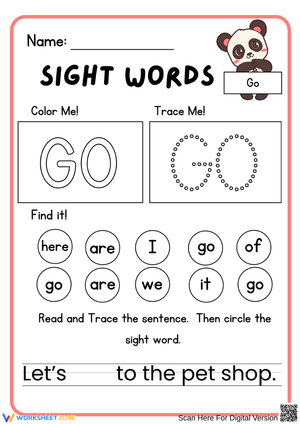
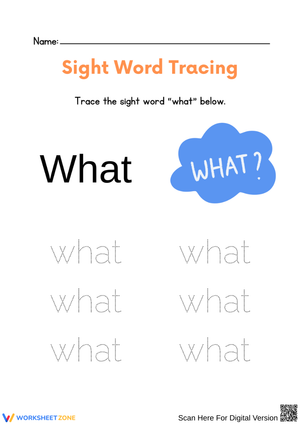
Across the set, students practice several distinct operations on the same target words rather than repeating the same action over and over. On trace-read-write pages, students study the word's letter sequence, say it aloud, and write it independently — a sequence that reinforces both spelling and visual memory at the same time. Sentence-completion pages require students to choose the correct word to finish a simple sentence, which moves practice from isolated recognition toward active usage. Cut-and-paste matching pages add a retrieval step that copying alone never produces.
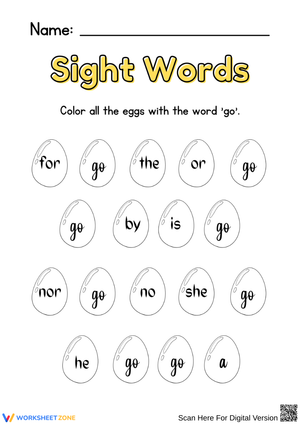
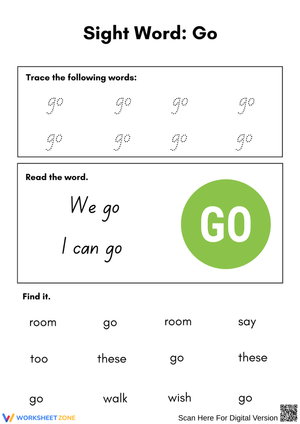
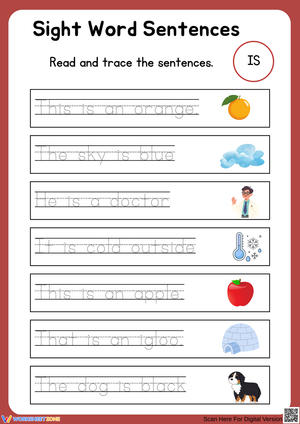
A well-organized 1st grade sight words worksheets set also includes read-and-find tasks, where students locate target words inside short, picture-supported sentences. That distinction matters: a student who reads "they" correctly on a standalone trace page may still pause over it mid-sentence during guided reading. Worksheets that address both levels — isolated recognition and recognition in running text — produce more durable gains than those that stay in only one mode.
Frequent Student Errors Worth Watching For and Correcting
The most common error pattern in first grade isn't complete ignorance of a word — it's partial learning. A student might read "said" correctly when it appears alone but consistently write "sed" or "siad" during independent writing. That gap between reading recognition and spelling production shows up clearly on worksheets that require writing from memory, not just circling or tracing. Those errors are diagnostic: catching them on a worksheet is far easier than spotting them buried in a writing draft.
Visual similarity causes a second pattern worth addressing directly. Pairs like was/saw, they/the, and were/where trip students up because the letters are identical or nearly so, differing only in sequence or length. More tracing doesn't resolve this; direct comparison does. When a student fills in "saw" where "was" belongs, that completed worksheet becomes the starting point for a focused comparison lesson — not just a correction to circle in red.
Working These Worksheets Into a Weekly Literacy Routine
The most effective approach is a five-day cycle built around one small word group. Monday introduces the words with oral reading and a trace-read-write page — low-stakes, multisensory, and quick to complete. Tuesday moves to a matching or cut-and-paste sheet during centers while the teacher runs a small group. Wednesday uses a sentence-completion page for independent work. Thursday brings a mixed-review sheet: circle the word, write it, read a sentence containing it. Friday is a short oral check or sentence-writing prompt using the same words.
When teachers display that week's word group on the word wall, in sentence stems, and on small-group materials alongside each worksheet, students start noticing the words across reading and writing instead of treating worksheet time as a separate task. The 1st grade sight words worksheets format works best as one component of that broader word environment — not as the only place where the words appear.
Dolch and Fry Lists — A Practical Comparison
Teachers frequently ask whether to follow Dolch words or Fry words. Both are widely used in Grade 1, and either works if the words match what students are currently reading and writing in class. The Dolch list is organized by grade band, which aligns naturally with decodable readers and shared reading texts. The Fry list is organized by raw frequency across a wide range of print, which suits classrooms where students encounter more varied materials early on.
The practical distinction is classroom alignment, not list superiority. If your shared reading texts lean heavily on Dolch-level words, start there. The instructional value comes from how many times students read, write, and use each word in context — not from which list appears in the worksheet header.
Adjusting the Worksheets for a Range of Learners
Differentiating these worksheets doesn't require separate materials for every group. The adjustment is in the response expectation, not the word list itself.
- Students who need additional support: Work with three or four words instead of the full group, read each sentence aloud together before independent work, and allow tracing before requiring production from memory.
- On-level students: Complete standard weekly pages — trace, write, and use each word in the given sentence frame.
- Students ready for extension: After completing each worksheet, write an original sentence for every target word, then underline any other high-frequency words they used in the process. This builds awareness that these words appear throughout their own writing, not just on worksheets.
Keeping the same word set across all three levels also makes Friday whole-group review workable. When everyone has practiced the same words — at different depths — the check-in is coherent rather than split across three unrelated word lists.
Standard Alignment
These worksheets align directly with CCSS.ELA-LITERACY.RF.1.3g, which asks first graders to recognize and read grade-appropriate irregularly spelled words. This standard sits within the Foundational Skills strand for a specific reason: words like "said," "come," "were," and "there" resist standard phonics patterns, so decoding strategies alone won't resolve them. Repeated reading and writing practice — exactly what each worksheet requires — is the instructional approach the standard points toward. Teachers building toward RF.1.4b, which addresses reading with accuracy and appropriate rate, find that strong high-frequency word automaticity feeds directly into fluency development under that standard as well.
Frequently Asked Questions
How many words should first graders practice each week?
Five to eight words per week works well for most first graders. That range allows enough repetition to consolidate both recognition and spelling without presenting so many new words that none of them stick. Teachers working with students who need more repetition often reduce to three or four words and extend the cycle to two weeks before introducing a new group.
Do students who already know most Dolch words benefit from these worksheets?
Yes — with adjusted expectations. Students who have strong recognition still benefit from the sentence-level and writing components, which push them toward accurate spelling and correct usage rather than just rapid identification. Those students frequently reveal spelling gaps that recognition-only practice never surfaces; "there," "their," and "they're" are a later but familiar example of the pattern.
Can these worksheets support intervention outside the classroom?
A set of 1st grade sight words worksheets resources works well in intervention settings because each worksheet is focused, printable, and requires no special preparation. A reading specialist can pull a targeted word group, print the relevant pages, and run focused sessions across several days without redesigning materials. The structured format also makes it straightforward to track which words a student has consolidated and which need continued exposure before moving forward.
Is tracing actually useful, or does it become rote busy work?
Tracing serves a specific purpose: it draws students' attention to letter sequence and directionality, which matters for easily reversed words like "was," "saw," and "where." The problem is when tracing is the only task on the page. When tracing leads directly into a write-from-memory step, the sequence builds genuine retention. When it fills ten lines with no recall requirement anywhere, it becomes copying — and copying doesn't consolidate memory the way retrieval does.












 Interactive Worksheet Maker
 Quiz Maker
 Word Search Maker
 Crossword Puzzle Maker
 Word Scramble Generator
 Sentence Scramble Generator
 Handwriting Worksheet Generator
 Name Tracing Generator
 Fill In The Blank Generator