


























Views
Downloads

Back to School Sight Words I Spy | Essential Grade K-1
Paste this activity's link or code into your existing LMS (Google Classroom, Canvas, Teams, Schoology, Moodle, etc.).
Students can open and work on the activity right away, with no student login required.
You'll still be able to track student progress and results from your teacher account.
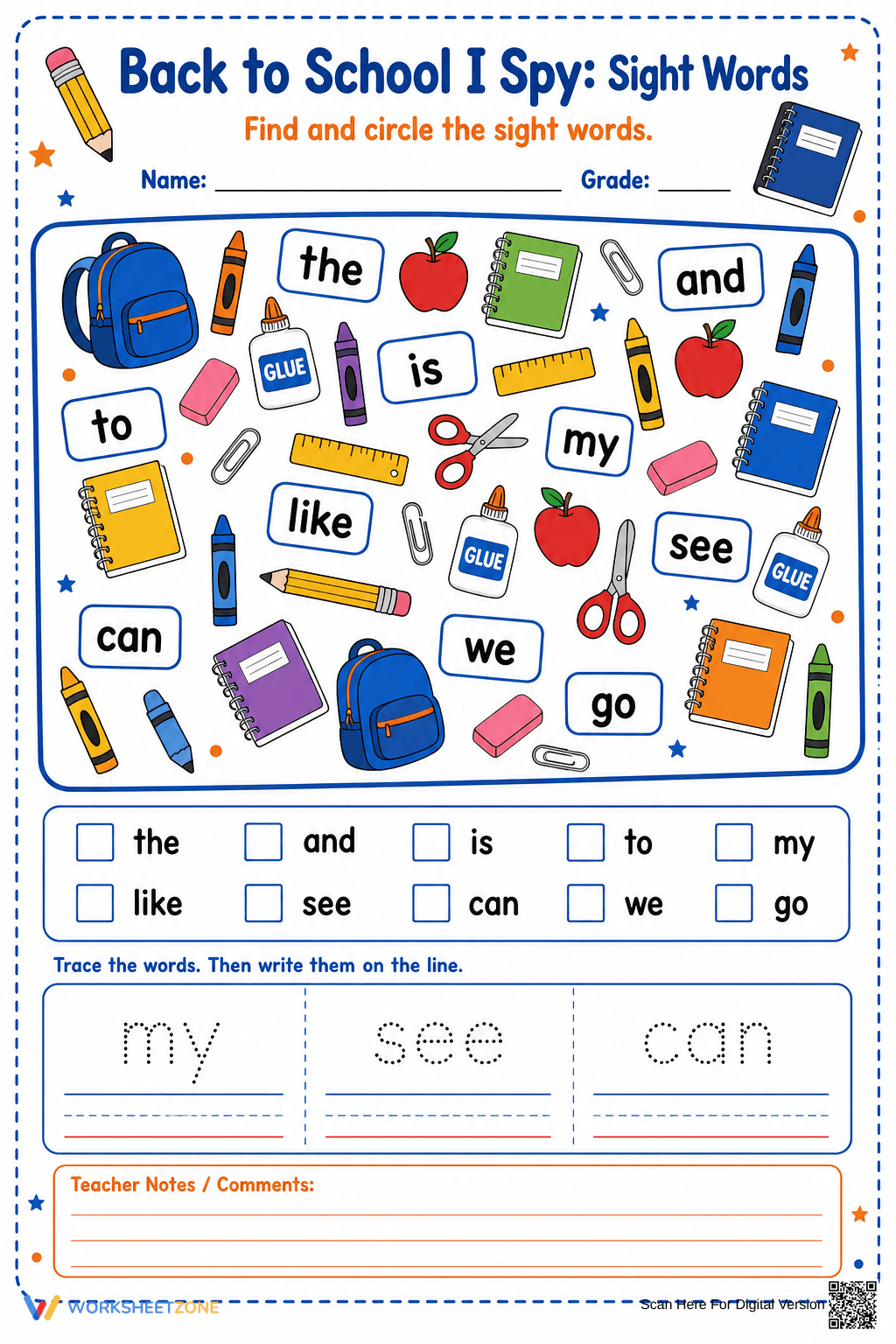
This Grade K-1 sight word worksheet provides students with a high-interest visual search activity to build literacy fluency. By identifying high-frequency words hidden within a classroom-themed scene, learners strengthen visual discrimination and word recognition. The integrated tracing section ensures students move from identification to active production of essential vocabulary.
At a Glance
- Grade: K-1 · Subject: ELA
- Standard:
CCSS.ELA-LITERACY.RF.K.3.C— Read common high-frequency words by sight- Skill Focus: Sight word recognition and tracing
- Format: 1 page · 13 tasks · Answer key included · PDF
- Best For: Morning work or literacy centers
- Time: 15–20 minutes
This single-page PDF features a vibrant "I Spy" search frame filled with 10 specific sight words (the, and, is, to, my, like, see, can, we, go) and school-themed illustrations. Below the search area, a checklist allows students to track their progress. The bottom of the page includes a dedicated tracing and writing strip for three target words: "my," "see," and "can," using primary-ruled lines.
This resource is designed for immediate classroom implementation with a total teacher prep time of under 2 minutes. First, print the single-page PDF for your class. Second, distribute the sheets during morning arrival or as a transition activity. Third, review the checklist or tracing section as a quick formative check. Its self-explanatory layout makes it an ideal choice for emergency sub plans or independent work packets.
The primary focus is `CCSS.ELA-LITERACY.RF.K.3.C`, which requires students to read common high-frequency words by sight. The tracing component supports `CCSS.ELA-LITERACY.L.K.1.A` by practicing letter formation within the context of meaningful words. Both standard codes can be copied directly into lesson plans, IEP goals, or district curriculum mapping tools.
Use this worksheet during the independent practice phase of a literacy lesson to reinforce newly introduced sight words. It serves as an excellent formative assessment tool; observe if students can locate words independently or if they rely on the checklist for visual cues. The activity typically takes 15 to 20 minutes, making it perfect for small-group rotations.
This resource is tailored for Kindergarten and early First Grade students who are developing foundational reading skills. It is particularly effective for English Language Learners (ELLs) who benefit from the visual pairing of words with school-related objects. Pair this with a sight word anchor chart or a shared reading passage to extend the learning.
High-frequency word recognition is a cornerstone of early literacy development, as these words often do not follow standard phonetic rules. According to Fisher & Frey (2014), visual search activities like "I Spy" engage students in active scanning, which improves orthographic mapping and word retrieval speeds. This worksheet aligns with `CCSS.ELA-LITERACY.RF.K.3.C` by requiring students to identify 10 essential sight words in a non-linear format, moving beyond simple rote memorization. Research from the RAND AIRS 2024 report suggests that integrating fine-motor tasks, such as the tracing and writing exercises included here, reinforces the neural pathways associated with word recognition. By combining visual discrimination with tactile writing practice, this resource provides a multi-sensory approach to mastering the Dolch and Fry word lists. Educators can use the 13 distinct tasks to gather data on student mastery for progress monitoring or RTI documentation.


