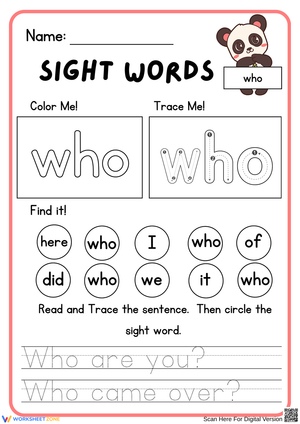
Sight Word Who PDF Worksheets for 1st Grade
These sight word who pdf worksheets for 1st grade give teachers a print-ready set of activities built around one of the most irregular words on the Dolch primer list — a word that appears constantly in leveled texts but resists every phonics strategy first graders are building at the same time. The set covers visual recognition, letter-sequence practice, and reading the word in sentence context, so students encounter "who" from several angles before recognition becomes automatic.
What Makes "Who" Different From Other High-Frequency Words
By first grade, most students have internalized that "wh" spells the /w/ sound. That rule holds up for "when," "where," "what," and "while" — but it collapses completely with "who," where the pronunciation is /huː/ and the "wh" does nothing students expect it to do. Students who try to decode it phonetically stall out or say "woh," and because the letters are almost identical to "how," confident guessers often produce the wrong word entirely.
This is one of the few Dolch words where strong phonics skills work against a student on the first pass. The child who sounds words out carefully is the one most likely to get burned here, because the spelling looks rule-based but isn't. Teaching "who" explicitly — with a direct side-by-side comparison to "how" and "hop" — moves faster than waiting for repeated exposure to do the work on its own.
Skills These Worksheets Build
Each worksheet isolates a different way of knowing the word, which matters because first graders who can trace "who" fluently don't always recognize it mid-sentence.
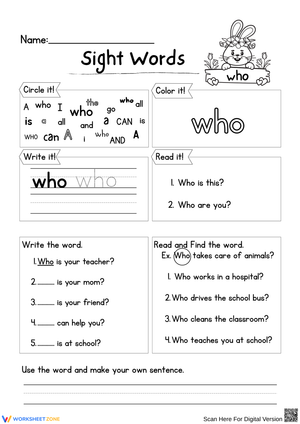
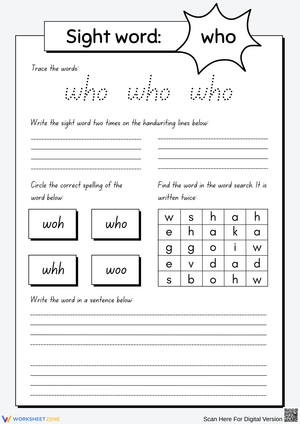
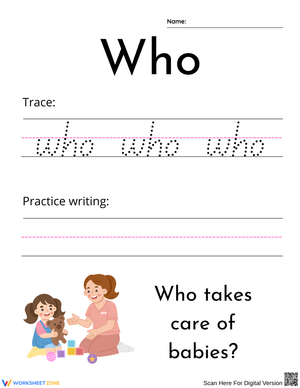
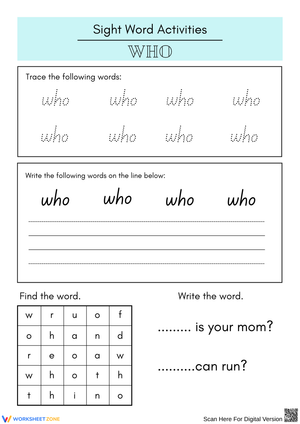
- Tracing and independent writing: Students trace the word on standard first-grade handwriting lines with letter-order arrows, then write it from recall in the same workspace. The shift from guided to independent production within the same task surfaces hesitation before it becomes a habit.
- Visual discrimination: Students scan a mixed word grid and circle every instance of "who," with distractors that include "how," "hop," and "hoe." Using distractors that share letters forces genuine letter-by-letter attention rather than whole-shape guessing.
- Sentence completion: Every blank falls inside a question — "_____ took the red crayon?" rather than a declarative sentence — so students practice reading "who" in the interrogative context where they encounter it most often in real text.
- Cut-and-paste letter sequencing: Students arrange loose individual letters into the correct order and glue them down. This slows the task deliberately, requiring students to attend to each letter rather than the overall word shape.
Errors That Show Up in Student Work — and What They Tell You
The most predictable mistake is writing or circling "how" instead of "who." It appears because students are holding a rough word shape in memory — three letters, starts with a tall letter, ends with a round one — rather than tracking the sequence. When this shows up in the sentence completion, put both words on the board simultaneously and ask the student to name the middle letter in each. That one comparison usually resolves the confusion faster than additional tracing does.
Phonetically accurate students frequently write "hoo," which is not confusion about the word but a logical application of decoding rules to irregular material. Students who write "hoo" have understood the sound correctly; what they lack is the visual memory of the spelling. Framing it as a decoding success — "You heard it right; now let's look at how it's actually spelled" — tends to land better than correction framing.
A third pattern, less common, is the reversal "woh." First graders still firming up left-to-right directionality sometimes produce this, especially in the cut-and-paste activity where the letters are physically loose. One monitoring note: if a student consistently reverses across multiple words, that's worth flagging for closer attention. In isolation, on this word alone, it rarely signals a deeper issue.
Building "Who" Into Your Literacy Week
Monday introduction works well. Write "who" on the board, say it aloud, and use it in two spoken questions — "Who is wearing sneakers today?" covers it — then distribute the tracing and writing worksheet. By mid-week, students are ready for the discrimination grids. Save the sentence completion for Thursday or Friday, when the word has had time to settle into memory. That five-day spread uses spaced retrieval, which matters more for irregular spellings than a single massed practice session does.
For literacy centers, laminate the tracing worksheet and set it out with dry-erase markers. Students cycle through independently, erasing and repeating. Paper copies work better for the sentence completion tasks, where you want a permanent record to check whether students are reading the questions or just inserting the target word regardless of meaning.
The sight word who pdf worksheets for 1st grade also hold up as take-home practice. The directions are straightforward enough for a parent or older sibling to support the work without a teacher's explanation. A short note clipped to the worksheet — asking families to say the whole word aloud before the child writes it, rather than spelling it letter by letter — reinforces the whole-word recognition approach that makes homework useful rather than counterproductive.
Standard Alignment
RF.1.3g requires first graders to recognize and read irregularly spelled words, and "who" sits near the top of any teacher's working list for that standard — it appears in the texts students read during guided reading within the first semester, well before most students have the phonics tools to decode it. Teachers who include sight word who pdf worksheets for 1st grade as part of their RF.1.3g instruction give students structured, repeated contact with the word before it shows up in running text, rather than treating recognition as something that will develop through incidental exposure.
The sentence completion activities also connect to L.1.1d, which addresses pronoun use in first grade. Students who understand that "who" asks about people — as opposed to "what," which asks about objects — are building early conceptual grammar before they can articulate the rule. That connection is worth naming during instruction: "We use 'who' when we want to know about a person."
Fitting These Worksheets to Different Readers
For students who need more support, add a reference card — an index card with "who" printed clearly — that sits on the desk during the discrimination and sentence completion tasks. Pulling that card away once a student completes the worksheet without glancing at it gives you a built-in fluency checkpoint. Students receiving intervention support often benefit from working through the activities in a different order: sentence completion first, tracing last. Moving from meaning toward form reduces the feeling that the task is a pure memory exercise with no connection to reading.
For students who master the word quickly, extend the sentence completion by asking them to write an answer sentence below each question: "Who took the red crayon?" → "Maya took the red crayon." That extension moves from reading comprehension into early writing production — appropriate for first graders who are ahead on sight-word automaticity but still benefit from sentence-level writing practice. It also stretches the worksheet's instructional value without requiring a separate activity.
Frequently Asked Questions
Why does "who" appear on the Dolch primer list if it's so irregular?
Frequency overrides phonetic regularity when it comes to list placement. "Who" appears in nearly every early reader that involves characters acting or speaking — which is almost all of them — so students hit it constantly before they have the decoding tools to handle it. Placing it at the primer level reflects the reality that early recognition is necessary even when the spelling makes no phonetic sense.
Can these worksheets work for kindergarteners or second graders catching up on high-frequency words?
The handwriting lines and sentence complexity are calibrated for first grade, but the set works at both edges of that range. Late-kindergarten students who have begun sight-word instruction handle the tracing and discrimination tasks without difficulty. Second graders who are still consolidating high-frequency words benefit most from the sentence completion activities, since those require reading in context rather than isolated recognition.
How does the visual discrimination task help a student who already recognizes the word?
Students who appear to "know" a word in isolation sometimes falter when it appears among similar-looking words — especially "how" for this specific word. The discrimination grid reveals whether recognition is solid enough to survive distraction, which is the actual condition under which students encounter words in real text. If a student who "knows" the word still circles "how" in the grid, that's useful information before you move to the next word in your sequence.
Do the worksheets address the "who" versus "how" confusion directly?
The discrimination grids include "how" as an intentional distractor, so a student who circles the wrong word flags the confusion immediately — which is more useful than discovering it mid-read-aloud. These sight word who pdf worksheets for 1st grade give you a clear window into whether a student has sorted out those two words before you move forward in your Dolch instruction.
Clear All