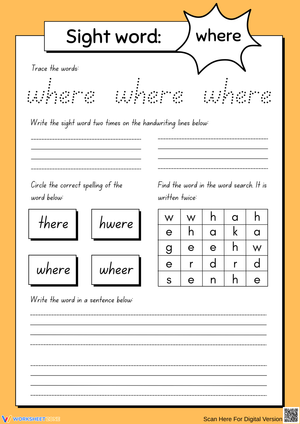
1st Grade Sight Word Where Worksheets
1st grade sight word where worksheets give teachers a targeted way to move first graders past letter-by-letter decoding and toward automatic recognition of one of the most common question words in early text. The set covers visual recognition, letter formation, and contextual use — the three things students actually need to own a high-frequency word, not just identify it on a flash card.
What Makes "Where" Hard for Beginning Readers
The wh digraph at the start is familiar — first graders have usually met it in words like when and what. The difficulty lives in the ere ending. By first grade, most students have internalized the vowel-consonant-e pattern: a final e makes the middle vowel say its name. In where, that rule doesn't hold. The word sounds like "wair," not the "w-here" the letters seem to suggest. Students who try to apply what they've learned about silent-e words will land somewhere between confused and confidently wrong — which is the harder problem to correct. The heart word approach handles this directly: identify the wh as the decodable part and tell students the ere chunk is simply going to live in memory. That honest framing tends to settle kids down. They stop fighting the phonics and start trusting the visual shape of the word.
The Specific Skills Targeted
The activities across the set address several distinct skills, not just repetition for its own sake:
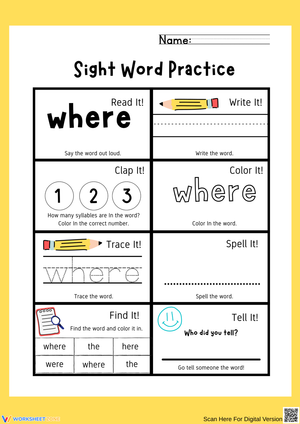
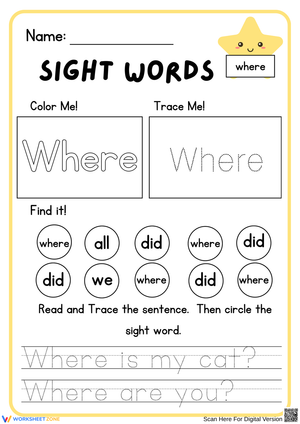
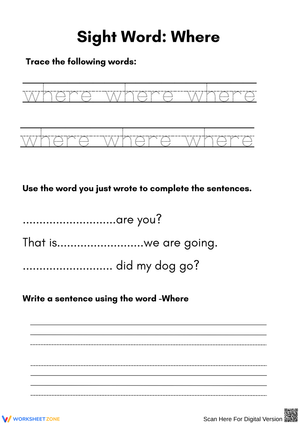
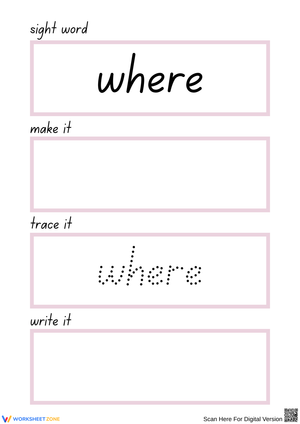
- Tracing the word with directional arrow cues to build correct letter-formation habits before errors become habitual
- Independent writing in isolation — blank lines where students produce where from memory without a model in front of them
- Visual discrimination tasks mixing where with close look-alikes: were, here, when, there — students circle or color only the correct word
- Sentence completion frames like "_______ is the dog hiding?" that require students to place the word inside a real question
- Short passage reading, where students underline every instance of where in three or four connected sentences
That last task closes the loop. Tracing and writing build encoding; finding the word in connected text shows students it functions the same way in actual sentences as it does on practice lines. That transfer matters more than it usually gets credit for.
Standard Alignment
These resources address RF.1.3g, the Common Core Reading Foundational Skills standard requiring first graders to recognize and read grade-appropriate irregularly spelled words. Where qualifies because the vowel chunk does not behave the way students' existing phonics knowledge predicts — the pronunciation is closer to the a in care than to anything a first grader's decoding rules would produce. In classroom terms, RF.1.3g is the standard most sight word instruction is quietly working toward even when it isn't posted on the board. It represents the expectation that students carry a bank of known words in memory so reading can operate without constant decoding effort. The 1st grade sight word where worksheets in this set give students the repeated, varied encounters needed to move where from something they have to work out into something they simply know.
Mistakes Students Make That These Worksheets Help You Catch
The most reliable error is substituting were for where. Both words share the same letters except for the initial wh, and when students write quickly, they default to the more phonetically consistent spelling. A student completing the frame "_______ did you leave your backpack?" will often write "Were did you leave your backpack?" — not because they're unfamiliar with where, but because were feels closer to the sounds they hear. Writing both words side by side during a brief teacher-led moment, then asking students to read each one aloud, is usually enough to make the distinction stick.
A second error shows up in visual discrimination tasks: students spot the word here embedded inside where and circle it instead of the full word. This actually signals good attention to word parts, but it needs a redirect. The moment can become a quick teaching point: "You noticed here hiding inside where — that's part of why the ending sounds unexpected." That observation tends to flip the error into a memory hook students hold onto well past the worksheet.
How to Work These Worksheets Into Your Week
Literacy centers are the most natural placement. When one group reads with the teacher and another works independently, a tracing or sentence-completion worksheet keeps the independent group on task without requiring teacher oversight. The activities are clear enough that first graders know exactly what to do — which matters during the 12-to-15 minute rotation window when redirection isn't available.
Morning work is a second strong fit. Arriving students need something concrete, low-stakes, and focused while the class settles. Pulling one worksheet per day during the first week a word is introduced keeps where visible every morning without claiming instructional time. By Friday, most students have written and read the word enough times that the spelling stops requiring effort. For students receiving intervention support, 1st grade sight word where worksheets work particularly well in a teacher-led small group, where the conversation around a student's error — spoken aloud, in real time — does work that silent independent practice cannot replicate.
Making These Resources Work Across Ability Levels
Students still developing fine motor control should start with the tracing worksheets that include directional arrows rather than faint gray outlines. The arrows signal where each stroke begins, which reduces the cognitive effort of letter formation enough that students can also attend to the word's overall shape — the part that actually needs to go into long-term memory.
Students who have solid letter formation and already recognize where consistently benefit from moving directly to passage reading and sentence-completion tasks. Add a quick spoken extension: after finishing the worksheet, the student composes one original question aloud using where as the opening word. This pushes the word into expressive language without requiring a new resource.
For students ready to go further, partner the 1st grade sight word where worksheets with a shared writing task: two students co-author three questions beginning with where, using a familiar classroom photograph or picture book illustration as a prompt. The worksheet becomes a reference point, not the endpoint.
Frequently Asked Questions
Which sight word lists include "where"?
The word where appears on both the Dolch Primer list and the Fry First 100 Words. Both place it among the words expected in kindergarten through early first grade. Most schools introduce it by mid-kindergarten or the start of first grade, depending on when their phonics program covers the wh digraph and how quickly students are moving through the high-frequency word sequence.
Why can't students just sound out "where"?
The wh at the front is actually decodable — students learn that digraph early. The problem is the ere ending. In a word like here, the final e makes the middle vowel long, giving students a predictable result. In where, the vowel sound is closer to the a in care — a pattern most first graders haven't been taught yet. Treating the ere portion as a unit to memorize, rather than asking students to decode it from rules they don't yet have, is the more practical approach at this stage.
Can kindergartners use these worksheets?
Where appears on the Dolch Primer list, which many kindergarten programs introduce in the second half of the year. The tracing and visual discrimination activities work for kindergartners who have solid pencil control and already read at least five or six sight words without prompting. The sentence-completion tasks assume students can read the surrounding words in each frame, so those fit better in first grade — or for late-kindergartners already working comfortably above grade-level expectations.
Clear All