These 1st grade long o printable worksheets address one of phonics instruction's genuinely tricky moments: the long O sound can be spelled at least five different ways, and a student who has internalized boat will still stall on snow until each pattern gets its own direct instruction. Each worksheet targets a specific spelling pattern — or moves students into mixed review once the individual patterns have been taught — so teachers can sequence practice precisely rather than hoping that general exposure does the work.
The Long O Spelling Patterns Covered
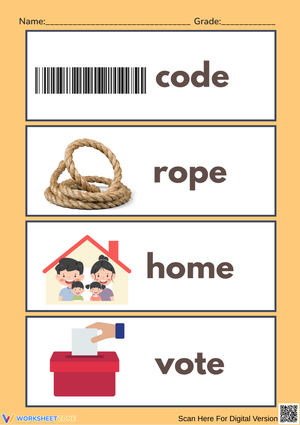
Long O instruction lands better when each pattern gets isolated attention before students are asked to distinguish among them. These worksheets address five patterns: o_e (as in bone and rope), oa (as in coat and road), ow (as in snow and blow), oe (as in toe and doe), and open-syllable O — single-syllable words like go, no, and so where the vowel stands alone and takes the long sound. The oe pattern appears less often in first-grade reading, but a student who encounters toe in a decodable book without having seen that spelling will guess at it. Including it early prevents that confusion from taking hold.
Activity Types Across the Set
First graders lose focus when the same task format repeats every session, so the worksheets rotate through several activity structures:
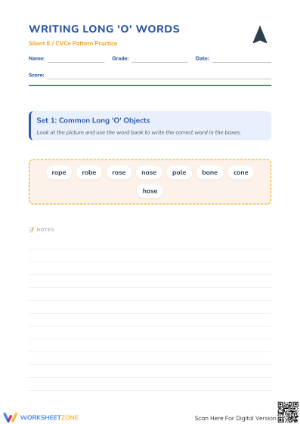
- CVC-to-CVCe transformations: Students write a short O word like hop, add a silent E, rewrite the new word, and read both aloud. The before-and-after pairing makes the mechanism of silent E concrete — students see exactly which letter changed and hear the result immediately.
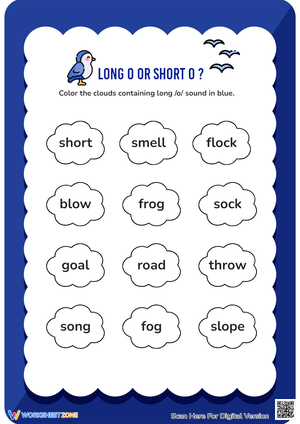
- Word sorts: Students place words into columns by spelling pattern (o_e versus oa, for example) or by vowel sound (long O versus short O). Sorting builds the auditory discrimination that purely visual recognition tasks can miss.
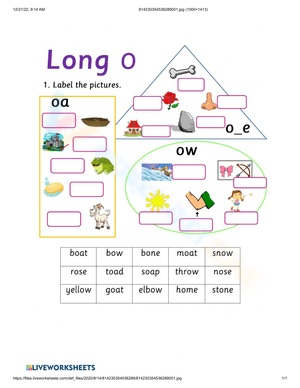
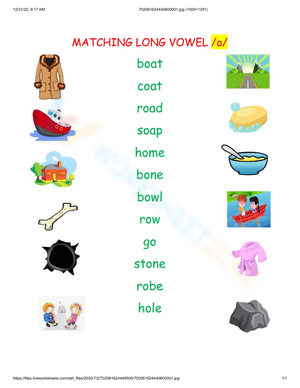
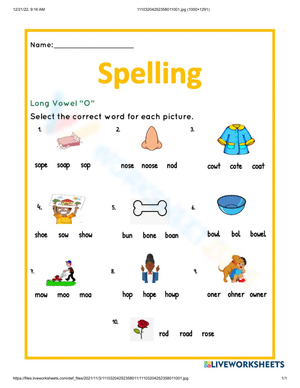
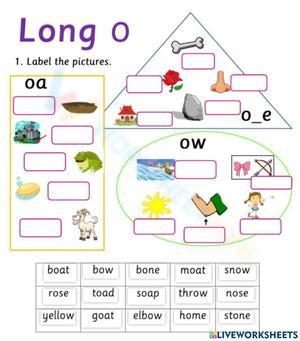
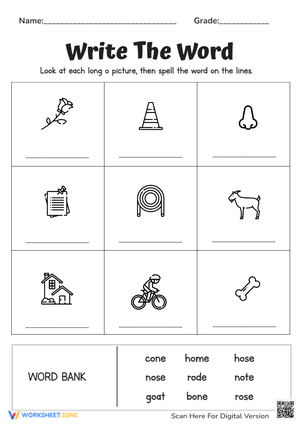
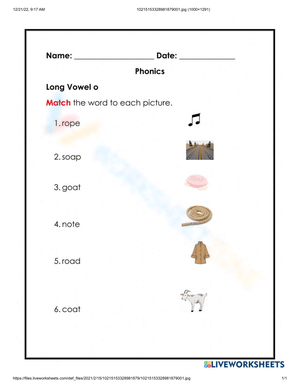
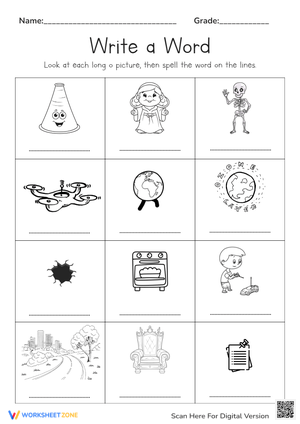
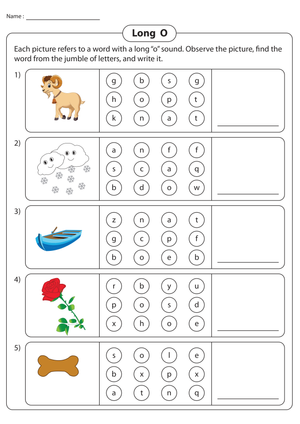
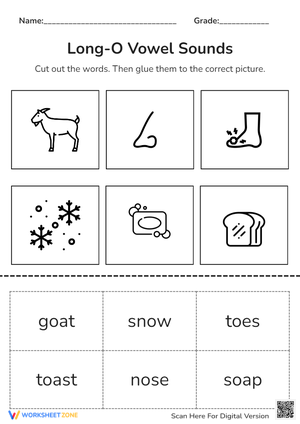
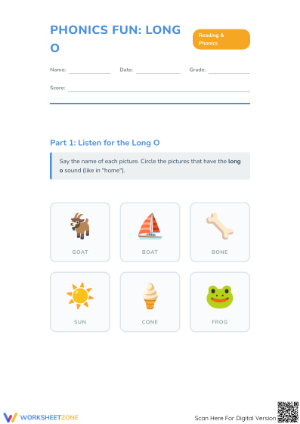
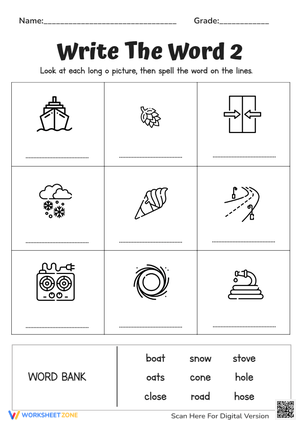
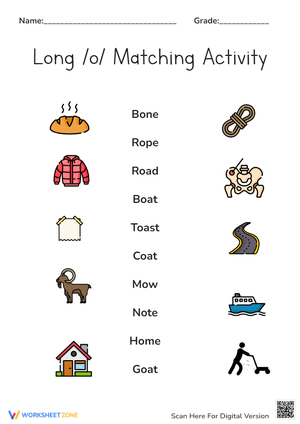
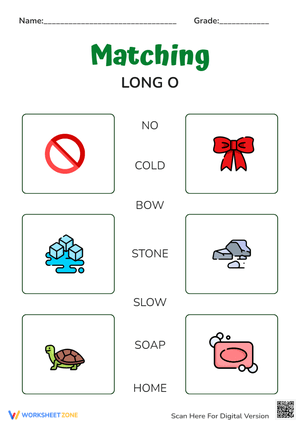
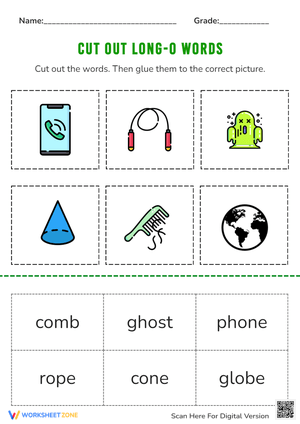
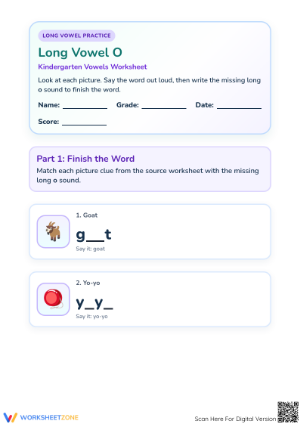
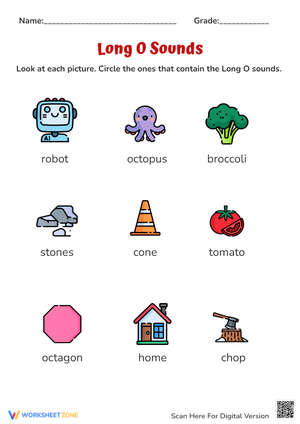
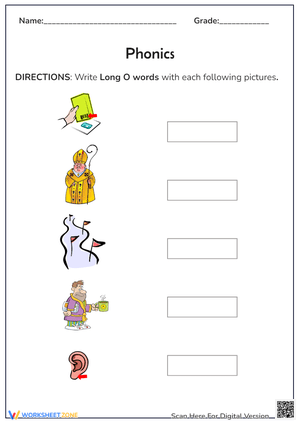
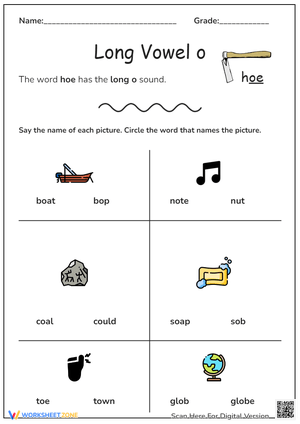
- Picture-word matching: An illustration anchors the vocabulary, so students connect the phonics pattern to a word they already know rather than memorizing a spelling in isolation.
- Fill-in-the-blank sentences: Students pull a word from a word bank to complete a sentence. The sentence context adds a comprehension layer — students cannot simply copy a letter string without understanding what the sentence means.
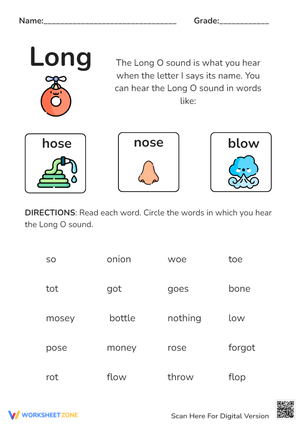
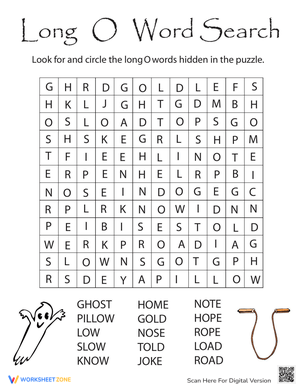
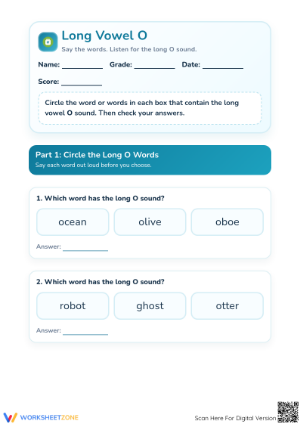
- Read-and-circle tasks: Students scan a sentence or short passage and mark every long O word. This trains the pattern-recognition reflex students need when reading connected text, not just word lists.
- Trace-and-write practice: Students trace a target word, then produce it independently. The kinesthetic component supports spelling retention in ways that purely visual exposure does not.
Where First Graders Go Wrong With Long O Patterns
The most persistent error is pattern overgeneralization. A student who has just learned that oa makes the long O sound will write rowd for road — and then turn around and write shoan for shown, applying oa where ow belongs. These aren't random errors; they signal that the student has learned a pattern but hasn't yet sorted out its positional and contextual constraints. Word sort worksheets surface this confusion during sorting rather than hiding it inside silent written work, giving teachers a chance to address the issue before it solidifies.
A second predictable mistake: students drop the silent E when writing o_e words from memory. They'll spell hop and feel confident because they've produced a real word. Brief CVC-to-CVCe transformation practice — writing the short O word first, then adding E and reading the new word aloud — gives students an explicit procedure to run when uncertain, rather than leaving them to rely on visual memory alone.
How to Work These Worksheets Into Your Phonics Block
Sequence matters here. Pattern-specific worksheets belong in the initial instruction days for each spelling — use them as guided practice while the lesson is still fresh, ideally within the same block where you introduced the pattern. The 1st grade long o printable worksheets formatted for mixed review are better held back for end-of-unit consolidation or for Monday morning warm-ups after a weekend break, where spaced retrieval is doing the heaviest memory work.
For small-group rotations, word sort and picture-matching worksheets run with minimal teacher direction, which frees you to pull a targeted group while the rest of the class works independently at their seats. A five-minute whole-group launch — projecting one worksheet and completing the first two items together — handles the transition into independent work cleanly and cuts down on procedural questions during the practice period.
Standard Alignment
These worksheets align to CCSS ELA-Literacy RF.1.3b, which requires first graders to decode regularly spelled one-syllable words, and RF.1.3c, which specifies knowledge of final-e and common vowel team conventions. In classroom terms, RF.1.3c is the reason long O instruction belongs in Grade 1 rather than Grade 2 — the standard explicitly calls for students to understand that a final E changes a vowel's sound and that vowel teams like oa operate by a consistent rule. Each worksheet is built around a single convention so that standard becomes more than a reporting checkbox; it becomes observable, measurable classroom behavior.
Tiering Practice for the Range of Learners in Your Room
Students still consolidating CVC words benefit from skipping the transformation tasks entirely and staying with simple picture-word matching on one pattern at a time. A visual anchor card showing the spelling rule (o_e → long O) reduces the number of things a struggling reader has to hold in working memory at once — no separate materials required, just a printed reference. For students who have already internalized each individual pattern, the mixed-review format works as a quick formative check; after completing the task, they can sort their answers by spelling pattern as a two-minute add-on that extends thinking without requiring a different worksheet. Students writing sentences fluently can treat any fill-in-the-blank exercise as a starting point and add a second original sentence using a different word from the same word bank, which moves practice from recognition into generative use of the pattern.
Frequently Asked Questions
In what order should I teach the long O patterns?
Most structured phonics sequences introduce o_e first because silent E follows a rule students can state and apply broadly. Vowel teams oa and ow come next — oa in medial position (as in coat), then ow at the end of words and syllables (as in grow). Open-syllable O and oe fit naturally toward the end of the sequence. The 1st grade long o printable worksheets are organized to match that progression, with pattern-specific pages designed to precede the mixed-review format.
How do I help students hear the difference between long O and short O?
Start with oral sorts before written ones. Call out a word — hop — and have students signal long O or short O with a hand gesture or response card. The physical response forces a decision and surfaces uncertainty immediately. Then move to written sorts, where students record their thinking. Running oral and written practice in the same lesson transfers the auditory distinction onto the page, which is where students need it when decoding.
Can these worksheets replace decodable reading practice?
No, and they shouldn't try to. Worksheet practice builds pattern recognition at the word and sentence level; decodable books give students the experience of applying those patterns across connected text in a sustained way. The two formats are additive — targeted practice sharpens the pattern, decodable reading transfers it. These 1st grade long o printable worksheets work best as the focused practice component of a broader phonics routine that also includes guided reading and independent book time.












 Interactive Worksheet Maker
 Quiz Maker
 Word Search Maker
 Crossword Puzzle Maker
 Word Scramble Generator
 Sentence Scramble Generator
 Handwriting Worksheet Generator
 Name Tracing Generator
 Fill In The Blank Generator