


























Views
Downloads
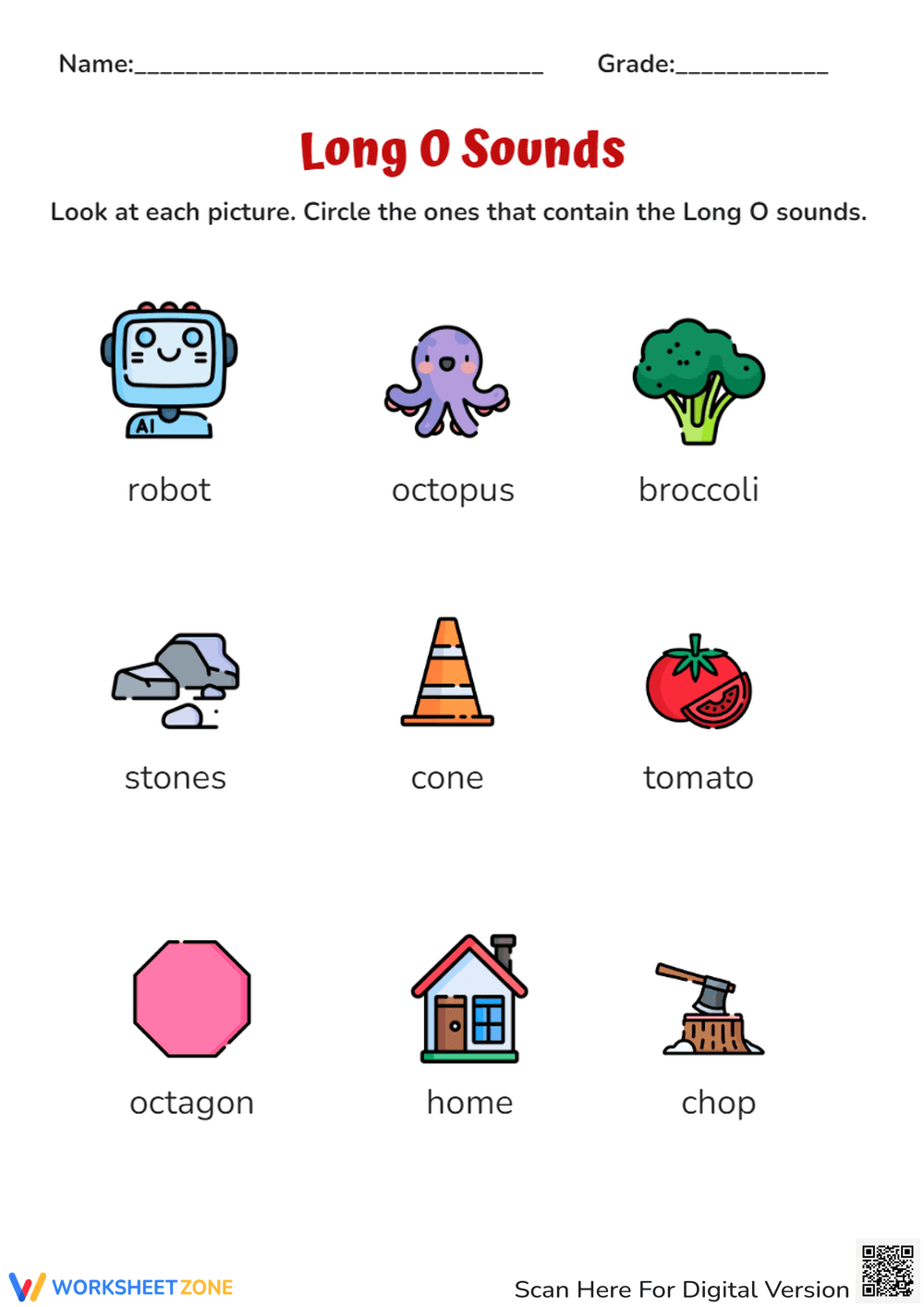

Long O Sound Phonics Printable Worksheet
Paste this activity's link or code into your existing LMS (Google Classroom, Canvas, Teams, Schoology, Moodle, etc.).
Students can open and work on the activity right away, with no student login required.
You'll still be able to track student progress and results from your teacher account.
This foundational phonics worksheet helps early readers master the Long O vowel sound by identifying it within familiar spoken and written words. Students examine a series of illustrated vocabulary words and circle the images containing the target sound, building essential phonemic awareness and decoding skills required for fluent reading.
At a Glance
- Grade: 1 · Subject: ELA
- Standard:
CCSS.ELA-LITERACY.RF.1.2.A— Distinguish long from short vowel sounds- Skill Focus: Long O Vowel Sounds
- Format: 1 page · 9 problems · Answer key included · PDF
- Best For: Independent practice
- Time: 10–15 minutes
This single-page resource features nine distinct picture prompts, each accompanied by its corresponding written word to support dual-coding. Students evaluate words like "robot," "cone," and "home" alongside distractors like "octopus" and "chop." The clean, uncluttered layout minimizes visual distraction, while the included answer key ensures accurate grading and immediate feedback.
Designed for immediate classroom implementation, this zero-prep resource streamlines instructional delivery:
- Print (1 minute): Generate copies of the single-page PDF for the entire class or a small intervention group.
- Distribute (1 minute): Hand out the worksheets alongside crayons or pencils. The intuitive instructions require minimal explanation.
- Review (3 minutes): Use the provided answer key to quickly check student work or facilitate a whole-class review session.
With a total teacher prep time of under two minutes, this activity serves as an ideal emergency sub plan, morning work assignment, or quick transition activity.
This activity is directly aligned to CCSS.ELA-LITERACY.RF.1.2.A, requiring students to distinguish long from short vowel sounds in spoken single-syllable words. By contrasting Long O words with Short O distractors, learners solidify their phonological processing capabilities. Both standard codes can be copied directly into lesson plans, IEP goals, or district curriculum mapping tools.
Deploy this worksheet during independent literacy centers after direct instruction on the Long O sound and silent E conventions. Alternatively, use it as a targeted formative assessment tool at the end of a phonics unit. While students work, teachers can observe whether learners are successfully sounding out the words or relying solely on visual cues. Expected completion time ranges from 10 to 15 minutes, making it highly adaptable for various instructional blocks.
This resource is primarily designed for first-grade students developing foundational phonics skills, though it serves as excellent remediation for second and third graders requiring additional vowel sound practice. English Language Learners (ELLs) benefit significantly from the clear picture-to-word associations. Pair this worksheet with a Long O anchor chart or a decodable reading passage to reinforce the target phoneme in multiple contexts.
Mastering vowel sounds is a critical milestone in early literacy development. According to a RAND AIRS 2024 report on foundational reading skills, explicit phonics instruction combined with targeted practice significantly improves decoding accuracy and reading fluency in primary grades. This resource supports that evidence-based approach by focusing on CCSS.ELA-LITERACY.RF.1.2.A, helping students distinguish long from short vowel sounds through visual and auditory discrimination. By requiring learners to actively evaluate and select words containing the Long O phoneme, the activity reinforces neural pathways associated with phonological awareness. Consistent practice with specific vowel patterns reduces cognitive load during independent reading, allowing students to transition from decoding to comprehension more efficiently. This targeted exercise provides the structured repetition necessary for long-term retention and reading success.


