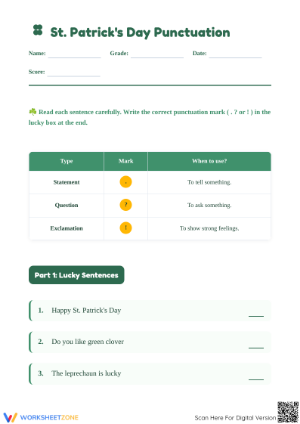
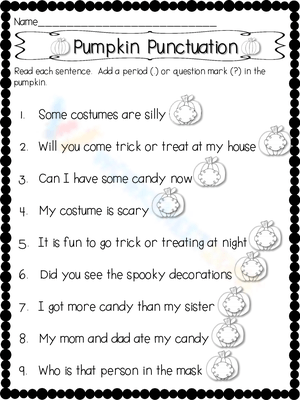
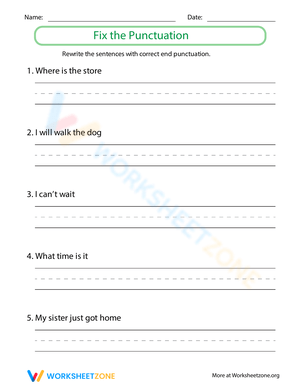
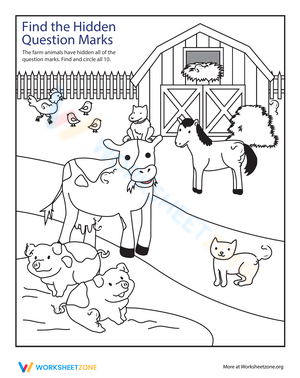
These 1st grade ending punctuation pdf worksheets give first graders targeted practice with periods, question marks, and exclamation points — the three marks that signal where a sentence ends and how it should sound. The set moves students from recognizing end marks in existing text to placing them independently in their own writing, using formats that differ from worksheet to worksheet to sustain attention across repeated practice.
Skills Covered Across the Set
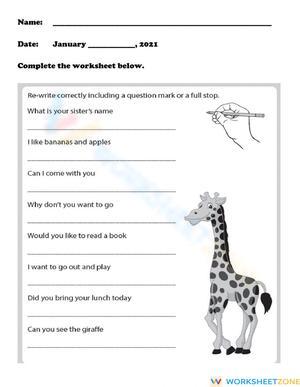
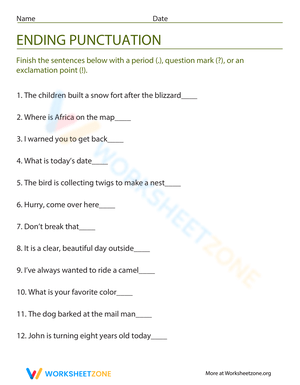
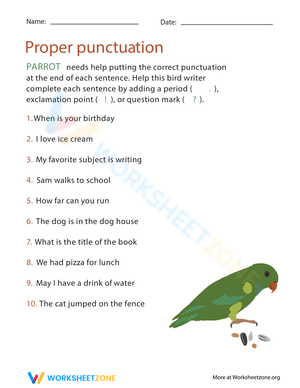
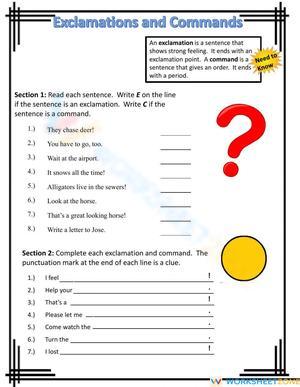
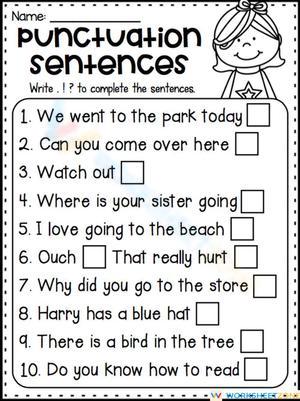
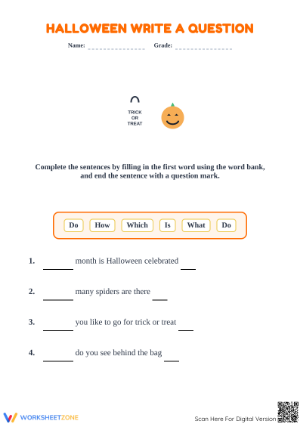
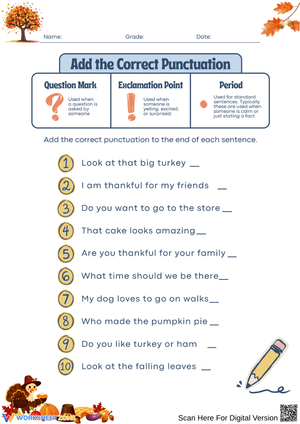
Each worksheet targets a distinct type of interaction with end punctuation rather than repeating the same task in different clothing. Sorting activities have students categorize sentence strips by end mark — statements in one column, questions in another, exclamations in a third — which forces a meaning-level read before any mark is chosen. Mark-completion exercises present finished sentences with a blank at the end; students write the period, question mark, or exclamation point that fits. Picture-prompt worksheets ask students to generate three original sentences about a single image: one statement, one question, one exclamation. That structure moves the task from identification to application, making students choose the mark from the inside out rather than identify what someone else already placed. Partner read-aloud worksheets pair students to verify their choices using voice — pitch rising at a question mark, dropping and stopping at a period — which connects the visual symbol to something students already understand about spoken language.
Punctuation Errors First Graders Make Reliably
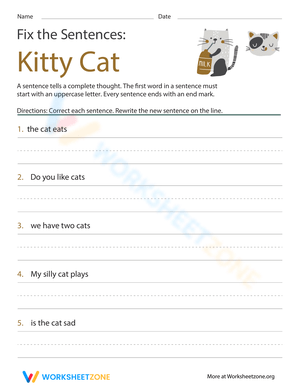
The most common error is not choosing the wrong mark — it is forgetting to add one at all. First graders are managing decoding, letter formation, spelling, and meaning simultaneously. By the time a sentence reaches its final word, end punctuation is the first thing dropped by an overloaded working memory. This is why 1st grade ending punctuation pdf worksheets that isolate the punctuation task — presenting a finished sentence with a blank at the end — are more effective at this stage than asking students to proofread their own freewriting. The skill needs practice as a standalone decision before it can operate reliably under the full demands of original composition.
The exclamation point creates a separate problem: once students discover it, they use it on everything. "We had lunch!" "My shoe is red!" A concrete classroom fix is to have students read their over-exclaimed draft aloud at full theatrical volume, treating every mark as an emergency announcement. Most students recognize within a few sentences that the effect collapses. Worksheets that include intentionally over-exclaimed paragraphs for editing practice give students a chance to work through that judgment on someone else's text before applying it to their own.
Distinguishing a statement from a question is harder when the sentence does not open with a standard question word. "It is raining today." and "It is raining today?" look nearly identical until students ask themselves whether the sentence gives information or requests a confirmation. Sorting activities that pair these near-identical sentence types build stronger analytical habits than worksheets that rely entirely on who/what/where/when openers.
Building These Worksheets Into Your Weekly Lesson Plans
Mark-completion exercises work cleanly as five-minute warm-ups before a writing lesson — short enough to finish before morning meeting transitions end, focused enough to prime students' attention on mechanics before they open their writing notebooks. Sorting activities suit literacy centers better, where the cut-and-paste format needs table space and the peer conversation that happens naturally at a table improves decision-making. Save picture-prompt worksheets for after whole-group modeling: show students how you write a statement, a question, and an exclamation about the same image, then release them to do the same on their own prompt. The mark-completion format also works as a Friday formative check — a fast scan of thirty papers at pickup time shows immediately which students are still confusing question marks with exclamation points. Rotating through 1st grade ending punctuation pdf worksheets in different formats across the week, rather than assigning them all at once, spreads practice without turning mechanics into a daily drill block.
One classroom tool worth adopting: designate a red crayon for punctuation editing only. Calling the activity "Punctuation Detective" and giving students a special tool shifts the task from tedious correction to purposeful investigation. Students who have a specific implement for a specific job attend to it more consistently than students doing a general "check your work" pass at the end of writing time.
Standard Alignment
These worksheets address CCSS.ELA-LITERACY.L.1.2.B, which requires first graders to use end punctuation for sentences. In the classroom instructional sequence, this standard typically enters after students have established sentence boundaries — knowing where a sentence starts and stops — and before they begin revising their own writing for correctness. Most Grade 1 teachers address L.1.2.B concurrently with opinion and narrative writing units, because both require students to produce complete sentences independently. The fluency connection matters equally: students who recognize end marks accurately read with appropriate phrasing and intonation, which supports comprehension at the text level rather than just the word level.
Adjusting the Worksheets for a Range of Learners
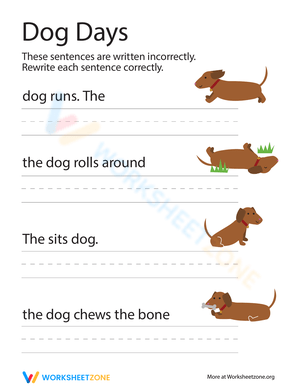
Students who are still building sentence awareness benefit from mark-completion exercises that include a picture alongside each sentence — a visual of a dog running supports decoding of "The dog runs fast." before students choose the end mark. For students who have the three marks under control, picture-prompt worksheets extended with a fourth sentence — "Write a sentence using any mark and explain why you chose it" — push the skill toward metacognitive application. Students working above grade level can take partner read-aloud worksheets and rewrite each sentence as a different type: turn every statement into a question, every question into an exclamation, then read the revised versions aloud to check whether they still make sense.
For students who consistently forget end marks in freewriting even after accurate worksheet performance, the gap is usually a transfer issue, not a conceptual one. Using 1st grade ending punctuation pdf worksheets as a brief daily warm-up, rather than an occasional standalone assignment, builds the habit of checking the end of every sentence as a routine step — which is precisely when the skill starts appearing reliably in student writing.
Frequently Asked Questions
How do I explain the difference between a statement and an exclamation to a six-year-old?
Tell students a statement is a calm, flat fact — "The cat is on the mat" — while an exclamation is what comes out when something surprises, scares, or thrills you. Have them say the same sentence first in a bored voice, then in a shocked voice. The vocal contrast makes the conceptual difference immediate and memorable without requiring abstract definitions.
My students put exclamation points on everything. How do I address that without shutting down enthusiasm?
Frame it as a power problem, not a rule problem. The exclamation point loses its effect every time it appears — the more it shows up, the weaker it gets. Ask students to find every exclamation point in a passage and pick the one mark that actually deserves to stay. Students respond well to the idea of protecting the strength of their marks rather than following a usage limit imposed from outside.
When should I introduce the exclamation point relative to the period and question mark?
Introduce the period first, on its own, until students use it automatically on telling sentences. Bring in the question mark next, with enough practice time between introductions to stabilize each mark before adding another. Introducing all three simultaneously is workable for strong readers, but for students still building fluency, sequential instruction with practiced intervals between each step produces more consistent results.
How does end punctuation practice connect to reading fluency?
End marks are phrasing instructions embedded in the text. A period signals a full stop and a breath reset. A question mark shifts intonation upward. An exclamation point calls for raised energy. Students who cannot read these signals automatically tend to read in a flat, continuous stream, which makes it harder to retain meaning across a sentence or a paragraph. Accurate recognition during practice transfers directly to reading with proper expression and appropriate pacing.












 Interactive Worksheet Maker
 Quiz Maker
 Word Search Maker
 Crossword Puzzle Maker
 Word Scramble Generator
 Sentence Scramble Generator
 Handwriting Worksheet Generator
 Name Tracing Generator
 Fill In The Blank Generator