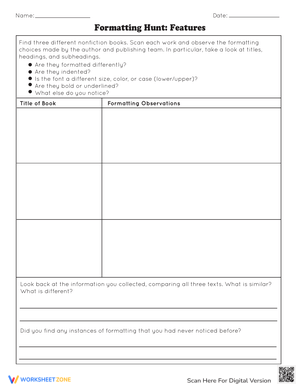
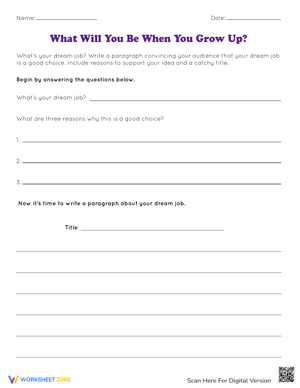
These creating a title worksheets give students structured practice with one of the most overlooked revision decisions in writing — choosing what to actually name the piece. Most students treat the title as a formality, something jotted at the top while the teacher is circling the room. This set asks students to treat title creation as a deliberate craft decision, shaped by purpose, tone, and audience.
What Students Practice Across the Set
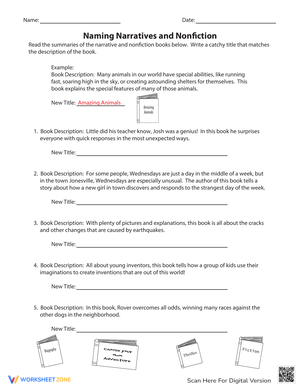
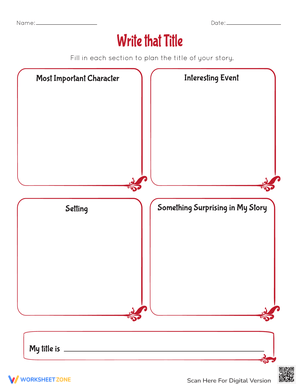
Each worksheet targets a distinct aspect of title craft rather than lumping the skill into a single brainstorm session. One significant focus is narrative title generation — specifically, having students locate the emotional peak of their story and mine language from that scene. A character who discovers a family heirloom during a rainstorm probably shouldn't title the piece "The Lost Watch." Working through a worksheet that asks students to identify the "most charged" moment and pull phrases from it often surfaces something closer to "Echoes in the Rain" — which does more work for a reader than the literal version. Middle school writers in particular tend to default to literal titles because thinking abstractly about theme is still new territory at that stage.
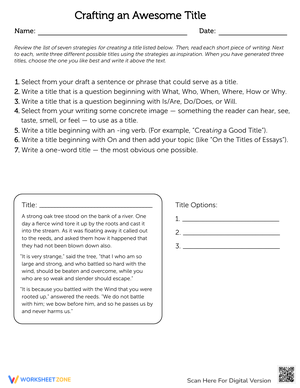
The set also covers academic and nonfiction title structures, particularly the two-part format: a brief hook, a colon, a descriptive subtitle. Students practice the difference between "Aviation" and "Touching the Clouds: The History of Powered Flight from 1903 to 1945." That comparison makes the principle concrete fast. Other worksheets use formula prompts — "The [Noun] of [Noun]," "A [Adjective] [Noun]" — to generate a high volume of candidates quickly. Producing twenty possibilities in ten minutes breaks the perfectionism that freezes many writers at this stage and gives them something real to compare rather than one title to second-guess.
Student Errors Worth Anticipating and Addressing
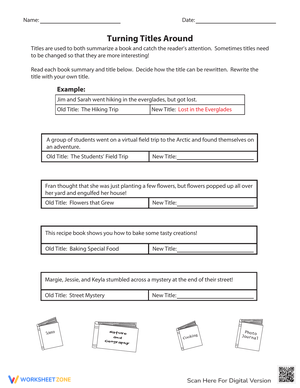
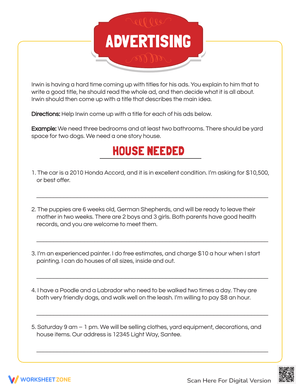
Three patterns show up reliably across grades. The first is the spoiler title: a student who has written a genuine twist ending names the piece after the twist, collapsing suspense before paragraph one. In actual student work, this looks like "The Boy Who Was Really a Ghost" sitting above eight careful paragraphs of mounting dread. The second is the vague genre placeholder — "My Story," "The Adventure," "About My Trip" — which tells a reader almost nothing specific about the work. The third is the sentence title, where uncertainty causes students to describe the entire plot in the title space: "The Story of a Girl Who Finds an Old Photo and Discovers Her Grandmother's Secret Life." That student is trying to be accurate. But the title has done the work of the first three pages. Each worksheet in this set addresses one or more of these patterns directly, including a "trim the fat" exercise where students reduce an overlong title to fewer than ten words while keeping what matters most.
Fitting These Worksheets Into Your Planning
These resources belong in the revision phase, not before drafting begins. A title created before the piece is written tends to lock students into an idea before the writing itself has revealed its actual subject. The stronger move is to assign title work immediately after a first draft is complete — either in the same writing workshop block or the following day before peer conferences begin. Creating a title worksheets work especially well as a station activity during workshop rotations: one small group generates candidates while the teacher conferences with another group across the room.
The peer-feedback component has a particular use in the last ten minutes before students share finished work. After small groups compare title options and mark which one makes them most curious to keep reading, that audience response carries weight a rubric cannot replicate — students hear immediately whether their title created interest or fell flat. The formula-heavy brainstorming worksheets work well as warm-up entries on revision days; they generate momentum fast and give students something concrete to do before they reopen a draft they've been avoiding.
Adapting the Set for Different Writers
Students writing below grade level often freeze when asked to brainstorm without parameters. For those writers, start with the formula worksheets and provide a short word bank — strong nouns and adjectives pulled directly from their draft — before they begin. Working from a constrained list produces usable candidates without adding the extra load of generating both a structure and content at once. Creating a title worksheets that use fill-in formats reduce that cognitive load while still requiring students to make genuine choices about which words belong where.
Students who move through the work quickly can be asked to read their title candidates aloud and listen for rhythm — whether a title sounds as strong as it reads on paper. Alliteration, syllable stress, and tonal catchiness are worth analyzing at this level. A student who has produced both "The Quiet Storm" and "A Whisper Before Thunder" has enough distance to evaluate the two aesthetically rather than just logically, and that's a meaningful extension for a writer who's ready for it.
Frequently Asked Questions
Are these worksheets for creative writing only, or do they address nonfiction and essays as well?
The set covers both. Several worksheets focus specifically on the two-part academic title structure, which students encounter most often in research writing and literary analysis. Others address narrative and creative titles exclusively. Creating a title worksheets that work across multiple genres help students see that the rules differ — creative titles can be abstract or allusive, while academic titles prioritize clarity and precise description — rather than applying one approach everywhere and wondering why it doesn't always fit.
At what point in the writing process should these be assigned?
After the first draft is finished. Some students find a working title helpful while drafting, and that's fine — but the revision-phase worksheets ask students to return to their draft, locate key moments or themes, and extract title language from what they've already written. That recursive move, letting the end of the piece inform the beginning, produces more coherent titles than anything generated before the draft exists.
How long does a typical title-creation activity take in class?
Most individual worksheets fit into fifteen to twenty-five minutes, depending on grade level and whether students work independently or in pairs. The formula-based brainstorming worksheets move faster. Peer-feedback activities take closer to twenty-five minutes when discussion is included. These ranges make title work a realistic fit for workshop rotations, end-of-class revision blocks, or Monday warm-ups before students reopen drafts from the previous week.












 Interactive Worksheet Maker
 Quiz Maker
 Word Search Maker
 Crossword Puzzle Maker
 Word Scramble Generator
 Sentence Scramble Generator
 Handwriting Worksheet Generator
 Name Tracing Generator
 Fill In The Blank Generator