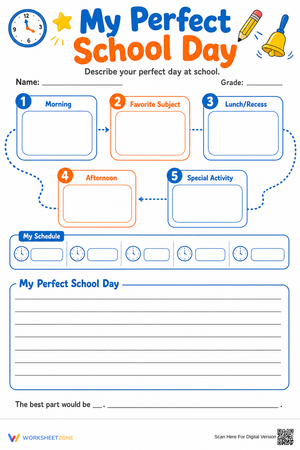
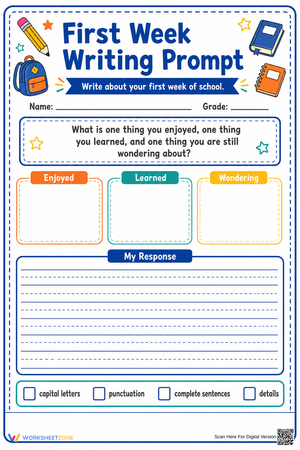
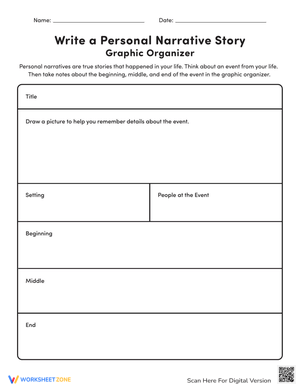
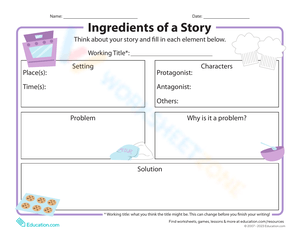
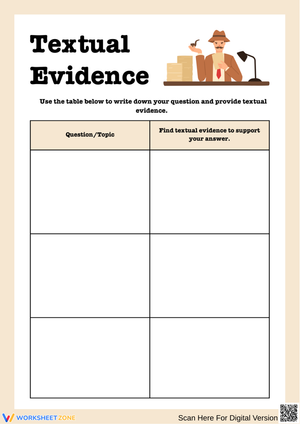
These prewriting worksheets give K-8 teachers a printable collection of genre-sorted organizers covering every major writing type students encounter from kindergarten through eighth grade. Each worksheet targets the planning phase alone — generating ideas, sorting them visually, and mapping a structure before any drafting begins.
What's Inside the Set
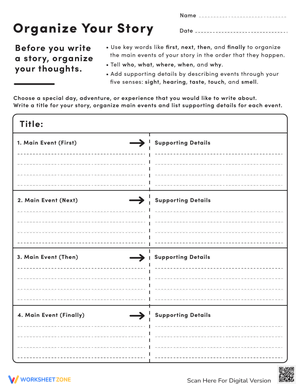
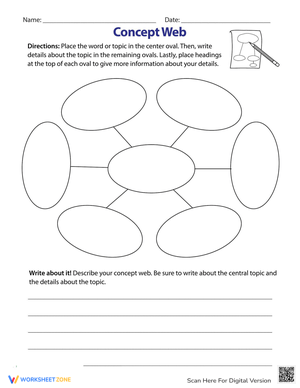
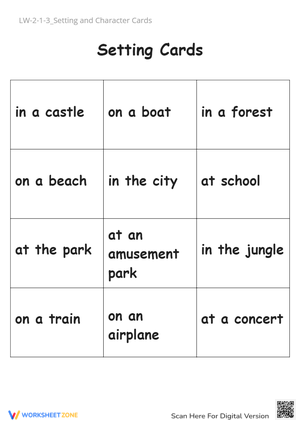
The organizers in these prewriting worksheets cover four writing genres across three grade bands. K-2 worksheets use simplified story maps: students label a character, a place, and a problem, then mark an arrow pointing toward a solution — keeping the format accessible without turning planning into another writing task. Grades 3-5 work with sequenced timeline planners, T-charts for persuasive work, and concept maps for expository topics where students group related facts under labeled subtopics before drafting. The 6-8 organizers include multi-column opinion-reason-evidence charts that require students to name a counterclaim and sketch a rebuttal before writing the essay itself.
Mind maps appear across several grade levels because they support both loose brainstorming and more structured planning without asking students to commit to a sequence too early. The Venn diagram worksheets include a "so what" box at the bottom — added for grades 4 and up — to push students past listing similarities and differences toward articulating the actual point of the comparison.
Error Patterns Worth Addressing Before Students Draft
The most reliable pattern in student prewriting is the abandoned organizer. A student fills it out carefully, then drafts as if it never existed. Their essay has no visible connection to what they planned. A two-minute fix before drafting starts: ask students to circle the three ideas on their organizer they'll actually use. That small step turns the worksheet from a completed task into a live reference they consult while writing.
Persuasive prewriting reveals a subtler problem. Students consistently list "reasons" that are restatements of their opinion. A student arguing that school should start later writes: "Reason 1: starting late is good. Reason 2: early mornings are hard. Reason 3: students need sleep." None of those is evidence. The opinion-reason-evidence charts in this set address this by providing a separate column labeled "your source or example," which forces movement past circular logic before the draft begins.
Expository concept maps expose a third pattern: students pile every fact they know into the center bubble instead of sorting facts into named categories. A student writing about the water cycle might list "evaporation, clouds, rain, oceans, sun, humidity" as seven separate spokes rather than grouping them under two or three labeled subtopics. That kind of plan produces a draft that reads as a list pretending to be paragraphs — catching it during planning is far easier than revising it out later.
Fitting These Worksheets Into the Writing Block
The strongest placement is the first ten minutes of a writing unit, before students have opened their notebooks to draft. Project the relevant organizer on the board and complete the first two boxes together as a class. That removes the "I don't know what to put here" freeze that stops reluctant writers before they've started. Most classes need only one modeled example before they work independently without interrupting you to ask what goes in each box.
Prewriting worksheets also serve as a fast formative checkpoint before the transition to drafting. Collect the organizers and scan them quickly — five minutes is typically enough to flag three recurring problems: off-topic ideas, missing evidence columns in persuasive plans, and narrative timelines with no discernible conflict. Catching those gaps before drafting prevents the structural rewrites that eat up revision days.
Some teachers run the story map worksheet as an exit ticket on day one of a narrative unit. Students sketch their story arc before leaving, hand it in, and receive one written note back. The next session opens with direction rather than a blank page.
Standard Alignment
These worksheets connect to CCSS Writing Standard W.CCR.5, which requires students to develop writing through a process that includes planning, drafting, revising, and editing. In classroom terms, that standard is most visible at the moment between receiving a prompt and writing the first sentence — exactly where these organizers intervene. W.CCR.5 spans K through 12, but the K-8 window is where students first learn which planning strategy fits which genre, and that targeted practice is what this set addresses. The persuasive and expository organizers also connect to W.3-5.1 (opinion/argument) and W.3-5.2 (informative/explanatory) for the grades 3-5 band.
Tailoring These Worksheets for Different Writers in the Room
For students who struggle to begin, pre-fill one or two boxes before distributing the worksheet — write the topic or central claim in the center bubble, or add a sample reason in the first row of the evidence chart. That provides a starting point without removing the thinking. Students who need less direction work from the same organizer with those boxes left blank.
Advanced writers in grades 5 through 8 often outgrow a single-organizer plan on longer assignments. Pairing the opinion-reason-evidence chart with a blank multi-paragraph outline works well: students use the chart to generate content and the outline to sequence it. That two-step process mirrors how experienced writers actually plan, and it gives students who would otherwise race through one worksheet a more demanding task that makes the planning phase feel worth their time.
For students developing English proficiency, the T-chart and Venn diagram options within these prewriting worksheets work especially well because the visual format reduces the language demand at the planning stage. A student can fill cells with single words or brief phrases and still produce a usable plan for drafting.
Frequently Asked Questions
Do these organizers work for timed, on-demand writing tasks, or mainly for multi-day projects?
Both. For a timed task where students draft within a single class period, most organizers in this set take fewer than five minutes to complete and still give students a clear plan to follow. The story map and timeline worksheets are especially useful in timed narrative situations because students can sketch an arc quickly and then write with a defined structure already in mind.
What grade levels does this set cover?
The set spans K through 8, sorted into three grade bands: K-2, 3-5, and 6-8. K-2 worksheets use larger boxes and simpler language. The 6-8 versions include the counterclaim column and multi-level outline formats that upper-grade argument writing requires.
Can these organizers be used in science or social studies, or only in ELA?
Content-area writing is actually one of the stronger use cases here. The concept map and categorization chart worksheets transfer directly into science and social studies tasks — a student planning an expository paragraph about the rock cycle or a persuasive argument about a historical policy decision uses the same organizer. Genre determines which worksheet fits, not the subject area.












 Interactive Worksheet Maker
 Quiz Maker
 Word Search Maker
 Crossword Puzzle Maker
 Word Scramble Generator
 Sentence Scramble Generator
 Handwriting Worksheet Generator
 Name Tracing Generator
 Fill In The Blank Generator